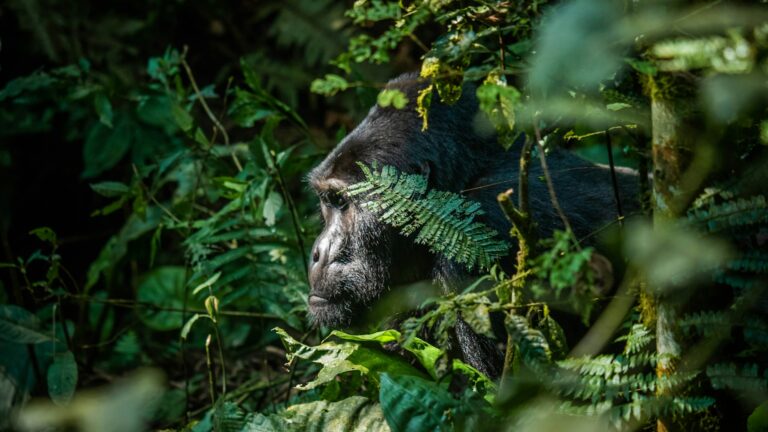








For a mountain gorilla, a human sneeze is no small matter. A virus that might keep one of us in bed for a few days can prove far more dangerous to an animal that shares so much of our DNA.
That is the paradox at the heart of one of the most hopeful conservation stories in Africa: the population is growing, yet those who protect the gorillas say the biggest threat is us.
A Real but Fragile Recovery
In the late 1990s, between 650 and 680 mountain gorillas remained in the wild. The last major census, completed in 2018, counted 1,063 across the Virunga volcanoes and Bwindi forest. That is an increase of roughly 60%.
The same year, the IUCN, the global authority that assesses extinction risk, changed the species’ status from “critically endangered” to “endangered.”
The organization credited a coordinated, cross-border effort: anti-poaching patrols, snare removal, veterinary care in the field and closer ties with the communities that share the gorillas’ habitat.
Mountain gorillas live in three countries: Uganda, Rwanda and the Democratic Republic of the Congo.
Nearly half the population, some 459 animals in 2018, makes its home in Bwindi Impenetrable National Park in Uganda. The rest are spread across the Virunga volcanoes. The 2018 count remains the most recent, and conservationists in the region hope the next census will show another rise.
The Invisible Enemy
In 1996, a scabies outbreak struck several gorillas in Bwindi’s Buhoma sector. Its source was later traced to neighboring human communities, where access to basic health care was limited. Another outbreak followed in 2000 and 2001.
The reason is biological. Ugandan veterinarian Gladys Kalema-Zikusoka explains that humans and gorillas share about 98% of their genetic material, so diseases pass easily from one to the other.
Nearly two decades later, when the COVID-19 pandemic hit, the risk of transmission between visitors, villagers and gorillas raised alarm once again.
The Veterinarian Who Started With the Villages
In 1996, Kalema-Zikusoka was serving as chief veterinarian for Uganda’s wildlife authority when the first outbreak occurred.
She came away from that experience with a single conviction: to protect the gorillas, you had to care for human health as well. In 2003, she founded Conservation Through Public Health, or CTPH, an organization built on the approach known as “One Health,” the idea that the health of people, animals and the environment is intertwined.
Its main tool is its Village Health and Conservation Teams program, launched in 2007 in partnership with Uganda’s Ministry of Health. This network of local volunteers visits households, promotes hygiene, teaches hand-washing and helps refer cases of scabies, tuberculosis and other diseases to the nearest health center. The volunteers also bring information on basic health care and family planning to people’s doorsteps.
The organization also supports income-generating projects for local families, including livestock farming, savings cooperatives and a coffee business whose sales help fund conservation.
When COVID-19 struck, that network was already in place. CTPH trained hundreds of volunteers along with local residents known as “gorilla guardians,” who guide the animals back into the park when they wander toward farmland. It distributed cloth masks, soap and posters. Rangers and visitors began wearing masks around the gorillas.
A Series That Tells the Story
This story is featured in “Africa: Earth’s Wild Home,” a seven-part documentary series from National Geographic, presented by Rolex. Kalema-Zikusoka is one of the explorers who appear in the series.
The series was produced by BBC Studios’ natural history unit, narrated by actress Wunmi Mosaku and filmed over nearly four years in about 30 countries.
It is the first installment of a planned franchise that will travel the planet continent by continent. Among its scenes are rarely captured moments: chimpanzees improvising tools to fish for algae, hyenas hunting elephants at night and an elusive African black leopard. The final episode focuses on the people working to protect wildlife.
The series premiered on the National Geographic channel on Oct. 2, 2026, and has been streaming on Disney+ and Hulu since Oct. 3. Availability varies by country, so check your local listings.
If You Want to See Them in Person
There is another way to encounter mountain gorillas in the wild: a permitted, guided visit in Bwindi or one of the region’s other protected areas.
These visits are regulated, with rules designed to reduce the risk of disease, including masks, hand hygiene and a minimum distance from the animals.
Tourism helps pay for the gorillas’ protection, but it comes at a cost. Kalema-Zikusoka herself has warned that close-up photos, the kind many visitors share on Instagram, lead people to expect contact that puts the animals at risk.
The lesson is simple: the best visitor is the one who watches from a distance and follows the rules.
Mountain gorillas are still endangered. But their recovery reveals something rare in conservation—that protecting a species can begin with improving the lives of the people who live beside it.