
When Professor J.R.R. Tolkien wrote the famous opening line of his first book—”In a hole in the ground there lived a hobbit”—he almost certainly had no idea what he was setting in motion.
The Hobbit began as a simple fantasy tale Tolkien had invented to entertain his children. But he enjoyed the process so much that he kept going, developing the story into a small adventure about a young hobbit who faces dragons and trolls alongside a company of dwarves and a powerful wizard.
Years later, Tolkien realized the world he had built still had more stories to tell. He expanded it into The Lord of the Rings, a trilogy that would redefine epic fantasy for the entire 20th century.
The books were an immediate sensation and were eventually adapted into an animated film. Then, at the turn of the 21st century, director Peter Jackson achieved something most considered impossible: turning that supposedly unadaptable saga into one of the most spectacular film achievements in cinema history. He did it, in no small part, by filming in his own backyard—New Zealand.
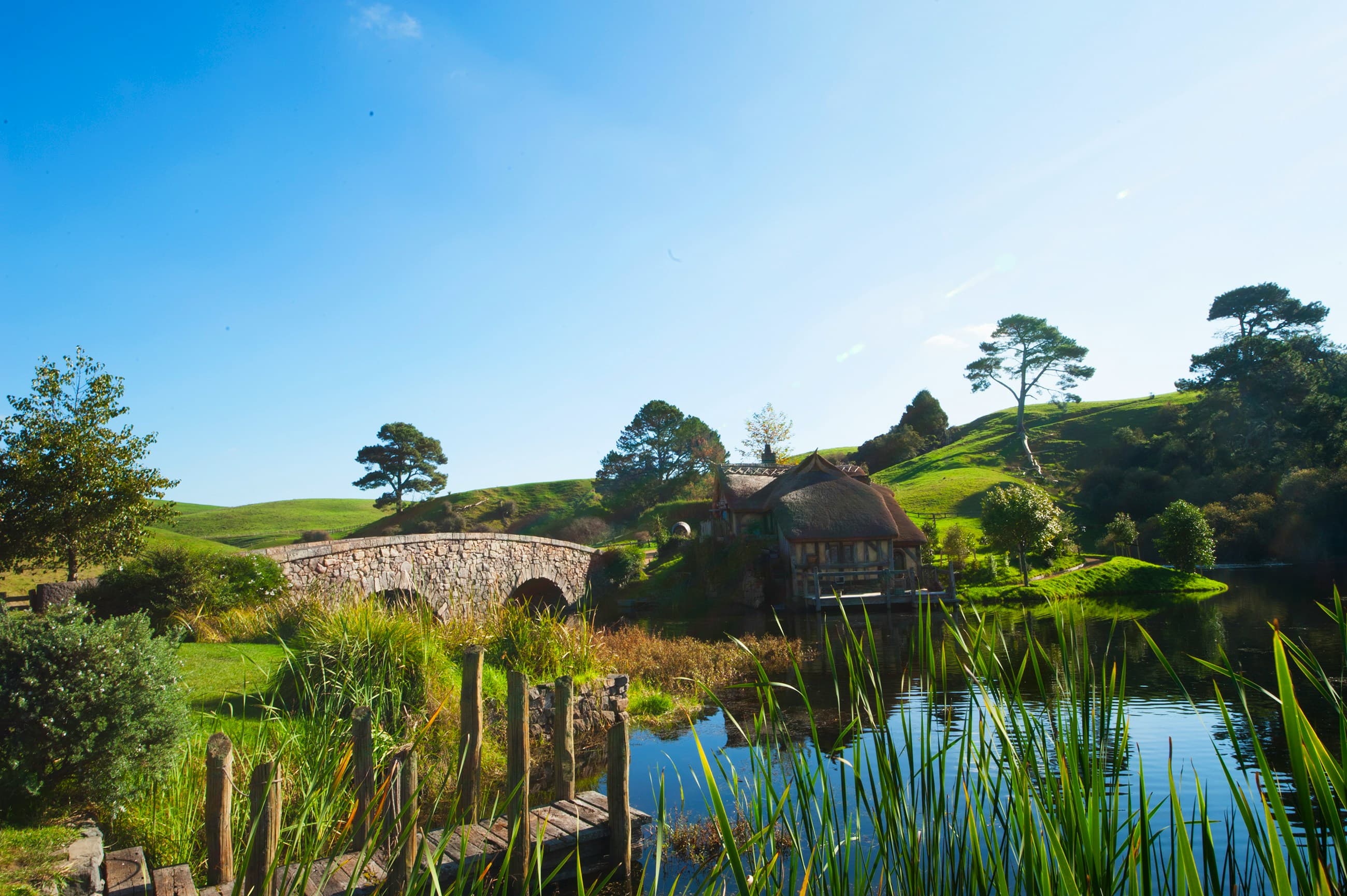
Hobbiton, the idyllic village Tolkien conjured up in his imagination, came to life at the bottom of the world, where those famous holes in the ground still exist today, drawing millions of visitors a year.
Hobbiton: New Zealand Is Middle-earth
New Zealand is a nation set apart from the rest of the world—Australia aside—and it has always stayed close to its roots, blending a British colonial legacy with Māori culture.
It was Peter Jackson who chose to show the world the breathtaking landscapes of his homeland: soaring mountains, deep valleys, and rolling green hills that seemed to belong to another age. In doing so, he transformed New Zealand into Middle-earth.
His commitment ran deep. Jackson secured permission from the New Zealand government to convert a small farm west of Hamilton into the real-life Shire. A film set was built from scratch—trees and flowers planted within months, hillsides hollowed out and shaped into hobbit homes.
Jackson promised that when filming on the original trilogy wrapped, he would leave everything as he found it. And he did. But when production began on the Hobbit trilogy, the set was pressed back into service. The family that owned the land reached an agreement with the studio to keep the structures intact and open the property to fans as a permanent attraction.
In the years since—more than a decade now—Hobbiton has become one of the most visited destinations in the entire country.
Travelers make the journey to this corner of the North Island to walk the same ground where some of the most iconic scenes in The Fellowship of the Ring were filmed. Several hobbit holes have been preserved, and visitors can stop for a drink at the Green Dragon Inn, wander past its ponds, and linger in a landscape that feels genuinely pulled from Tolkien’s imagination.
An Immortal Legacy
New Zealand had already hosted significant productions before Jackson came along—most notably the cult television series Xena: Warrior Princess and Hercules—but it was The Lord of the Rings that put the country’s landscapes on the world’s radar in an entirely new way.
Jackson recognized that New Zealand could provide everything he needed to bring his epic fantasy to life on location. Principal photography alone took more than a year and a half.
The films were an instant phenomenon. They dazzled new generations, earned their place as works of genuine cultural significance, and proved that Jackson had done the impossible—he had faithfully captured the spirit of Tolkien’s work while introducing the world to a country most had never thought to visit.
From that point forward, New Zealand became a pilgrimage destination for fans of the saga. The journey was long and the flights were not cheap, but tourism is estimated to have grown by more than 40% in the years following the release of Jackson’s films. That surge translated into hundreds of millions of dollars in hotel stays, meals, and bookings—a direct contribution to the nation’s GDP. The New Zealand government clearly recognized the opportunity, giving Jackson extensive support throughout production, including military assistance to reach certain remote locations.
Today, the filming locations have become sacred ground for fans around the world. Hobbiton draws the largest crowds, but it is far from alone. The parks and natural landscapes that stood in for Lothlorien, Mordor, and Rohan draw their own devoted visitors, each one making a journey that Tolkien himself never imagined.
New Zealand has become the Middle-earth Tolkien dreamed into existence—even if it sits about as far as you can get, anywhere on the globe, from the English study where the professor first put pen to paper.