

It was 1907 when a Hungarian-born explorer named Aurel Stein stumbled upon what is now considered the greatest collection of Buddhist art in human history.
The treasure was not buried underground. It was held in silence, inside chambers carved into a cliff face at the edge of one of the most unforgiving deserts on earth.
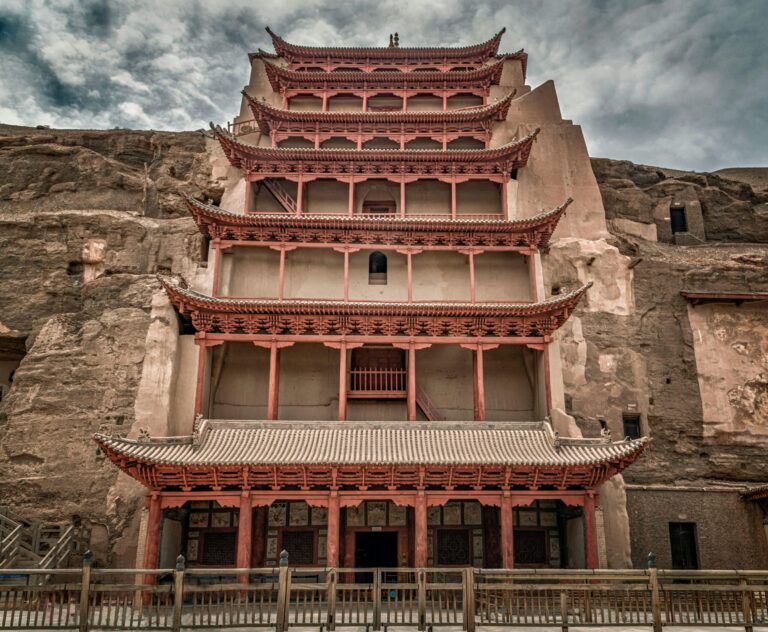
The Mogao Caves, widely known as the Caves of the Thousand Buddhas, occupy a critical point in Asian geography: the oasis of Dunhuang, in China’s Gansu province.
Mogao was the bottleneck of the Silk Road. Here, the route split in two to skirt the Taklamakan Desert — a name that, according to tradition, carries a warning: those who enter rarely return.
Merchants understood that passing through Dunhuang meant entering the most dangerous stretch of the journey. These caves offered the perfect refuge — a place to seek divine protection before stepping into the feared sea of sand.
Over time, what began as a place of prayer became something far larger: a repository of humanity’s collective memory.
Le Zun’s Dream
Legend holds that in A.D. 366, a Buddhist monk named Le Zun had a vision of a thousand Buddhas bathed in golden light radiating from the cliff face. Moved by the apparition, he carved out the first meditation cave on the spot.
From that moment forward, across the next thousand years — from the Wei dynasty through the Yuan — the site never stopped growing. Monks, aristocrats, and, above all, wealthy merchants funded the excavation of more than 700 caves.
These spaces functioned as retreats, but primarily as votive offerings — a kind of spiritual insurance policy before crossing the desert. By commissioning artists to fill an entire cave with murals and sculpture, merchants hoped to secure safe passage for their caravans.
The extreme aridity of the Gobi preserved these works in near-miraculous condition. That preservation is precisely what makes the Mogao Caves the largest art gallery in the world.
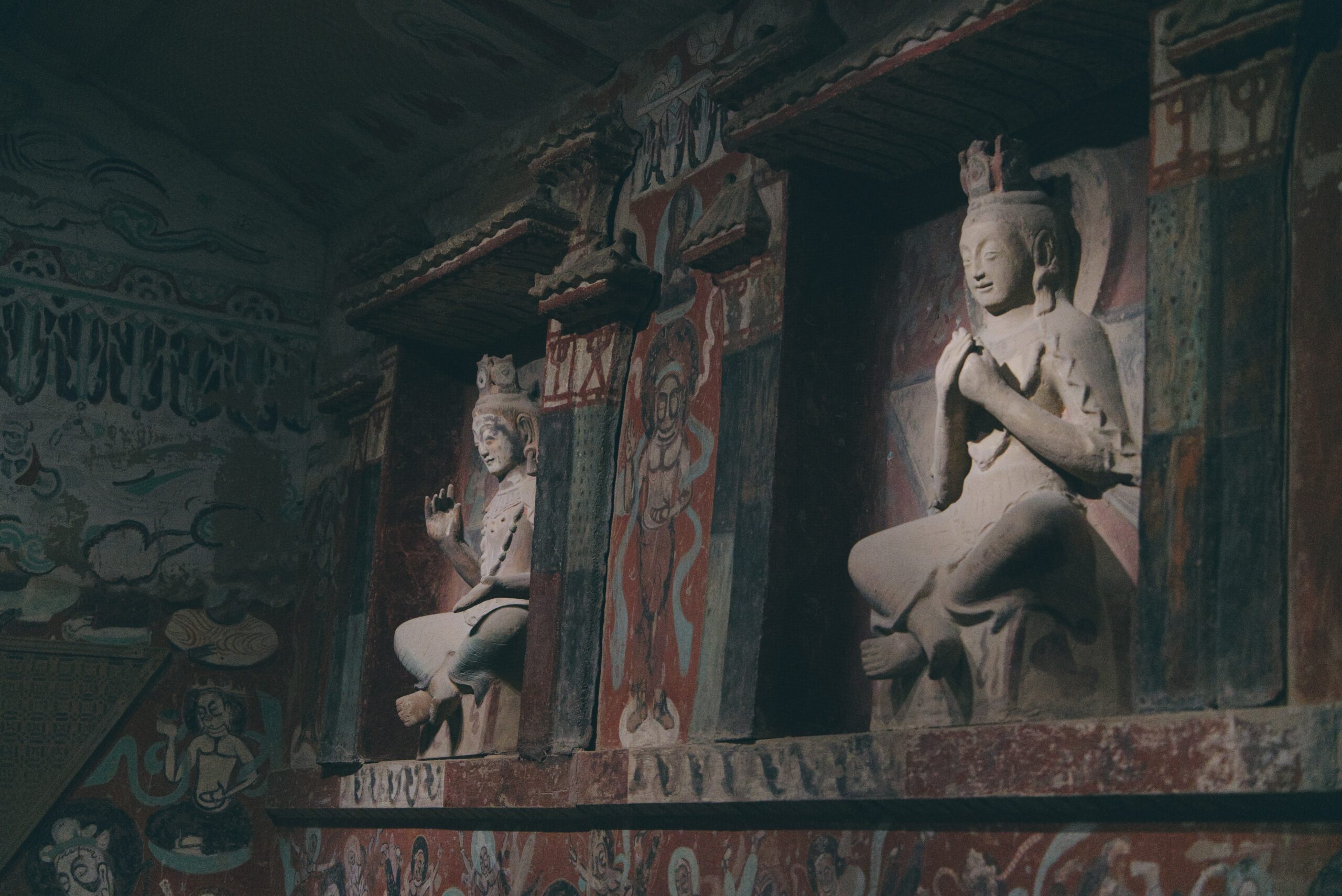
The murals cover more than 484,000 square feet and reveal a profound syncretism — the natural result of the exchange of ideas, faiths, and cultures that flowed along the Silk Road.
Buddhist celestial figures soar across painted rock alongside Hindu deities, all watched over by figures draped in robes of distinctly Persian cut.
The Treasures of the Mogao Caves at Dunhuang
When Stein, a scholar of Sanskrit literature, arrived with his caravan at Cave 17, he encountered a treasure he could never have imagined finding in his lifetime.
Rumors had been circulating of grottos filled with ancient manuscripts and Buddhist art. Determined to see them for himself, Stein prepared for a journey that was anything but easy — his caravan required camels loaded with blocks of ice just to survive the desert’s suffocating heat.
When he arrived, he was met by Wang Yuanlu, a Taoist priest who had appointed himself guardian of the caves.
A combination of diplomacy and shrewdness allowed Stein to persuade Wang to grant him access. He first invoked the legendary monk Xuanzang — the great translator of Buddhist sutras into Chinese — to earn the guardian’s trust. But it was a silver donation that ultimately unlocked the door.
When Wang finally agreed to show Stein one of the manuscripts, it turned out — by fate or coincidence — to be one of Xuanzang’s own translations. Reading this as a divine sign, the guardian relented.
The so-called “Library Cave” is estimated to have held around 50,000 manuscripts, of which 7,000 documents and thousands of fragments ultimately passed into Stein’s possession. The collection’s value was incalculable: texts in Tibetan and Sanskrit, Xuanzang’s translations, and the oldest printed book in the world — the Diamond Sutra.
Stein secured this text, printed some 600 years before the famous Gutenberg Bible. It is not a book in the conventional sense but a scroll of roughly 6,000 words — a text that condemns the illusion of the material world.
Beyond spiritual texts, the Mogao Caves held contracts, medical and astronomical treatises, calendars, and literary works. Put simply, the caves housed one of the most extraordinary historical archives ever assembled.
With manuscripts and paintings packed into his cases, Stein set out for Lahore (in present-day Pakistan). Word of the hidden treasure spread quickly, and in the years that followed, other European scholars made their way to the site.
In 1924, American historian Langdon Warner visited the caves. Using crude methods, he pried fragments of murals from the walls and removed sculptures that today sit in Western museums.
By some estimates, roughly 80% of the original contents were removed over the course of these expeditions — what China now firmly denounces as systematic plunder. The Chinese government moved to protect the site in the 1930s, but the damage had already been done.
What remains at Mogao, however, is still astonishing.
How to Visit the Mogao Caves
Because the pigments are extraordinarily fragile — sensitive to fluctuations in humidity and the carbon dioxide exhaled by visitors — the Mogao Caves are among the most protected sites in the world. Visiting them is, above all, an act of awareness and respect.
The experience does not begin at the cliff. It begins at the Digital Exhibition Center.
Before approaching the grottos, visitors attend two cinematic presentations, including one projected inside a 360-degree dome that offers full visual immersion in caves closed to the public for conservation reasons.
At the archaeological site itself, visits are by guided tour only, in small groups. Of the 492 caves that still contain murals, only a rotating selection opens to visitors each day, minimizing human impact on the most sensitive spaces.
Along the route, visitors encounter two colossal Buddha figures. The larger of the two stands 115 feet tall — a scale that defies conventional logic. Unlike the rock-cut sculptures found elsewhere across Asia, these figures were shaped from clay over intricate armatures of wood and straw.
Beyond that, the itinerary unfolds at the guide’s direction. Certain stops, however, define the arc of artistic evolution along the Silk Road.
One is Cave 302, from the Sui dynasty. Its walls carry scenes of daily life and commerce, reflecting the first great cultural exchange that the world’s most famous trade route made possible.
Caves 23 and 156, from the Tang dynasty, are equally remarkable. Their murals depict peasants working the fields and a procession of warriors in finely detailed armor — all rendered in a palette of vivid color that has survived intact for more than a millennium.
In Cave 61, from the Song dynasty, a masterwork of early cartography appears on the wall: a detailed rendering of Mount Wutai, complete with temples, roads, and inns — a visual guide for pilgrims navigating the landscape a thousand years ago.
A Few Final Notes for the Mindful Visitor
Photography inside the Mogao Caves is strictly prohibited. Flash, even from a smartphone, poses a direct threat to the pigments.
Leave your phone in your pocket. Let your eyes do the work, and trust your memory to hold what no image could adequately capture.
And if you want to carry one image home with you, climb the Mingsha Shan dunes — the Singing Sands — at sunset.
Watching the sun drop behind the mountains of sand as the Mogao cliff turns the color of ochre is to complete a circle that began with the monk Le Zun’s vision more than 16 centuries ago.