

If the world has ever felt too small, it may be because you haven’t yet set foot in Chongqing.
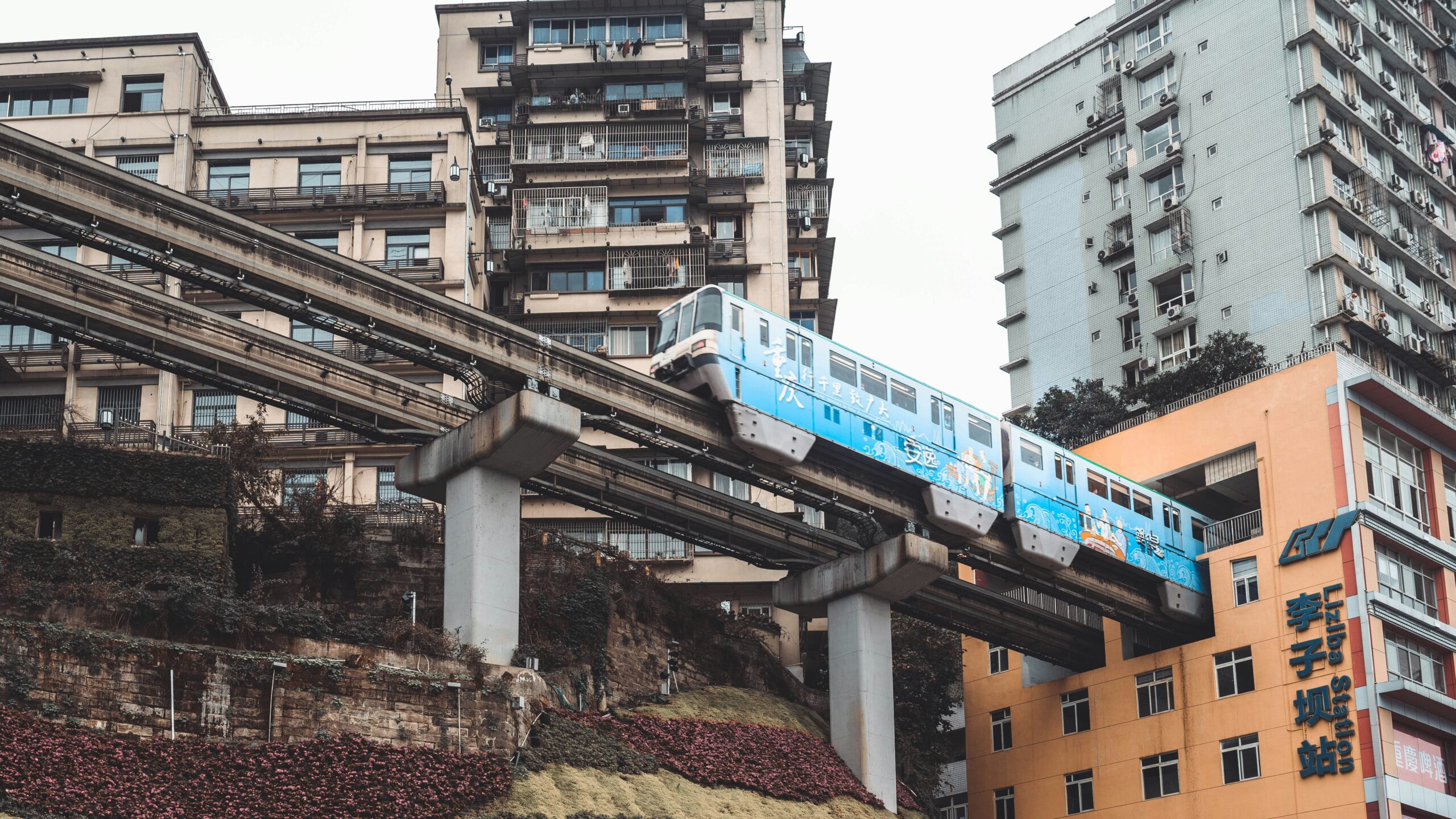
Chances are you’ve seen it on social media recently: a monorail train nonchalantly gliding through the side of a 20-story apartment building. Or a public plaza that turns out to be the rooftop of a skyscraper. That is Chongqing.
Welcome to the “8D” city—the place where Google Maps surrenders and your sense of direction becomes little more than a polite suggestion.
Located in southwestern China at the confluence of the Yangtze and Jialing rivers, Chongqing is a metropolis of more than 30 million people whose urban design breaks every known rule.
Chongqing: The Anatomy of a Futuristic City
It is hard to believe that a city blazing with giant LED screens has more than 3,000 years of history behind it. And yet Chongqing is one of the oldest cities in the country.
Chongqing served as the capital of the ancient Ba Kingdom and as China’s wartime provisional capital during World War II. The deep mountains and valleys surrounding it, combined with its near-permanent fog, made it a natural fortress that held back the Japanese advance.
That same geography that once served as a shield is now the reason for its surreal character.
With no flat land to build on, Chongqing grew into a vertical labyrinth of skyscrapers, bridges, and highways. Here, the concept of “ground floor” is entirely relative. You can enter a building from the street on the tenth floor and exit onto a different street on the first. The city doesn’t so much rise above its terrain as grow out of it.
But Chongqing’s appeal isn’t only about buildings that appear to sprout from cliffsides or escalators that climb entire mountainsides. Its transit system is an engineering achievement that deserves its own chapter.
The famous Liziba Station—the one that looks, in every viral video, like a monorail punching straight through a residential block—seems like an AI-generated hoax. It isn’t. It was simply how engineers solved the problem of moving people through a densely packed urban corridor. The visual spectacle is striking, but what surprises visitors most is the silence. Thanks to rubber-tire technology, residents of the building feel little more than the faint vibration of a dishwasher.
And the strangeness doesn’t stop there. The Huangjuewan Interchange is a nightmare for any driver who hasn’t memorized it. Five levels of roadway, 20 ramps, and eight directions tangled together like a bowl of noodles. Take the wrong exit and you’re looking at a half-hour detour through the outskirts before you can turn around.
For the best views, the Yangtze River Cable Car is a must. What was once a daily commute for factory workers is now a glass capsule that drifts above the river, offering an unobstructed panorama of one of the world’s most improbable skylines.
Chongqing: Curiosities of a City That Never Sleeps
To live in Chongqing is to embrace a constant contradiction—which is, in fairness, true of most great cities.
Stand at the Liberation Monument, ringed by luxury boutiques and 3D digital billboards, and you are in the gleaming present. Walk a few steps down a steep stone staircase and you are in the old city, in narrow lanes that still hold the spirit of old China.
Chongqing is the world capital of hot pot. Leaving without trying its spicy broth would be a minor act of cultural negligence—though be warned: the Sichuan peppercorn will leave your tongue pleasantly numb. One restaurant, Pipa Yuan, occupies an entire hill and seats nearly 6,000 diners at once. The scale is almost impossible to picture.
Then there are the city’s repurposed wartime bunkers. Thousands of air-raid shelters were carved into the rock during the war to protect the civilian population. Today, those damp tunnels house metro stations, vegetable markets, wine museums, and noodle shops.
If you’ve seen Spirited Away, standing before Hongya Cave at night—its golden lantern light glowing—will pull you straight into that film’s world. The 11-story complex, built into a cliff face and modeled on traditional wooden stilted architecture, is one of Chongqing’s most arresting sights. The contrast between its ancient aesthetic and the modern skyline behind it is the kind of image that stays with you. Boats departing from here sail the Jialing River, offering yet another angle on a city that rewards being seen from every direction.
For Chongqing’s most traditional face, head to the Shibati district. Its narrow cobblestone streets still evoke another era. It draws crowds, and it knows it, but the atmosphere is genuine enough—and the backdrops are extraordinary.
Chongqing and Its Bond With the Three Gorges
To speak of Chongqing is to speak of the Yangtze, and to speak of the Yangtze is, inevitably, to speak of the Three Gorges Dam.
Beyond being an architectural landmark, the world’s largest hydroelectric power station was the engine that transformed Chongqing from a regional river port into the global megalopolis it is today.
Situated several hundred miles downstream, the dam raised the river’s water level enough to allow deep-draft vessels to reach the heart of the city. That single change made Chongqing the most important inland port in southwestern China—a direct gateway to the Pacific for the automobile and technology factories spreading across its hills.
As with all monumental projects, the construction of the Three Gorges Dam came at a steep human cost. Entire towns and thousands of acres of fertile land disappeared beneath the reservoir. Enormous numbers of people were displaced, relocated into the very skyscrapers that now define the city’s horizon.
Today, luxury cruise ships depart from the city’s port to sail the gorges of Qutang, Wu, and Xiling. Within hours, travelers leave Chongqing’s technological world behind and enter a landscape of mist and ancient rock that has inspired Chinese classical painting for millennia.
Life at the Edge of the Technological World
For all its science-fiction aesthetics, life in Chongqing retains a human warmth that catches visitors off guard. Unlike the formality of Beijing or the corporate tempo of Shanghai, Chongqing has a reputation for directness and a sharp, irreverent humor.
You’ll often find groups of elderly men playing mahjong at folding tables beneath elevated highways carrying thousands of cars overhead. The “bangbang men”—bamboo-pole porters—still haul goods up and down the city’s endless staircases, as they always have. Meanwhile, autonomous delivery robots roll along the sidewalks of the newest neighborhoods without anyone looking twice.
Technology here is a survival tool. 5G coverage reaches the deepest tunnels, and facial recognition systems are woven into the rhythms of daily life.
None of it, though, has managed to erase the soul of a city that refuses to forget its mountain and river roots.