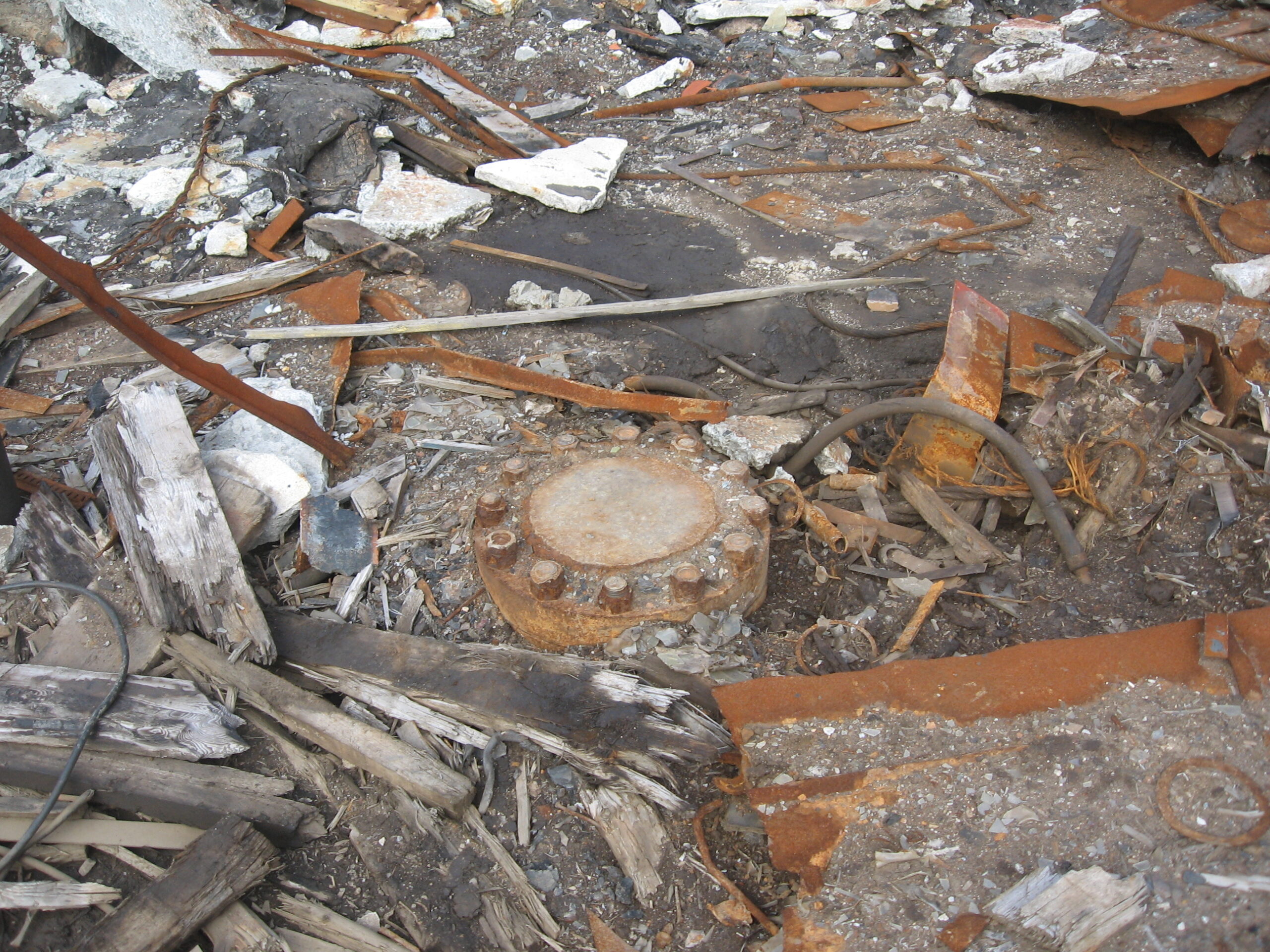
In a desolate corner of the Arctic, amid the ruins of an abandoned industrial structure, lies a steel plate secured by twelve thick bolts. The opening it covers measures just 9 inches in diameter. Yet beneath it, a vertical shaft plunges 40,230 feet into the continental crust.
The Kola Superdeep Borehole was not designed to extract oil or natural gas.
It began in May 1970 as a Soviet project to drill deeper into the Earth’s crust than anyone had before and bring up samples directly from deep within the planet.
Soviet Engineering’s Arctic Ambitions
During the 1960s and 1970s, the geopolitical rivalry between the two Cold War superpowers extended beyond the race to the Moon. Exploring beneath the Earth’s surface opened a second front in the technological competition.
After the United States abandoned Project Mohole — its attempt to drill through the seabed — in 1966, Moscow set up its own rig on the Kola Peninsula in northwestern Russia, near the borders with Norway and Finland.
The Soviets initially aimed to reach about 49,000 feet (15 kilometers) to study the deep structure of the continental crust and the hypothesized boundary between granite and basalt, known as the Conrad discontinuity.
During the first nine years, the massive Uralmash-4E drilling rig penetrated granite layers without major technical setbacks. In June 1979, the Kola Superdeep Borehole broke the world record of 31,440 feet, set by the Bertha Rogers, a gas well in Oklahoma.
This progress allowed researchers to bring up rock samples 2.7 billion years old.
Among the project’s most striking discoveries was free water trapped at depths where scientists thought no fluid could exist, along with drilling mud that came up from the borehole bubbling with hydrogen.
The Thermal Barrier That Stopped the Drill Bits
Progress continued until 1989, when drilling reached its maximum depth: 40,230 feet. The entire shaft was drilled through that narrow opening — barely wider than two hands side by side — which demanded precise control of the rotary system.
For perspective, the borehole is deeper than Mount Everest (29,032 feet) and deeper than the Mariana Trench (36,070 feet).
At those extreme depths, however, physics set a limit that the technology of the day could not overcome.
Theoretical models predicted that at a depth of 7.5 miles, subsurface temperatures would be around 212 °F. Instead, instruments recorded more than 356 °F.
At such temperatures, the granite lost its rigidity and began behaving more like plastic than solid rock.
Each time the crew pulled up the drill bit to replace worn teeth, the hole walls collapsed under the extreme pressure and temperature. Drill pipes bent or snapped inside the shaft, forcing workers to drill sidetracks around the blocked sections.
In 1992, with no technical means of drilling deeper and funding collapsing after the dissolution of the Soviet Union, the project was shut down for good.
The Urban Legend of the Screams from Hell
The secrecy with which Soviet authorities ran the project in its early years made it a breeding ground for urban legends.
By the late 1980s, a story began circulating in tabloids and religious media across North America and Europe.
According to the tale, engineers lowered a heat-resistant microphone down the borehole to record the sounds of tectonic movement.
The story claimed that instead of geological noise, the speakers played a chilling murmur of human voices and high-pitched screams. Rumor had it that the drill had broken through the crust straight into Hell itself.
Journalists later traced the recording circulating online to the soundtrack of the 1972 horror film Baron Blood, slowed down and altered.
The project’s lead scientists repeatedly pointed out that the site never had microphones capable of withstanding 356 °F. Despite these denials, popular lore dubbed the borehole “the Well to Hell.”
Industrial Ruins in the Murmansk Tundra: Visiting the Site
The scientific complex remained partially operational until mid-2008, when the facilities closed permanently and the borehole was sealed with its now-famous metal cap.
Rust and the harsh Arctic climate have since reduced the drilling station to industrial ruins surrounded by the tundra of the Murmansk region.
In recent years, the Kola Peninsula has attracted urban explorers and photographers drawn to Cold War relics.
The borehole can be reached by road from the port city of Murmansk or the town of Zapolyarny, though visitors should take care around the crumbling buildings, with their decaying roofs and frozen, uneven ground.
Before planning a trip, travelers should check their government’s current travel advisories and find out whether a permit is required to enter this border zone.
A visit to this far-northern outpost means standing directly above the deepest point humans have ever drilled into the Earth’s crust.
A simple metal cap is all that marks the gap between the ambitions of modern engineering and the hard limits set by the planet’s interior.