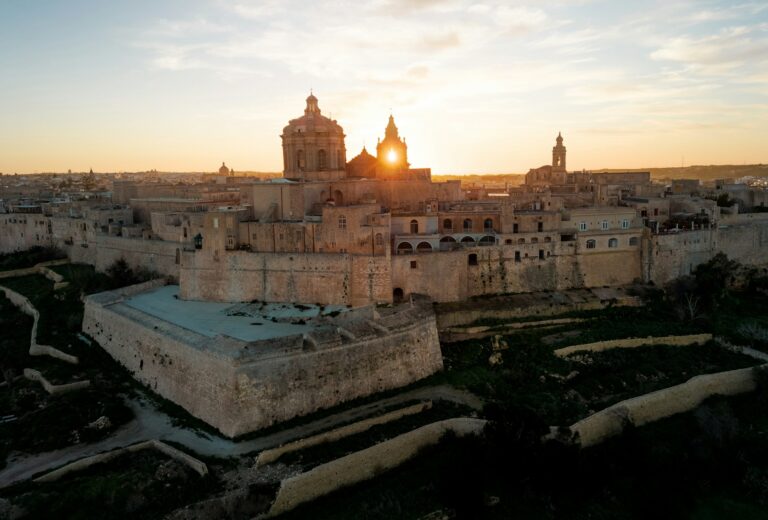

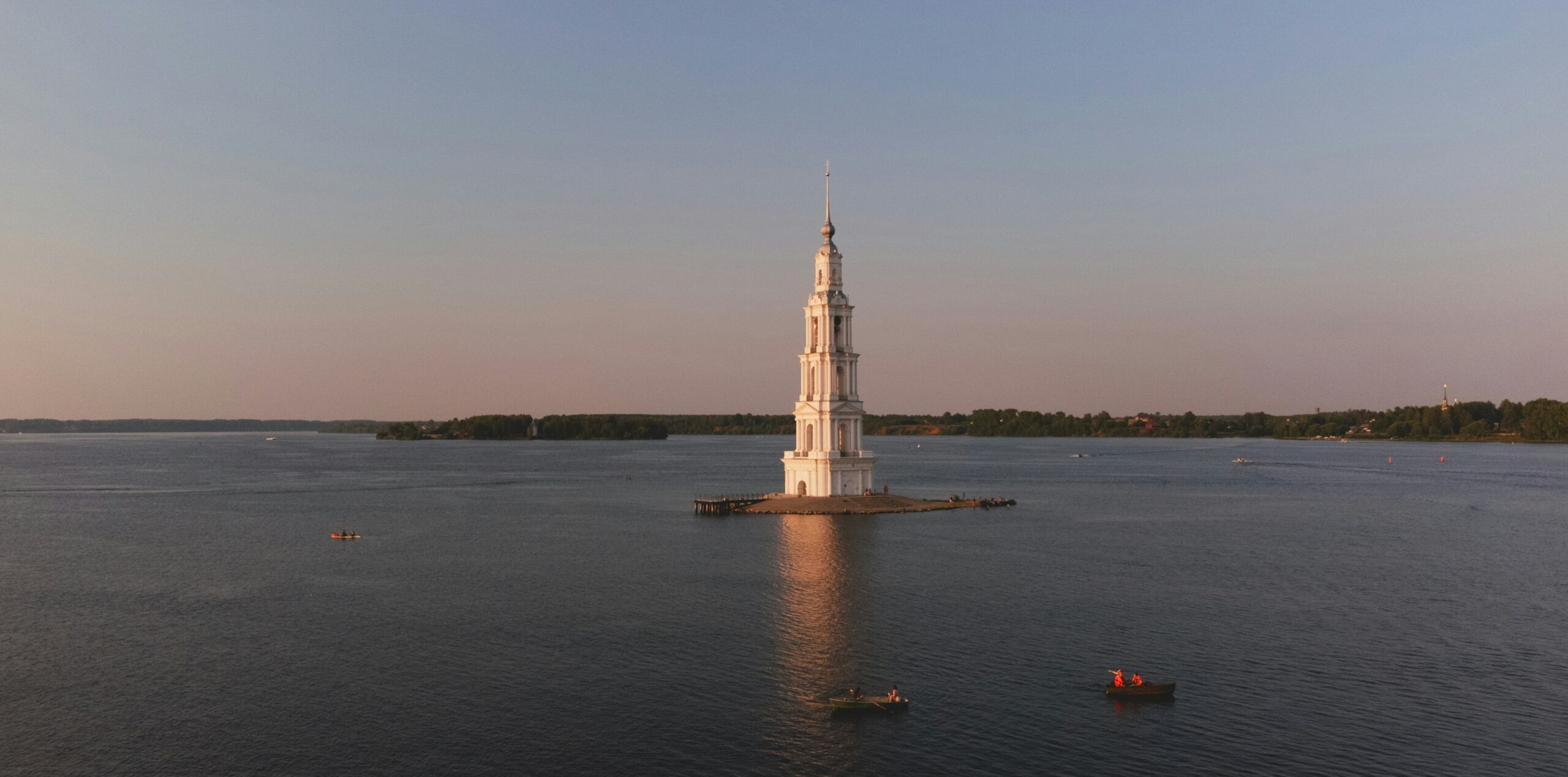
A bell tower rising more than 230 feet stands alone in the middle of the Uglich Reservoir in northwestern Russia.
Kalyazin is not the only submerged town on earth, but what makes it remarkable is the story that lies beneath the water.
Kalyazin, along with some 200 villages in Ukraine and dozens of settlements scattered across the Soviet Union, was buried under water to make way for reservoirs, canals, and dams.
These were Stalin’s “socialist projects,” an agenda meant to build an advanced industrial economy and prove the superiority of the Soviet system over capitalism.
In the process, thousands of families were forced to leave their homes overnight. Streets, houses, government buildings, and churches were lost.
Still, some structures stayed above the surface—or at least part of them did.
The Kalyazin bell tower is the most iconic example of this survival: a tower that stands as a silent witness to one of the darkest chapters in Russian history.
The history behind the flooded bell tower of Kalyazin
The small town of Kalyazin is located in the Tver region, on the right bank of the Volga River, about 200 km from Moscow.
Of its roughly 12,000 inhabitants, very few remember the time when families were forced to abandon their homes without explanation. But Stalin’s order was clear, and there was no choice but to obey.
The Soviet model of that era sought to prove, by any means necessary, the supremacy and grandeur of the regime over its great rival: the capitalist system.
So, beginning in the late 1930s, the Russian government ordered the construction of monumental structures meant to display the might and glory of the USSR. This drive to industrialize not only took an environmental toll but also claimed many lives and reshaped the country’s geography.
More than 5,000 square kilometers of land were flooded by the waters of the Volga. As a result, more than 600 villages and the city of Mologa were wiped off the map, along with vast stretches of farmland and the forests lining the riverbanks.
According to the few surviving witnesses from that decade, Soviet authorities began visiting the towns that would be flooded a year before construction on the reservoir began. The instructions were blunt: families had to leave, because their homes would soon be underwater.
Houses were appraised and then marked with paint across their facades. This mark indicated the date by which the inhabitants had to leave their homes.
While the government provided transport for household belongings, livestock had to be driven on foot for hundreds of kilometers.
Many people refused to leave their homes. As you can imagine, things did not end well for them.
The result was the largest hydroelectric power station on Earth at the time: the Volga GES, which remains the biggest in Europe to this day.
But amid all this engineering and progress, the Kalyazin bell tower remained standing, a reminder of a chapter of history that not everyone wants to discuss.
Kalyazin today: the comeback of the tower that refused to sink
The Kalyazin bell tower dates back more than two centuries—to the year 1800.
Back then, it was the crown jewel of St. Nicholas Cathedral, a church attached to a monastery that for centuries was a pilgrimage site for the tsars, including the dynasty of Nicholas II, the last tsar of Russia. If you’ve seen the movie “Anastasia,” you’ll know exactly what we mean.
When the old town of Kalyazin was flooded between 1939 and 1949 to make way for the Uglich power station, the cathedral was demolished, but the bell tower was left intact.
The reason? Its imposing height of 74 meters made it a perfect landmark—an improvised lighthouse—for ships navigating the new reservoir.
Over time, the Kalyazin bell tower became one of the region’s main tourist symbols.
Everyone wanted to see this tower rising from the water up close, and the town was quick to capitalize on such a surreal image.
Today, several companies offer yacht trips and cruises that circle the tower.
To ensure its preservation, engineering work was done to fill in the area around the base, creating a small artificial island with a dock where visitors can disembark.
In winter, the Uglich Reservoir freezes over completely (this is Russia, after all). This lets tourists and locals reach the base of the bell tower by walking across the ice.
The site has even regained its spiritual aura: occasional Eastern Orthodox ceremonies are held there, bringing liturgical life back to a place that progress once tried to drown.
Meanwhile, the tower still stands, unfazed, the last vestige of a world swept away by the rise of the Soviet Union, reminding us that memory always finds a way to float to the surface.