

While mainstream tourism flocks to Petra, another Nabataean legacy has survived, nearly intact, in the heart of the Saudi desert: Hegra.
Also known as Mada’in Salih, al-Hijr, or Hijra, this archaeological zone is the Nabataeans’ second most important site, outranked only by Jordan’s iconic Petra.
The great necropolis of Hegra holds more than a hundred tombs and roughly two thousand years of history. It was also the first site in Saudi Arabia to be designated a UNESCO World Heritage Site. Today, it is cautiously beginning to open up to the world.
To unlock its secrets, though, visitors must brave the unrelenting sun of the AlUla valley. Despite sharing the same builders, Hegra and Petra are worlds apart.
Yet for all their differences, both sites evoke the glory of an empire that vanished beneath the desert sands — though not without leaving a mark that those same sands preserved.
The Nabataean Necropolis That Defies the Desert
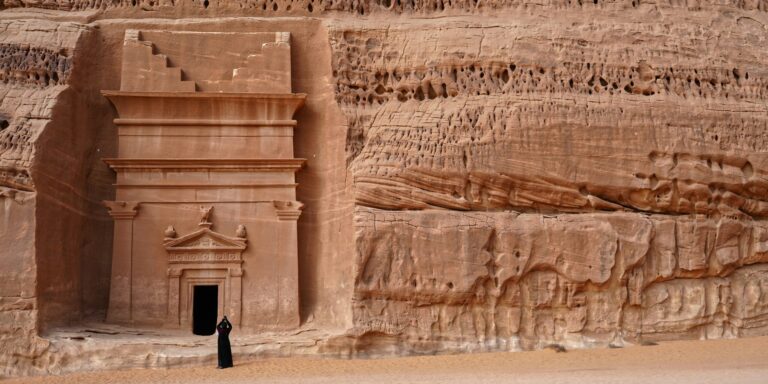
At its height, Hegra was a thriving city. Time erased its dwellings but left its necropolises standing: 111 monumental tombs, now protected within an archaeological park established in 1972.
For much of its modern history, the site was accessible only to Muslim visitors. In 2020, the Saudi government went a step further and began welcoming tourists from around the world — part of Vision 2030, an ambitious plan to diversify the kingdom’s economy and open the country to the outside world.
Those who make the journey — still relatively few — are overcome by the same sense of discovery that Charles Montagu Doughty, the British traveler and writer, felt when he became the first European to document the necropolis.
The tombs of Hegra were carved into rock formations more than 500 million years old. Here, the stone shows its age in a striking palette, from the deep reds of the late Cambrian to the pale, almost white tones of the Ordovician.
Although both the rock and the tombs are ancient, with the tombs dating to between the first century B.C. and the first century A.D., they are astonishingly well preserved. The desert sand acted as a seal, protecting inscriptions and rock paintings that survive today as rare glimpses into Nabataean civilization.
Unlike in many burial traditions, the tombs at Hegra do not lie underground. They rise toward the sky, some reaching 65 feet.
The decoration of the tombs is restrained but rich in symbolism. Eagles, lions, sphinxes, and Medusa heads appear side by side on the same facades, reflecting a blend of cultures born of centuries of trade.
The Legacy of Hinat
As in many funerary complexes, the size and decoration of each tomb reflected the social standing of the deceased. Some bear inscriptions in ancient Aramaic that name their owners and warn against desecrators.
The most revealing example appears on the tomb of Hinat, where the stone reads:
“This is the tomb that Hinat, daughter of Wahbu, built for herself, for her children, and for her descendants forever. No one has the right to sell it, to pledge it, or to rent it. Whoever acts otherwise shall have their right revert to the rightful heir. In the twenty-first year of King Maliku, sovereign of the Nabataeans.”
This inscription is one of Hegra’s most valuable epigraphic texts, as it sheds light on the role of women in Nabataean society. Not only did Hinat commission her tomb, she also set the terms for its inheritance and protection.
The discovery of her tomb was also key to uncovering Hegra’s history. Excavations turned up the remains of about 80 individuals, along with textiles, which helped researchers better understand Nabataean burial customs.
This confirmed that Hegra was far more than a waystation on the trade routes. It was a vibrant social hub.
Qasr Al Farid: Hegra’s Unfinished “Lonely Castle”
No visit to Hegra is complete without seeing Qasr Al Farid. Known as the “Lonely Castle,” this monument breaks the mold: it is carved out of a single monolith that stands alone in the middle of the sandy plain.
Destined to be the final resting place of Lihyan, son of Kuza, the tomb was never finished, which gives you a rare look at how the ancient stonemasons worked. Its isolated setting only adds to the impact: the facade, more than 65 feet high, commands attention.
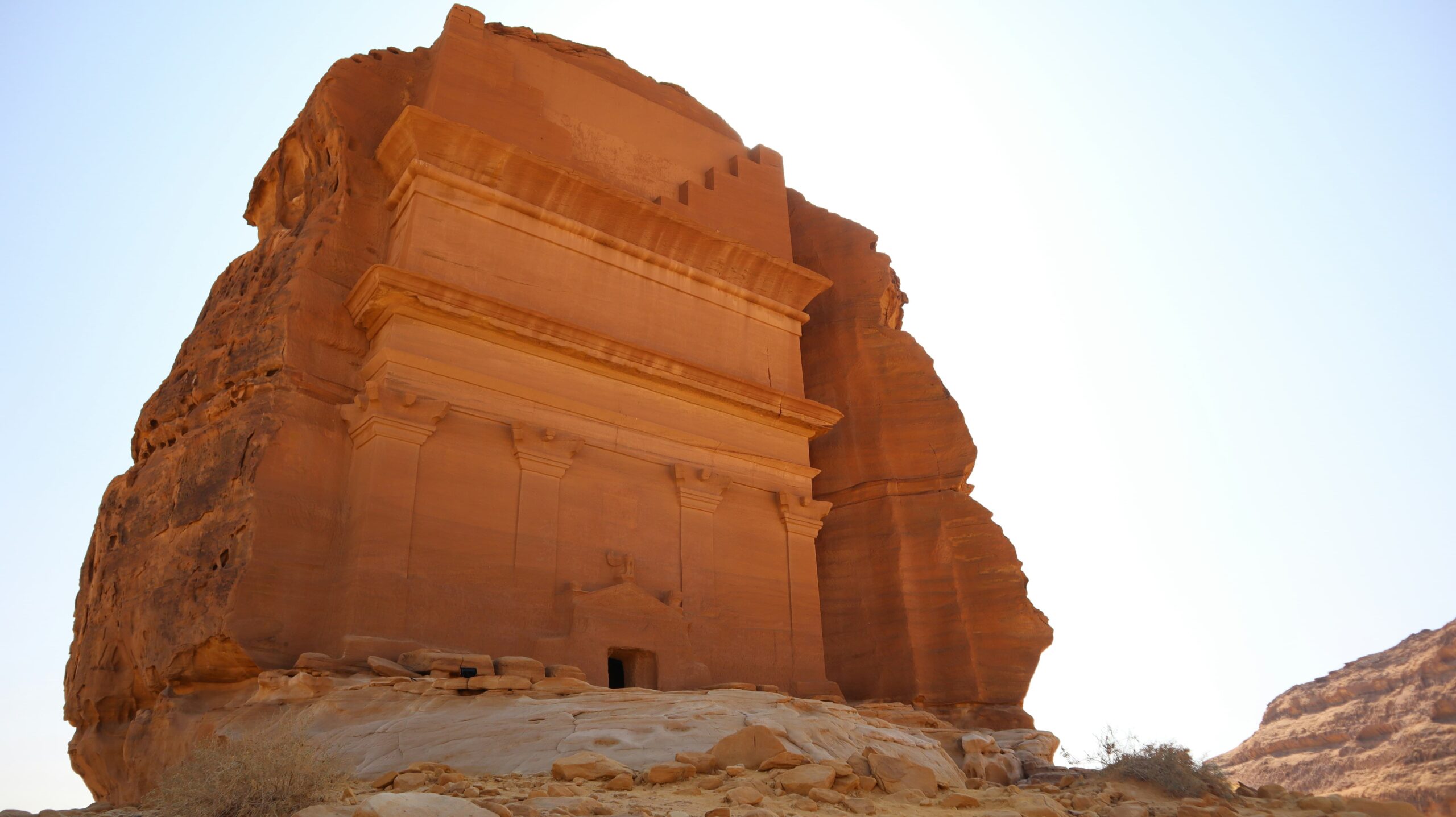
Look closely at the base and you’ll see that the carving is rougher than at the top, especially on the stepped frieze, which represents the souls’ path to heaven.
That imperfection and absolute solitude make this monolith the most evocative sight in the entire valley.
An Empire Forged in Frankincense and Stone
You can’t understand Hegra without knowing the history of the Nabataeans, the ancient desert nomads who for centuries controlled the most strategic stops along the Frankincense Trail.
Endless camel caravans loaded with treasures passed through their territory, and Hegra offered them vital shelter after weeks of crossing the desert.
While Petra was the political and administrative heart of the northern kingdom, Mada’in Salih emerged as the great southern capital. This enclave was the stronghold that secured Nabataean control of the trade routes across the Arabian Peninsula and the flow of goods to the Mediterranean.
But the Nabataeans were more than traders in spices from the far reaches of the East. They were also great engineers who knew how to turn the desert into an oasis. Their system of wells, cisterns, and aqueducts allowed them to farm and to store water through long droughts. As a result, Hegra thrived in a hostile desert environment, sheltering its citizens and pilgrims alike.
The Nabataeans’ economic boom lasted from the fourth century B.C. to the first century A.D. From their capital, the ancient city of Petra, to this enclave in the Hejaz, they controlled the tolls and traffic linking Yemen and Oman with the Levant, turning road dust into legendary wealth that still shows in the carvings they left behind.
As you leave the AlUla valley, one thing is certain: Hegra is far more than a collection of monumental facades. If anything, it is a reminder that even as empires fade, their traces endure, carved in stone.