





For a long time, India’s stepwells remained among the great overlooked wonders of the tourist trail. While the Taj Mahal and the palaces of Jaipur drew millions of visitors each year, these subterranean structures sat in silence — many of them abandoned, swallowed by vegetation, forgotten.
That began to change over the past decade. Social media put these ancient reservoirs on the radar of a new generation of travelers, and the most seasoned among them have started weaving them into their itineraries through Rajasthan and Gujarat.
Even so, they remain a footnote in the country’s tourism story. For most visitors, the stepwells still sit in the long shadow of India’s more celebrated monuments.
For those willing to seek them out, the reward is something rarer than spectacle: a lesson in how an entire civilization learned to transform water scarcity into an act of faith — and into something very close to art.
Stepwells: A Descent Into the Earth’s Memory
The arrival of water pumps and modern plumbing during the British Raj marked the beginning of the end for these structures. Today, the Indian government is working to reclaim them from obscurity. Rani ki Vav, for instance, now appears on the 100-rupee note — a quiet assertion of national pride.
What were India’s stepwells built for? How did they come to be?
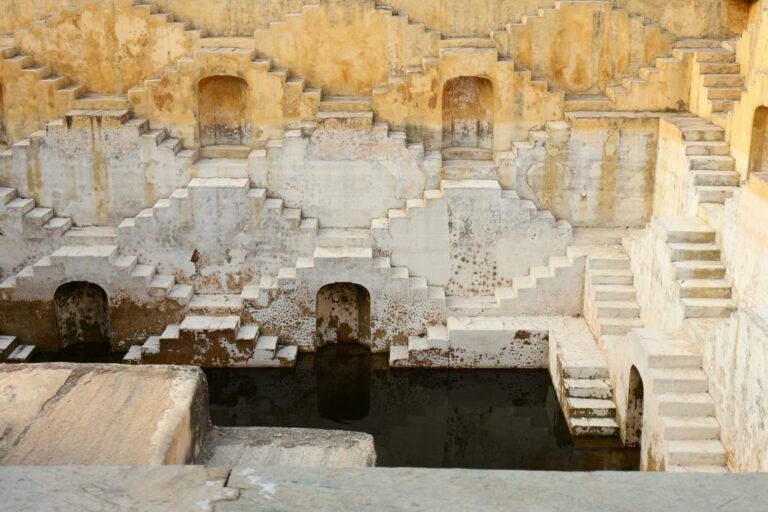
Known as baoris in Rajasthan and vavs in Gujarat, these structures were born of necessity.
The largest concentration of them is found in a region where the sky withholds rain for ten months of the year. Faced with chronic water scarcity, communities devised these remarkable stepwells as a solution that was both practical and, in time, profoundly beautiful.
Around the third century A.D., they were little more than trenches with rough-hewn steps descending into the earth to reach the water table. Over the centuries, they evolved into displays of architectural sophistication — layered, sculpted structures reaching depths of nearly 100 feet.
During the medieval period, between the 11th and 16th centuries, India’s stepwells became symbols of power and devotion. The rulers of the Solanki and Rajput dynasties understood that to control water was to control the fate of their people.
One of the most striking details of their history is that the vast majority of these inverted cathedrals were commissioned by women. Queens and noblewomen had them built as acts of public charity and as places for the community to gather.
In a society where women were largely excluded from public life, the stepwells offered something rare: a shaded refuge underground where women could socialize, away from the punishing heat above.
As mentioned earlier, the arrival of the British Raj permanently altered the fate of the baoris.
The colonial administration could not accept the sacred and the utilitarian sharing the same space. To British eyes, the stepwells were breeding grounds for disease. The fact that their construction techniques kept the water remarkably clean was of little consequence. British authorities declared them unsanitary and ordered them shut.
From the late 19th century onward, the wells were sealed, abandoned, or replaced by iron pipes. Slowly, they fell into obscurity, and vegetation began consuming the carved reliefs of the deities that had guarded their waters for centuries.
Today, after decades of neglect, these structures are reemerging as archaeological treasures — and as a reminder that India’s ancient engineers had already mastered the principles of sustainability long before the word existed.
The Spiritual Side of the Wells
These reservoirs, which sustained entire populations for centuries, are more than feats of engineering: they are sacred places. In the Indian worldview, water is itself divine, personified by the goddess Ganga.
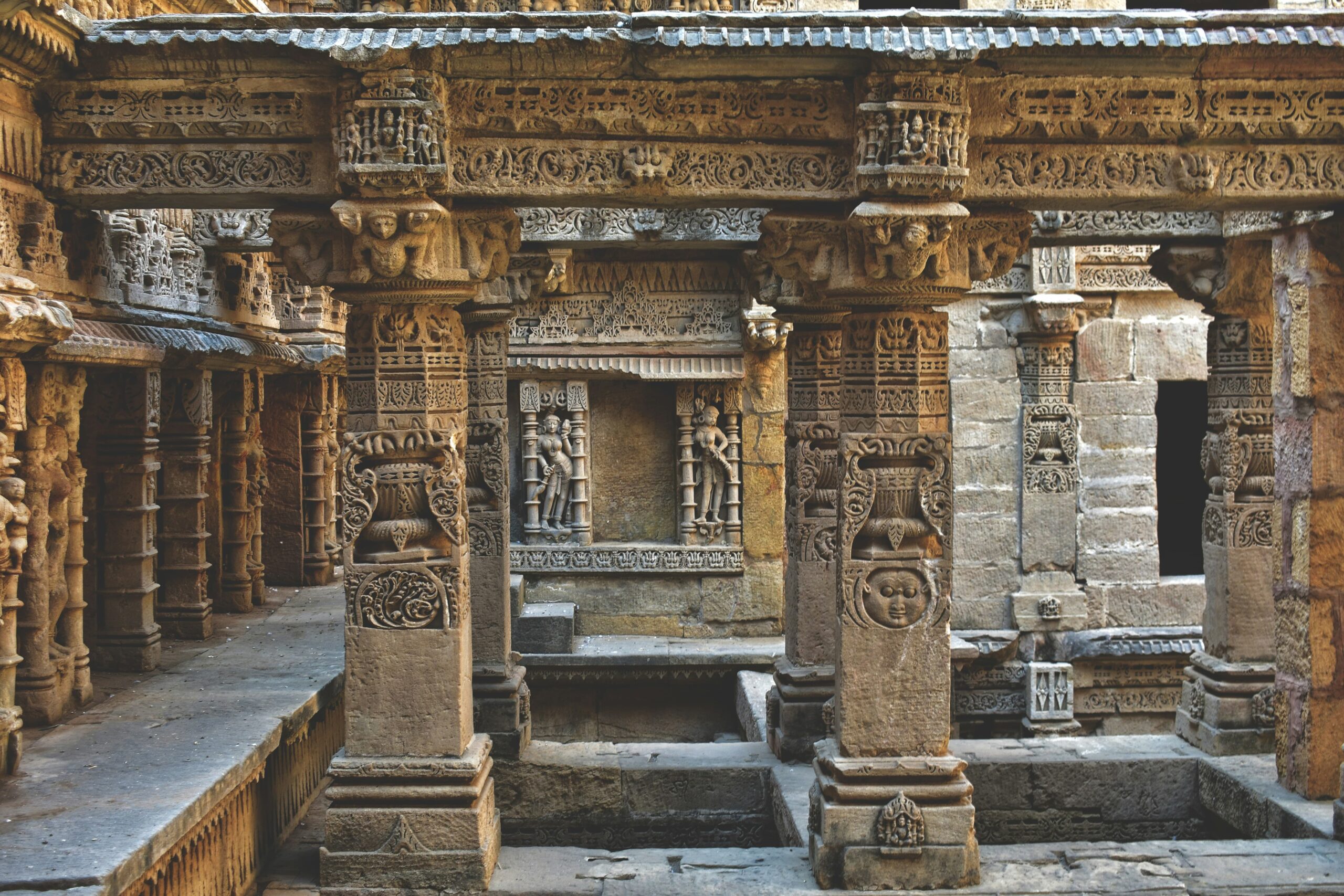
To descend the steps of a vav or a baori is to walk into a living theater of Hindu mythology. The walls are dense with carved reliefs that serve both a protective and a narrative purpose.
On the upper levels, where sunlight still picks out every contour, the carvings tend to depict scenes of everyday life: musicians, dancers, elephants in procession, women arranging their hair.
But the deeper you go, the more the imagery turns toward the transcendent. Figures of Vishnu begin to appear, often rendered in his Anantashayana form — reclining on the cosmic serpent amid the primordial ocean of chaos.
The symbolism is deliberate. The water at the bottom of the well represents that same primordial ocean from which all life emerges.
Alongside Vishnu, it is common to find the Seven Mothers (Saptamatrikas) and the goddess Durga, figures that reinforce the site’s deep connection to the feminine.
In other wells, serpent figures (Nagas) appear on the walls. In Indian mythology, these creatures are the guardians of hidden treasures and water sources. Popular belief held that if the Nagas of a well were properly honored, the water would never run dry.
Dense as the imagery is, the carvings are just as remarkable for the way they interact with light. In wells like Rani ki Vav, the sculptures appear to emerge from the stone when sunlight hits at just the right angle. At that moment, the atmosphere turns almost surreal.
In stepwells built under Islamic patronage — such as Adalaj — the decorative language shifts entirely. The deities vanish, replaced by intricate floral and geometric patterns that respect the Islamic prohibition on depicting the human figure. Yet the elegance remains, and so does the devotion to detail.
The Queen’s Stepwell: The Artistic Pinnacle of the Underground World
Rani ki Vav, the “Queen’s Stepwell,” stands in Patan and is, by most measures, the most extraordinary stepwell in India.
Its construction dates to the 11th century, when Queen Udayamati commissioned it as a memorial to her late husband. A thousand years on, it remains immaculately preserved.
Shortly after it was completed, the nearby Saraswati River flooded, burying the well beneath tons of silt. For nearly a millennium, this masterpiece lay hidden — protected from erosion, invasion, and looting by a thick layer of mud.
In the 1980s, archaeologists finally completed its excavation, revealing a seven-level structure in which stone becomes a living museum.
Those fortunate enough to walk its galleries will find more than 500 major sculptures and a thousand smaller figures depicting deities, celestial nymphs, and musicians.
The real revelation, however, comes at the deepest level, right at the well’s edge. It is there that the visitor understands that Rani ki Vav is far more than a feat of hydraulic engineering or a funerary monument. It is, in every sense, an act of love carved into the heart of Gujarat.
This UNESCO World Heritage Site stands as a reminder that the most enduring works of human civilization are not always found on the surface or on mountaintops — but sometimes in the silence of what lies beneath.