
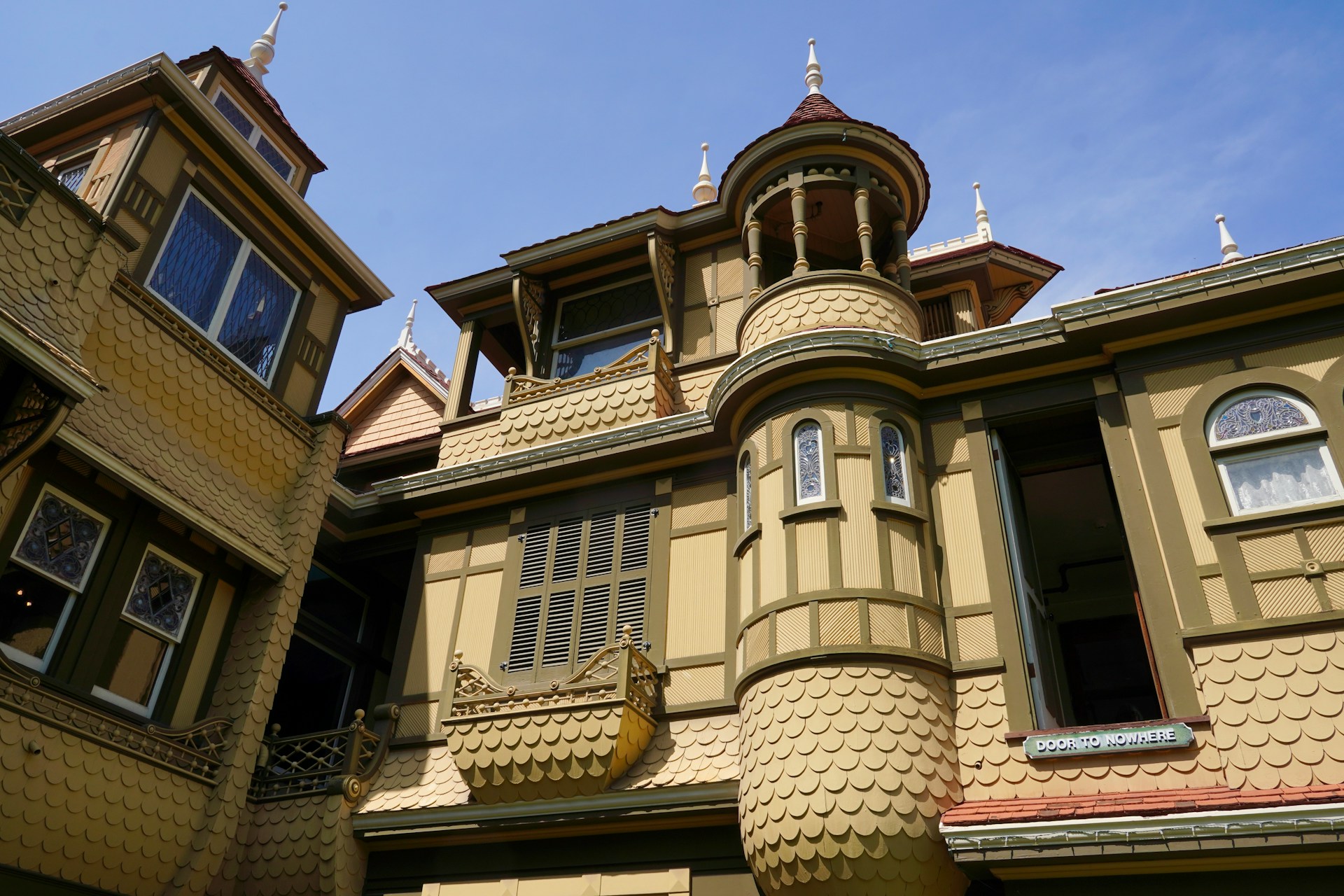
A staircase climbs to the ceiling and simply stops. An upstairs door swings open onto thin air. A window is set into the floor.
San Jose, California, is home to a Victorian mansion where such oddities are the rule, not the exception. It is known as the Winchester Mystery House, or simply the Winchester House, and for more than a century its history has been retold as a ghost story.
The truth, as it so often is, is more interesting.
A Farmhouse That Never Stopped Growing
It began in 1884, when Sarah Winchester bought an eight-room farmhouse in the Santa Clara Valley. It was a modest two-story home on about 45 acres.
What followed had no blueprint and no architect. Sarah directed the work as she went, and one addition was stacked on top of the next for nearly four decades.
By the time she died in September 1922, the farmhouse had become a labyrinth of roughly 24,000 square feet, with about 160 rooms, 2,000 doors, 10,000 windows, and 47 fireplaces. There were also 13 bathrooms and six kitchens, but reportedly only one shower.
The layout was said to be so confusing that some of the staff needed maps to find their way around.
Who Was Sarah Winchester?
Sarah was the widow of William Wirt Winchester, son of the founder of the Winchester Repeating Arms Company.
After losing her infant daughter in 1866 and her husband in 1881, she inherited a vast fortune that would bankroll her life’s work.
For decades, newspapers and tour guides cast her as a tormented woman. Historians tell a different story: a wealthy, strong-willed widow with no training in architecture who nonetheless ran her construction site with a firm hand.
And then, inevitably, there is the ghost legend.
The most popular version holds that after her husband’s death, Sarah consulted a Boston medium. The medium supposedly told her that the spirits of those killed by Winchester rifles were out for revenge against her family. The fix was to head west and never stop building, to keep the ghosts confused and herself alive.
It is a wonderful story. But it rests on accounts that surfaced long after the fact, and scholars regard it with skepticism.
What the record does show is that Sarah built constantly, often tearing out or abandoning work that didn’t satisfy her, and that this approach produced a chaotic, sprawling floor plan.
The Oddities, Explained
Many of the house’s curiosities have explanations that are more practical than supernatural.
Some windows ended up indoors because new rooms were built around them. Some staircases lead nowhere because later construction cut them off. Then came the 1906 earthquake, which badly damaged the upper floors.
Sarah chose not to rebuild many of those areas, which were sealed off or simply abandoned.
Other features do seem deliberate. The number 13 turns up again and again in windows, steps, and decorative details. The house also boasted luxuries rare for the era: stained glass, gold-plated fixtures, and modern conveniences far ahead of their time.
There’s one more twist: not everything strange in the house can be pinned on Sarah.
A carpenter who worked on the house claimed that some of its most eye-catching quirks were added after her death, once the property had been turned into a tourist attraction.
How to Visit
The house stands at 525 South Winchester Boulevard in San Jose, a little more than an hour’s drive south of San Francisco. Parking is free. It is open every day except Thanksgiving and Christmas, with hours that change by season:
- September through April: 10 a.m. to 4 p.m. on weekdays and 10 a.m. to 5 p.m. on weekends.
- May through August: 10 a.m. to 5 p.m. on weekdays and 10 a.m. to 7 p.m. on weekends.
The standard visit is the Mansion Tour, a roughly hourlong guided walk through 110 of the 160 rooms. For an additional fee, visitors can add the basement and the attic.
There is also a two-hour small-group tour with Janan Boehme, the house’s historian and curator. It takes in areas normally closed to the public, with a particular focus on preservation.
For those looking for something more thrilling, the house offers flashlight tours after dark and, around Halloween, candlelight tours. The candlelight tours tend to sell out, so book well in advance.
Tickets are sold at the box office and on the official website, where visitors can book a specific date and time.
One important note: because the house is a historic building, its interior is not wheelchair accessible. Wheelchair users can instead watch a video of the tour in an accessible building on the grounds and take a self-guided stroll through the gardens.
Tours with American Sign Language (ASL) interpreters are offered on select dates each month, and a companion gets in free.
The Victorian gardens are part of the experience as well and can be explored at your own pace with a digital map. That walk is wheelchair accessible and included with any tour. For those who cannot make the trip, the house offers a 360-degree virtual tour and an official video that can be rented for 72 hours.
One House, Many Stories
More than a century after her death, Sarah Winchester remains an enigma.
Was she a woman pursued by ghosts, an obsessive builder, or simply a widow with money, time, and the freedom to do as she pleased with her own home?
Probably a little of all three. What’s certain is what she left behind: a mansion that, no matter how many times you walk its halls, never quite gives up all its secrets.