Oman barely registers on the world’s radar, yet more than 2,000 years ago the sultanate had its moment of glory.
The country is home to the Boswellia sacra, a gnarled, ancient tree that for centuries has yielded a substance more coveted than gold: frankincense.
Oman grew rich on this resin, which was burned on the altars of the pharaohs and in the temples of the Roman Empire.
To travel the frankincense route in Oman today is to move through a landscape where the boundary between myth and commerce dissolves beneath the Indian Ocean sun.
The fragrance of “white gold”—the resin that once connected civilizations—still rises from the bark of these ancient trees.
Oman, a country only now appearing on travelers’ maps, still bears the marks of a trade route that changed the world.
Where the Frankincense Route Begins: The Trees of Wadi Dawkah
To grasp the scale of the frankincense route in Oman, you have to leave the coast behind and push inland, into the heart of Wadi Dawkah.
About 25 miles from Salalah, this UNESCO-protected natural amphitheater is a stronghold of the Boswellia sacra, a twisted-trunked tree that is arguably one of the most influential in history.
Harvesting frankincense, known in Arabic as luban, remains a ritual untouched by modernity. No machines are involved—only the menghaf, a small chisel used to make precise incisions in the bark. From those cuts flows a white, milky “blood” that crystallizes on contact with the air, forming tears of resin.
The tears are left to dry in the sun for two to three weeks, slowly taking on their final color. Some turn amber; others develop the silvery green that distinguishes hojari frankincense, the purest variety in the world.
To visit Wadi Dawkah is to step backward in time. Walking among the trees, you can easily picture the Bedouin tribes weighing their sacks of resin before setting out on the long journey north.
Those crystal tears were the currency that made survival possible in some of the harshest terrain on Earth.
The trees standing in the valley today are the last witnesses to one of the most consequential trade routes in human history.
Gateway to the Indian Ocean: Sumhuram and the Frankincense Ports
The frankincense drawn from Wadi Dawkah reached the wider world through the ports of the Dhofar coast.
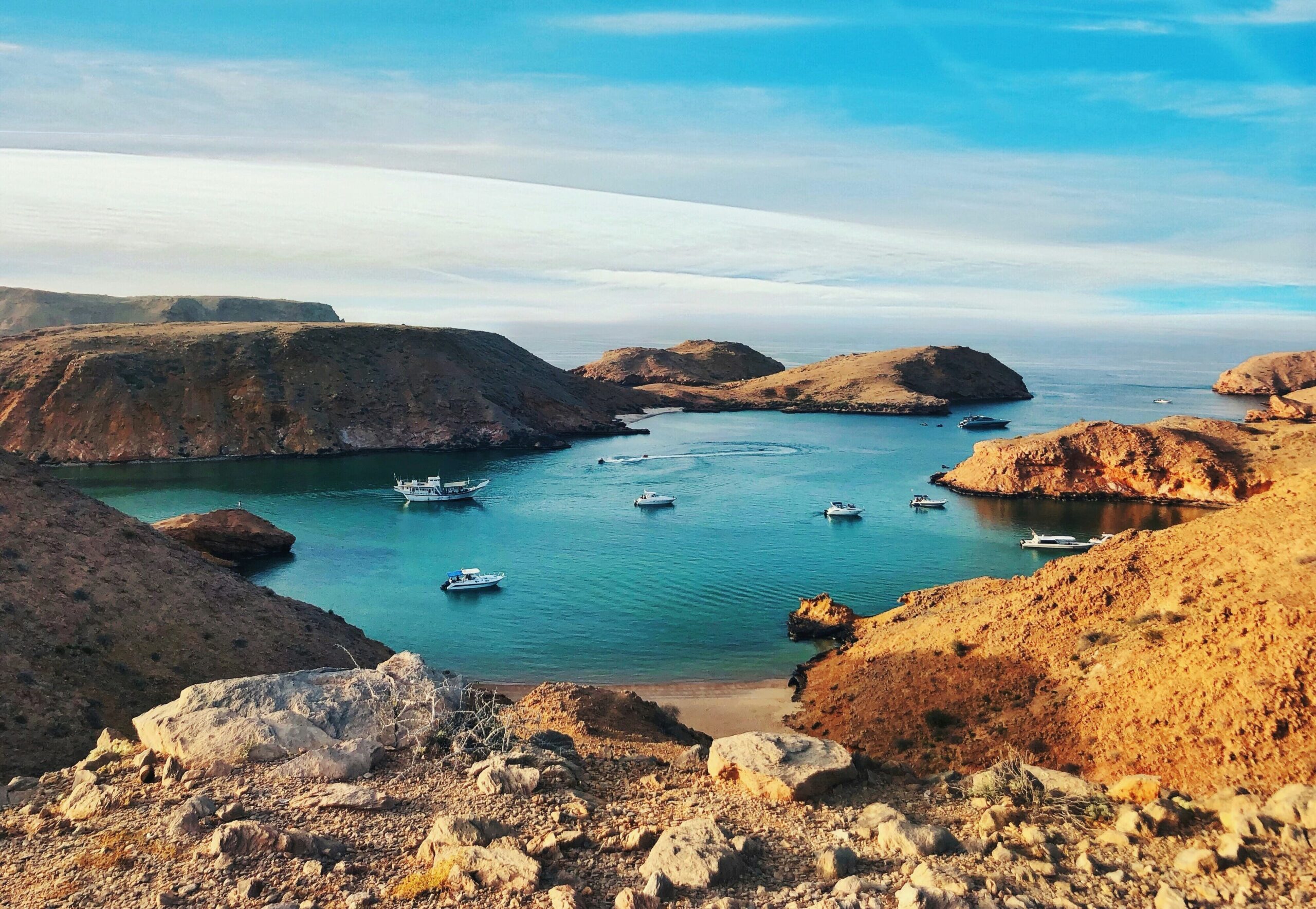
About 25 miles east of Salalah lie the ruins of Khor Rori, the ancient fortified city of Sumhuram.
Rising above a turquoise lagoon where flamingos gather, this relic of the ancient world was, two thousand years ago, southern Arabia’s most strategically important port.
Limestone walls protected warehouses that held tons of “white gold” before it was loaded onto ships bound for Red Sea ports, India, and even the distant markets of China.
For anyone following the route, walking into Sumhuram drives home the sheer scale of the enterprise. Every gram of resin was weighed and taxed within these walls. Phoenician sailors, Greek merchants, and Nabataean officials negotiated prices in the shadow of its ramparts.
The location was no accident. The Khor Rori lagoon offered natural shelter from the monsoons, allowing dhows—the traditional wooden sailing vessels—to wait for the right moment to depart, their holds heavy with fragrance.
From here, some of the frankincense went by sea to Ptolemaic Egypt.
Meanwhile, inland, began the ordeal every caravan dreaded most: the desert crossing to the legendary city of Ubar.
Ubar and the Trial of the Rub al-Khali
The Rub al-Khali—the “Empty Quarter”—was the ultimate test along the frankincense route through the sultanate.
At the edge of this ocean of endless dunes lies Shisr, the site that explorer Sir Ranulph Fiennes and archaeologist Nicholas Clapp identified in the 1990s as the legendary city of Ubar.
For centuries, camel caravans departed from here loaded with resin, facing a journey of thousands of miles across the brutal Rub al-Khali before reaching the markets of Petra and Gaza.
Ubar was a logistical hub that collapsed in spectacular fashion. The weight of its structures and the over-extraction of underground aquifers caused the limestone cavern beneath the fortress to give way, swallowing the city whole.
There is a certain irony in its ruins. A city that controlled the ancient world’s greatest luxury trade was ultimately undone by the very ground it sought to master, a fate it shares with Argentina’s Epecuén.
Ubar marks the end of the physical trail of Oman’s frankincense route. In its day, though, it was a crucial waypoint on the long journey that turned humble tree resin into an object of devotion in temples across the Mediterranean.
The Living Legacy of Frankincense in Oman
The journey does not end among ancient stones. It ends in the beating heart of Salalah.
At the Al-Hafah Souk, the scent of frankincense overwhelms the senses. Local women draped in colorful abayas guard towering mounds of resin with quiet authority. Here, luban is sorted by color and clarity, and it is impossible to walk more than thirty feet without the white smoke of a majmar—a traditional incense burner—stopping you in your tracks.
For Omanis, frankincense is inseparable from their identity. It is burned at dawn to bless the home, used to perfume clothing before a celebration, and offered as a gesture of welcome to every guest.
It even finds its way into the local cuisine—sometimes as water infused with frankincense and prized for its medicinal properties, sometimes as a flavoring in ice creams that challenge Western palates.
It is, in the end, a heritage that outlasted the fall of empires and the discovery of oil.
Leaving the souk with the scent of frankincense still clinging to your skin, you understand that the route never truly closed. The means of transport changed, the maps were redrawn—but the resin trail remains the compass that guides travelers through this corner of Arabia.