
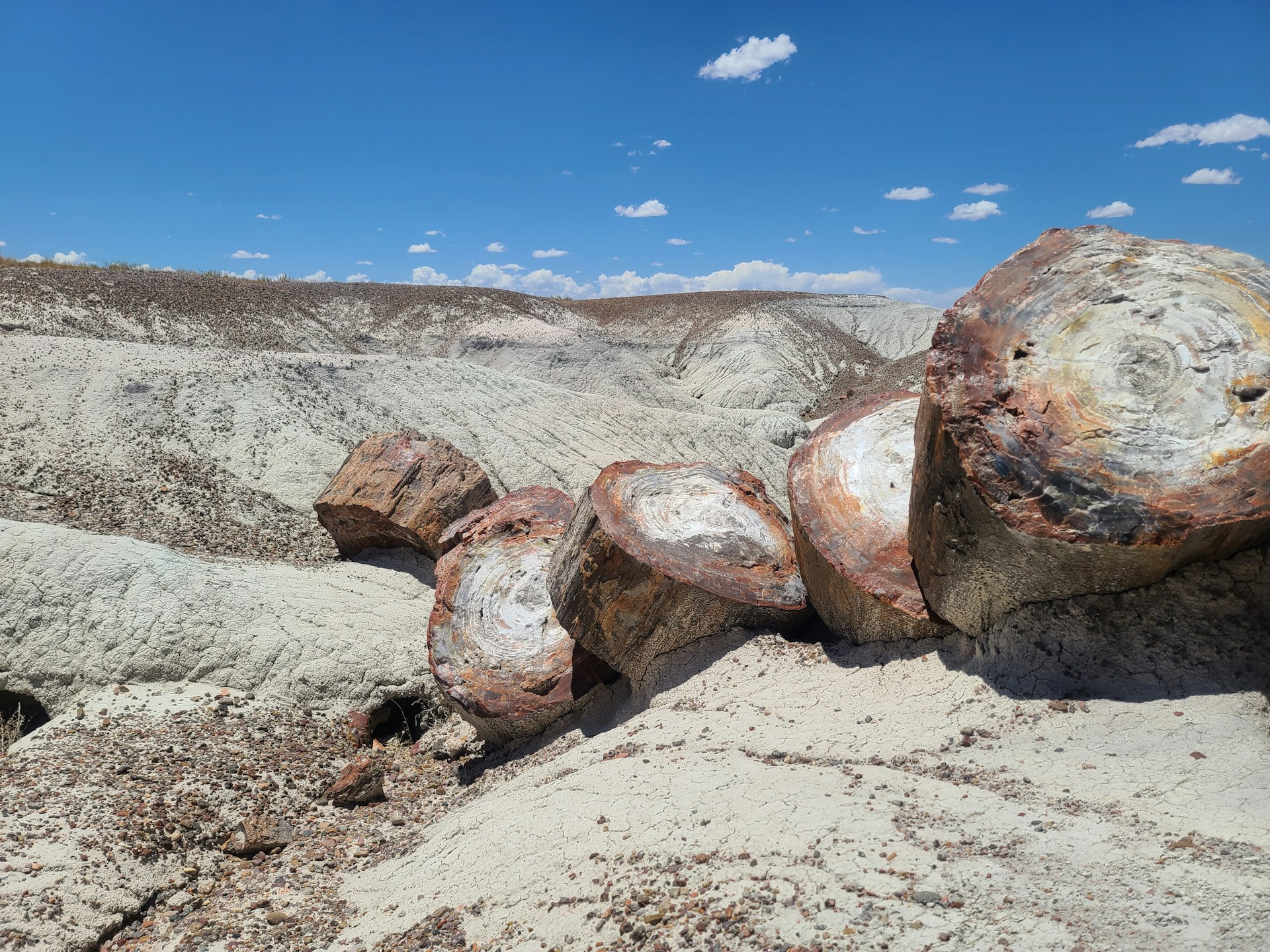
In northeastern Arizona lies a landscape that seems to belong to another world: logs split into clean, even segments — as though sawed by a machine — that catch the sunlight and glitter like shattered glass.
But they are not wood. They are quartz, in the exact shape of the trees that grew here more than 200 million years ago.
Welcome to Arizona’s Petrified Forest, one of the largest concentrations of petrified wood on Earth.
A Landscape That Began Forming in the Triassic
To understand the Petrified Forest, you have to go back to the Triassic, roughly 225 to 200 million years ago.
What is now the arid northeastern corner of Arizona was then an entirely different place: wide rivers, sprawling floodplains, and forests of enormous conifers — some reaching nearly 200 feet — belonging mostly to an extinct species known as Araucarioxylon arizonicum.
When those trees fell, many were swept into rivers and buried in the mud of the floodplains. Around the same time, intense volcanic activity blanketed the region in layers of ash, which settled into those same waters.
That combination proved decisive. Buried quickly in an oxygen-poor environment, the logs were protected from decay.
How Wood Became Stone
The petrification process itself took millions of years.
During that time, groundwater rich in silica — dissolved largely from that same volcanic ash — seeped slowly through the buried wood, depositing minerals in its cells and gradually replacing nearly all of the original organic material with solid quartz.
The result preserves the growth rings and even the texture of the bark in astonishing detail, though the material itself is now entirely mineral.
The colors that make these logs so striking today — reds, yellows, purples, greens — come not from the wood itself, but from mineral impurities locked inside the quartz.
Iron produces reds and oranges, while manganese yields purples and blacks. Where the logs later cracked, true crystals of clear quartz, amethyst, and citrine grew in the gaps.
Much later, the gradual uplift of the Colorado Plateau, which began roughly 60 million years ago, put the petrified logs under such intense stress that many snapped into clean segments, like glass rods breaking under pressure.
It was the erosion that followed, stripping away layer after layer of sediment, that brought these stone logs back to the surface, where they lie today.
The Park Today
Petrified Forest National Park encompasses two distinct landscapes.
To the north stretches the Painted Desert, a rolling expanse of clay hills banded in shades of red, gray, and lavender that shift in tone as the light changes throughout the day.
To the south lie the densest concentrations of petrified logs, spread across several named areas.
Among them are Crystal Forest, known for its quartz-studded logs; Jasper Forest; and Giant Logs, home to some of the largest and most intact specimens in the park.
The park also preserves traces of a human past that is, in geological terms, very recent. One is Agate House, an eight-room dwelling built more than 900 years ago almost entirely from blocks of petrified wood.
Another is Puerco Pueblo, the ruins of a village of some 100 rooms, with petroglyphs still visible on nearby rocks — including one in the shape of a mountain lion that has become a symbol of the park.
Little-Known Facts
Beyond its geology, the Petrified Forest picked up a curious legend over the course of the 20th century: the park’s so-called curse.
Since 1906, when removing petrified wood was officially banned, hundreds of visitors who took pieces anyway have ended up mailing them back, along with letters of apology blaming the theft for a run of bad luck.
The park’s archive now holds more than 1,200 of these “conscience letters,” the oldest dated 1935, and a selection of them is on display at the Rainbow Forest Museum.
Another little-known fact is that Petrified Forest National Park is the only national park in the United States to preserve a section of historic Route 66 within its borders.
It is worth noting that this stretch cannot be traveled by car or bicycle — it serves instead as a commemorative site featuring a line of historic telegraph poles, a vintage 1956 Studebaker classic car placed as a monument, and the faint remains of the original roadway.
More recently, the park earned another distinction: certification as an International Dark Sky Park. With exceptionally little light pollution, it has become a sought-after stargazing destination.
How to Visit
The park is in northeastern Arizona, near the town of Holbrook and less than a two-hour drive from Flagstaff, right off Interstate 40.
It is open every day except Christmas. Hours vary by season: generally 8 a.m. to 5 p.m., with longer hours in summer.
Admission is good for seven days and costs $25 per vehicle, $20 per motorcycle, or $15 per person on foot or by bicycle.
The main park road is a scenic drive of about 28 miles linking the overlooks and short trails, most of which take under an hour to walk, so the whole park can be seen in a single day.
One final note, which has less to do with curses than with common sense: removing even a small fragment of petrified wood from the park remains a federal offense.
The good news is that shops in nearby towns like Holbrook sell pieces collected from private land outside the park — for anyone who wants a keepsake without the legal risk or, if the letters are to be believed, the cosmic consequences.