On the Yamal Peninsula, a narrow finger of land reaching into the Arctic Ocean, the Nenets of Siberia keep alive the world’s last great nomadic way of life.
Beneath skies of glacial blue and temperatures that plunge to -58°F, this Indigenous people thrives in complete harmony with its environment. For them, time is not measured in hours but in the distance between one pasture and the next, in the relentless rhythm of thousands of hooves striking snow.
The name Yamal translates as “the end of the world,” and it is the setting for an ancient migration route now under greater threat than ever.
While nomadic life has all but vanished elsewhere in the world, the Nenets continue moving their chums and reindeer herds across the endless tundra.
Their story is one of resistance. Despite pressure from the gas industry and the thawing of the permafrost, they refuse to trade the snow-white horizon for the walls of a concrete city.
The Great Nenets Migration: 620 Miles Across the Arctic Ice
You can’t understand the nomadic Nenets people without understanding movement. Every year, these communities undertake one of the most extreme migrations on the planet, traveling up to 620 miles across the Yamal tundra.
The route is anything but a straight line. Lichen, the primary food source for their reindeer, dictates the path. The most perilous stretch comes when temperatures drop to -58°F and thousands of animals, along with entire families riding sleds, must cross the frozen waters of the Ob River.
In this feat of endurance, ice barely 3 feet thick groans under the weight of an entire people who stake their lives on winter holding firm.
Logistics are everything during the migration. Each family travels with its caravan of sleds, hauling the poles for their dwellings along with basic household goods. While the men guide the main herd, the women lead the cargo sleds.
In this white desert, there are almost no visual landmarks. But for the Nenets, every ripple in the snow and every shift in the wind signals where to make camp, and above all, where to take shelter from the dreaded purga, a ferocious blizzard capable of blinding a man in seconds.
This mobility is both a strategy for keeping the herds fed and the foundation of their freedom. The nomadic life allows the Nenets to escape the rigid structures of the state and the settled life that many other Indigenous groups have already accepted.
Ultimately, staying nomadic is the only way to remain masters of their own fate and to keep their bond with an unforgiving land that is the only home they have.
The Chum: The Nenets’ Shelter at the End of the World
In the vastness of the tundra, the chum is the only refuge the Nenets of Siberia have.
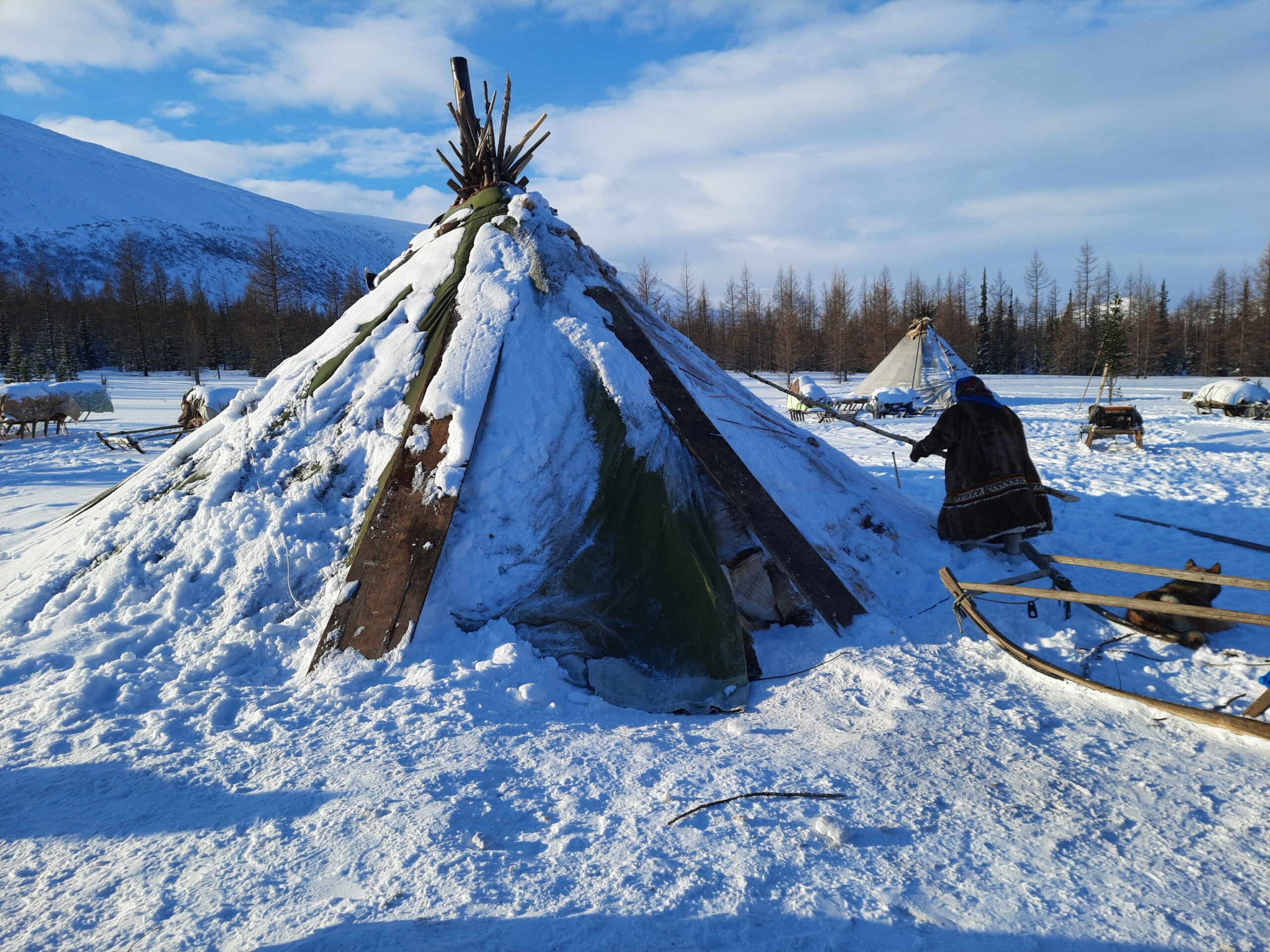
This structure, engineered for extreme survival, is conical, much like the Native American tipi. It is built from roughly 40 birch poles covered in a double layer of reindeer hide. It is remarkably resilient, able to withstand winds that would flatten any modern tent.
Equally striking is how quickly it can disappear. In under an hour, the women of the family can dismantle the entire shelter, load it onto sleds, and erase every trace of human presence from the snow.
A heavy hide flap serves as the door, and the contrast on the other side is striking. While the Arctic howls outside at -40°F, the central stove keeps the interior warm enough for the family to shed their heavy fur coats.
The interior is sacred and strictly ordered. There is a place for cooking utensils, a sleeping area covered in hides, and a section at the back where the family’s most treasured possessions are kept.
Life in the chum revolves around hot tea and reindeer meat, often eaten raw to preserve the vitamins that heat would destroy.
The chum spans just a few feet in diameter. But inside, in the warmth, ancestral stories are passed down and children learn to read the behavior of the herd. In short, it is where the community renews itself.
A Future in the Balance: Gas, Thaw, and the End of the World
The Yamal Peninsula is caught in a cruel paradox today. For the Nenets of Siberia, this land is a sacred pasture. For the global economy, it is one of the world’s largest natural gas reserves.
Vast deposits lie beneath the region, and they have drawn massive industrial development.
Pipelines now cut across migration routes and asphalt roads fragment the tundra. Vast industrial complexes light the Arctic horizon with gas flares.
On top of this industrial pressure comes a relentless adversary: climate change. The Arctic is warming roughly twice as fast as the global average, and the consequences for the Nenets are devastating.
The permafrost, the permanently frozen layer of ground beneath the tundra, has begun to thaw, turning firm terrain into impassable swamps.
But the greatest danger comes from rain-on-snow events. When rain falls in the depths of winter and temperatures then plunge again, a thick crust of ice forms over the ground that reindeer cannot break through with their hooves to reach the lichen beneath. The result is mass starvation that can wipe out entire herds within days.
Never has this people’s resilience been tested so severely. Young Nenets must choose between following the trail of their ancestors across an increasingly hostile and regulated landscape, or seeking shelter in the cities.
Yet most continue to choose the freedom of the tundra. For them, as long as there are reindeer and a chum can still be pitched beneath the northern lights, the Yamal Peninsula will remain their home.