
If you had to name a Spanish city to represent sustainable tourism, Benidorm would almost certainly not make anyone’s list.
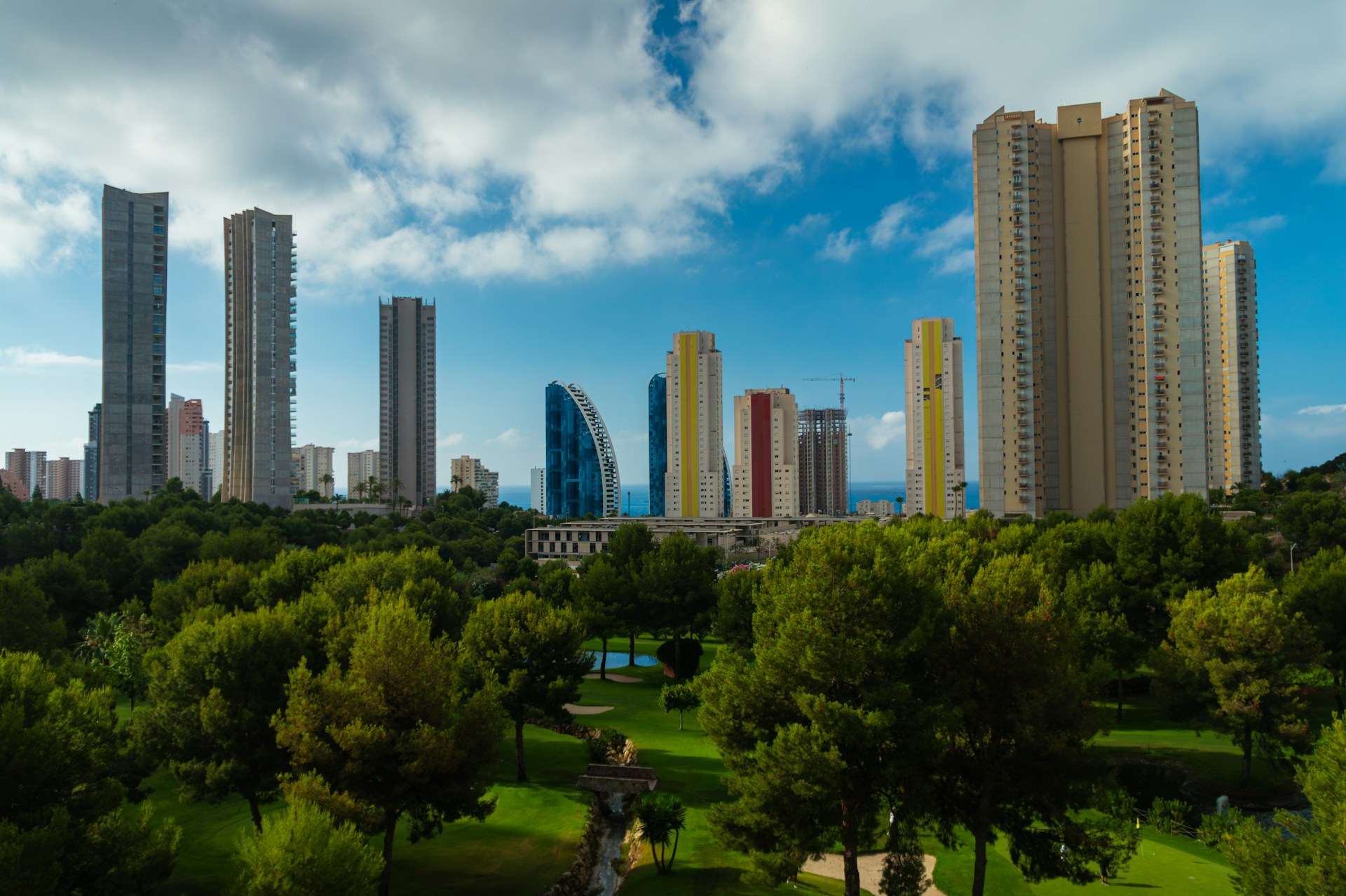
Its postcard image tells a different story: a skyline of more than a hundred towers rising above the sea, millions of tourists a year, and a reputation as a mass-market destination that has dogged it since the 1970s.
And yet there it is — a finalist for one of the European Union’s most prestigious urban sustainability awards. It is not the only Spanish surprise among the finalists, but it is easily the most striking.
A Prize With Seven Criteria and Real Money at Stake
Each year, the European Commission hands out two parallel titles: the European Green Capital, for cities with more than 100,000 residents, and the European Green Leaf, for towns and cities with 20,000 to 100,000 residents.
Both recognize measurable progress across seven specific areas: air quality, water management, biodiversity and green space, circular economy and waste, noise pollution, climate change mitigation, and adaptation to its effects.
For the 2028 awards, an independent panel of experts reviewed 27 candidate cities and selected eight finalists.
Three of them are Spanish. Zaragoza is competing for the Green Capital title against Aalborg (Denmark), Bielsko-Biala (Poland), Kosice (Slovakia), and Porto (Portugal). Benidorm and Chiclana de la Frontera, meanwhile, are vying for the Green Leaf against Portugal’s Estarreja.
The winner of the Green Capital award receives 600,000 euros, and the Green Leaf winner receives 200,000 — both sums earmarked for environmental projects during the title year.
The winners will be announced Oct. 8 at a ceremony in Guimaraes, the current European Green Capital.
Benidorm’s Case: Build Up, Not Out
Back to the big surprise. The key to understanding why Benidorm is on this list has nothing to do with parks or gardens. It has to do with an urban planning decision made nearly 70 years ago.
In the mid-1950s, the town faced a choice between two growth models: a low-rise garden city of detached villas, like much of the Mediterranean coast, or a vertical city of high-rise towers.
It chose the latter. That bet — unusual at the time and criticized for decades — is now central to its bid.
The logic is simpler than it sounds: concentrating tourist accommodation in towers allows a city to host millions of visitors while using far less land than an equivalent low-rise development would require.
Urban planners have calculated that meeting the entire tourist demand of Spain’s Mediterranean coast with Benidorm’s model would take only a fraction of the land that the same number of beds would occupy in low-density sprawl.
And despite its reputation as a car-dependent city, more than 70% of trips within Benidorm are made on foot. The city also has more than 81 miles of bike lanes.
The city has protected more than 60% of its land since adopting its original plan in the 1950s, and in recent years it has committed to measuring and offsetting the carbon footprint of its tourism industry.
This is not the first time Benidorm has made the final round: it was also a finalist for the 2027 award, though it did not take the title.
Chiclana and Zaragoza: Two Very Different Strategies
If Benidorm makes the most counterintuitive case among the Spanish finalists, Chiclana de la Frontera offers a more conventional one — though no less compelling.
The European Commission singled out the city, in Cadiz province, for its carbon footprint monitoring system, its public energy information tools, and its community programs that bring residents into the transition to cleaner energy. It is an approach rooted in data and civic participation rather than radical urban transformation.
Zaragoza, the only Spanish city competing in the main category, takes a different tack: a green connectivity project that links urban parks, riverbanks, wetlands, and street trees into a single, continuous ecological network.
The strategy is designed both to expand habitat for local wildlife and to reduce the city’s flood risk. It is green infrastructure planned on the scale of an entire city — quite different from Benidorm’s compact vertical model or Chiclana’s data-driven approach.
Three Cities, Three Takes on the Same Goal
Seeing these three cities on the same list is interesting for what they show together: there is no single path to urban sustainability.
Zaragoza is weaving a network of nature into the fabric of a large city.
Chiclana is betting on transparency and resident participation.
And Benidorm — the most unexpected of the three — is defending an idea that for decades sounded more like a criticism than a compliment: that concentrating density in towers can, paradoxically, be gentler on the land than spreading out across it.
The verdict comes Oct. 8. But whatever the outcome, Benidorm’s presence on this list has already achieved something: it has forced us to rethink the images we instinctively reach for when we hear the word “sustainable.”