

In the Indian Ocean, about 1,700 miles northwest of Perth, lies a reef that kept a secret for more than 30 years. Only a handful of divers knew it was there.
Now a team of scientists has mapped it, and the numbers are staggering: a coral colony stretching nearly a mile along the seafloor of the Cocos (Keeling) Islands, a remote Australian territory.
If it proves to be a single organism, it would rank among the largest coral structures ever recorded. That question, however, remains open.
A Find Decades in the Making
The story begins with Dieter Gerhard, who runs a dive center on the islands. More than 30 years ago, he noticed an unusual coral on the outer reef. For a long time, no one knew where it ended. It seemed to be several separate patches, each one impressive in its own right.
Eventually, Gerhard reached out to J.P. Hobbs, a marine biologist at the University of Adelaide. Hobbs started with a measuring tape and quickly realized it was no match for what lay before him.
He spent months taking measurements alongside researchers from the Queensland Museum and James Cook University, and in the end he turned to GPS. Sometimes he ran low on air before reaching the edge, so he would mark the spot and pick up where he left off on the next dive. It took 12 dives to trace the full outline.
What Kind of Coral Is It, and How Big Is the Largest Coral Colony?
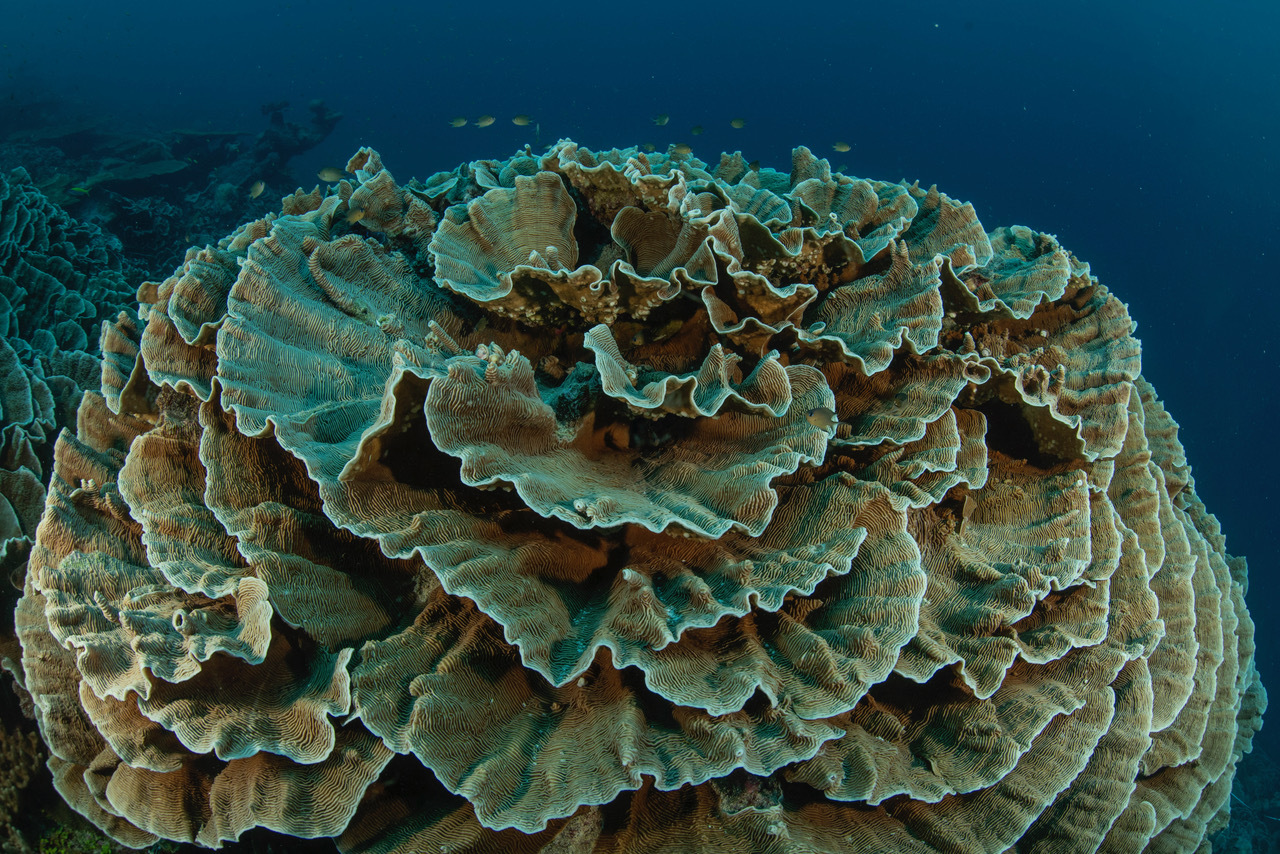
The coral belongs to the genus Pachyseris, known as rose coral. Rather than forming a rounded mound, it grows as a thin, sprawling sheet.
It spreads across the reef’s outer slope at depths of 46 to 213 feet, in what is known as the mesophotic zone, where very little light penetrates.
The colony is nearly a mile long, with an average width of 120 feet, and some sections extend 660 to 980 feet beyond the main body. In all, it covers 612,900 square feet, roughly the area of eight soccer fields.
One or Many?
Whether it is one organism or many is the question intriguing scientists.
A coral colony is made up of thousands of polyps, all clones of one another. Over the years, though, separate colonies can grow toward each other and merge. Researchers are weighing two possibilities: that this is what happened here, or that the structure is a single colony.
To find out, the team is running genetic analyses. If the entire structure turns out to be a single individual, it will rewrite the record books.
The current record for the largest individual coral belongs to one found in the Solomon Islands in 2024. It measures about 110 feet across and is estimated to be between 300 and 500 years old.
By comparison, a coral nearly a mile long is on another scale entirely. And if it turns out to be several fused colonies, the find will still be remarkable for other reasons: its sheer size and its health.
For now, the researchers are choosing their words carefully. They describe it as “one of the largest coral colonies ever recorded.”
Where Are the Cocos (Keeling) Islands?
The Cocos (Keeling) Islands are an external territory of Australia made up of 27 coral islands arranged in a rough ring.
Only two are inhabited: West Island, home to the airport and most of the lodging, and Home Island, the heart of the Cocos Malay community.
About 600 people live in the archipelago. The reef lies within the Cocos Islands Marine Park, and the research is part of ongoing studies there.
Getting there means flying from Perth. According to the islands’ tourism office, QantasLink flies twice a week, on Mondays and Fridays. The trip takes just over four hours, either nonstop or with a stop on Christmas Island.
Although the flight departs from an international terminal, it is a domestic route: No passport is required, but travelers need photo identification. Tourism Australia also notes that no more than 144 visitors can be on the islands at any one time, something worth keeping in mind before booking.
What to Do in the Cocos Islands
The main draw is the lagoon, where visitors dive, snorkel, fish and kitesurf in warm, exceptionally clear water.
Direction Island is home to Cossies Beach, named Australia’s best beach in 2017 and a must on any visit. The same island has one of the area’s best snorkeling spots, The Rip.
On Home Island, travelers can learn about the culture of the Cocos Malays, who speak their own dialect, and visit the Pulu Cocos Museum, which tells the story of the islands under the rule of the Clunies Ross family.
The climate is tropical year-round, and the sea tends to be calmest between November and April.
A Secret No Longer
There is something about this find that sets it apart. It wasn’t made by a robot or a satellite, but by a diver who ran low on air more than once.
Even on a planet this thoroughly mapped, the ocean still hides giants, waiting for someone to swim down and measure them with a tape.