
Witches have haunted the edges of fairy tales since anyone can remember, almost always cast as the villain. Sorcerers and dark magicians have played that role too, but witches occupy the collective imagination differently, in large part because of their identity as women.
During the Middle Ages and the Renaissance, the majority of people tried by the Inquisition across Europe were women, and many of them were condemned for witchcraft.
The witch’s image was cemented in the popular mind through stories like Snow White, Hansel and Gretel, and, more recently, The Wizard of Oz. In L. Frank Baum’s telling, two witches appear—one wicked, one good—a distinction that was unusual for its time. In recent decades, that idea has taken firmer hold in fantasy storytelling, with well-meaning witches who bear little resemblance to the traditional image of the villain.
Perhaps that cultural shift is what made it possible for a small corner of the Alpujarra Granadina to lean into its own mythology. The village of Soportujar embraces without hesitation its identity as the «land of witches», drawing a steady stream of visitors curious about that unusual reputation.
A Village That Welcomes Witches in the Heart of Sierra Nevada
Soportujar is a small village of barely 260 residents, set in the Alpujarra district, in the province of Granada.
The region owes much of its character to its proximity to Sierra Nevada, one of the few places on the Iberian Peninsula where snow lingers year-round. The village sits on the far side of the mountain from the ski slopes and winter resorts, in a landscape defined by dramatic terrain and the whitewashed architecture of the sierra.
What makes Soportujar special is not simply its setting or its modest size, but its wholehearted devotion to the witch.
Legend holds that centuries ago, when the village was on the verge of being abandoned for lack of families, King Philip II urged many Galician families to settle in this part of the Alpujarra. The Galician tradition of the meigas, as those communities call their witches, took root there. No documented witch ever lived in Soportujar, but the stories have survived the centuries.
Those stories left their mark on the landscape. The village is home to several sites tied to the legend, including the Puente Encantado—the Enchanted Bridge—that marks the entrance to town, and the Cueva del Ojo de la Bruja, the Cave of the Witch’s Eye, where witches and mantequeros were said to lurk: thieves and killers who abducted children to steal their fat and render it into magical ointments.
In recent decades, Soportujar has woven these stories into its identity and folklore, going so far as to open a Witchcraft Research Center in the heart of the village. The devotion runs so deep that the classic witch, broomstick and all, now appears on the village’s official coat of arms.
Witchcraft Tourism and Good Food
Visitors have been arriving in growing numbers, drawn by the reputation of the witches’ village. The arrival of German and British residents who have settled in the area has brought new life to what is still, at heart, a small mountain community—with all the charm and limitations that come with it.
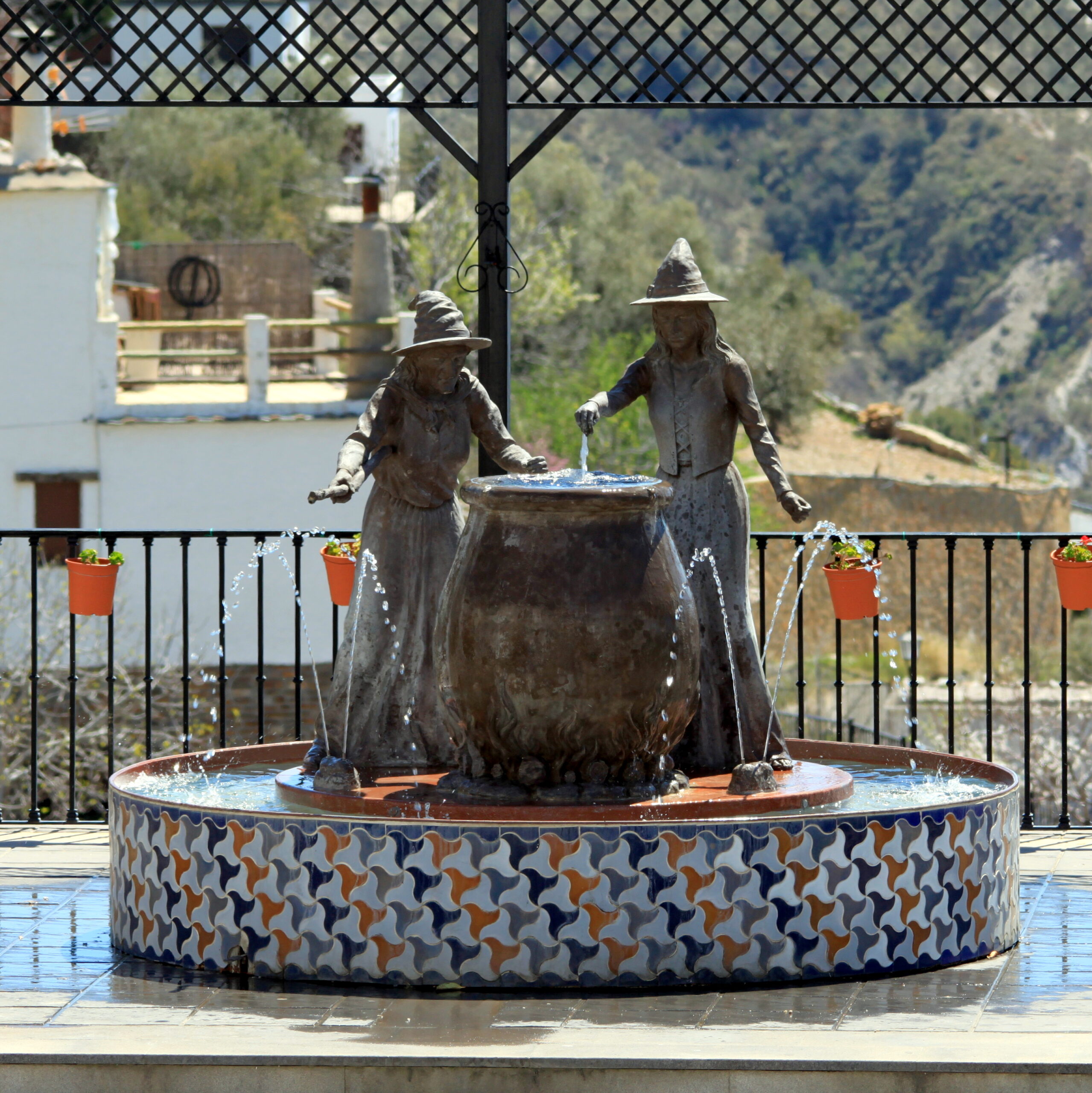
Today, people come to pose for photographs with the enormous sculpture of the Slavic witch Baba Yaga, or to stand at the Mirador del Embrujo, where a sculpture of two witches hunched over a cauldron commands sweeping views of the surrounding mountains.
But Soportujar is more than a village full of witch sculptures and folk mythology. Like the rest of the Alpujarras, it is known for its food. Dishes like Alpujarran stew and migas are fixtures on local menus: hearty, unpretentious, deeply satisfying. In winter, when the cold and wind descend on the sierra, this is exactly the kind of food you want. The weather, locals will tell you, is scarier than any witch.
The place can be unforgiving in the colder months, but few places in Andalusia are as quietly beautiful as this in spring or summer, when the snow retreats and the landscape softens.
Soportujar has understood something that many small villages have not: in an era of viral content and fierce competition for rural tourism, being the witches’ village is a genuine asset. Few places remain as authentic as this corner of the Alpujarra Granadina, where a handful of residents chose to embrace their legends rather than bury them, and turned the wicked witch into the most compelling ambassador their village could ask for.