

Since June 2024, there’s been a new way to take in the beauty of northwestern Argentina: the Tren Solar de la Quebrada.
The rail service connects six villages in the Quebrada de Humahuaca, in the province of Jujuy, along a 26-mile route powered by solar energy stored in lithium batteries. It comes in two options and follows a corridor that the region’s indigenous peoples have used for roughly 10,000 years.
What It Is and How It Works
The train runs along the former Ramal C del Ferrocarril Belgrano, a freight line that shut down in 1993.
The restoration took eight years and involved laying new track and rehabilitating the original stations, while preserving their historic architecture. It is the first service of its kind in South America and Argentina’s first panoramic train.
The cars, manufactured in China, seat 70 passengers in reclining chairs beneath wide windows designed for taking in the view.
The train moves at an average of about 20 miles per hour — a deliberately unhurried pace. The point is not to move people quickly between towns but to let the landscape unfold slowly.
Solar energy is captured and stored in lithium and nickel batteries, and the region gets roughly 300 sunny days a year, enough to keep the trains running without any fossil fuels.
The Route: Six Stations and 26 Miles
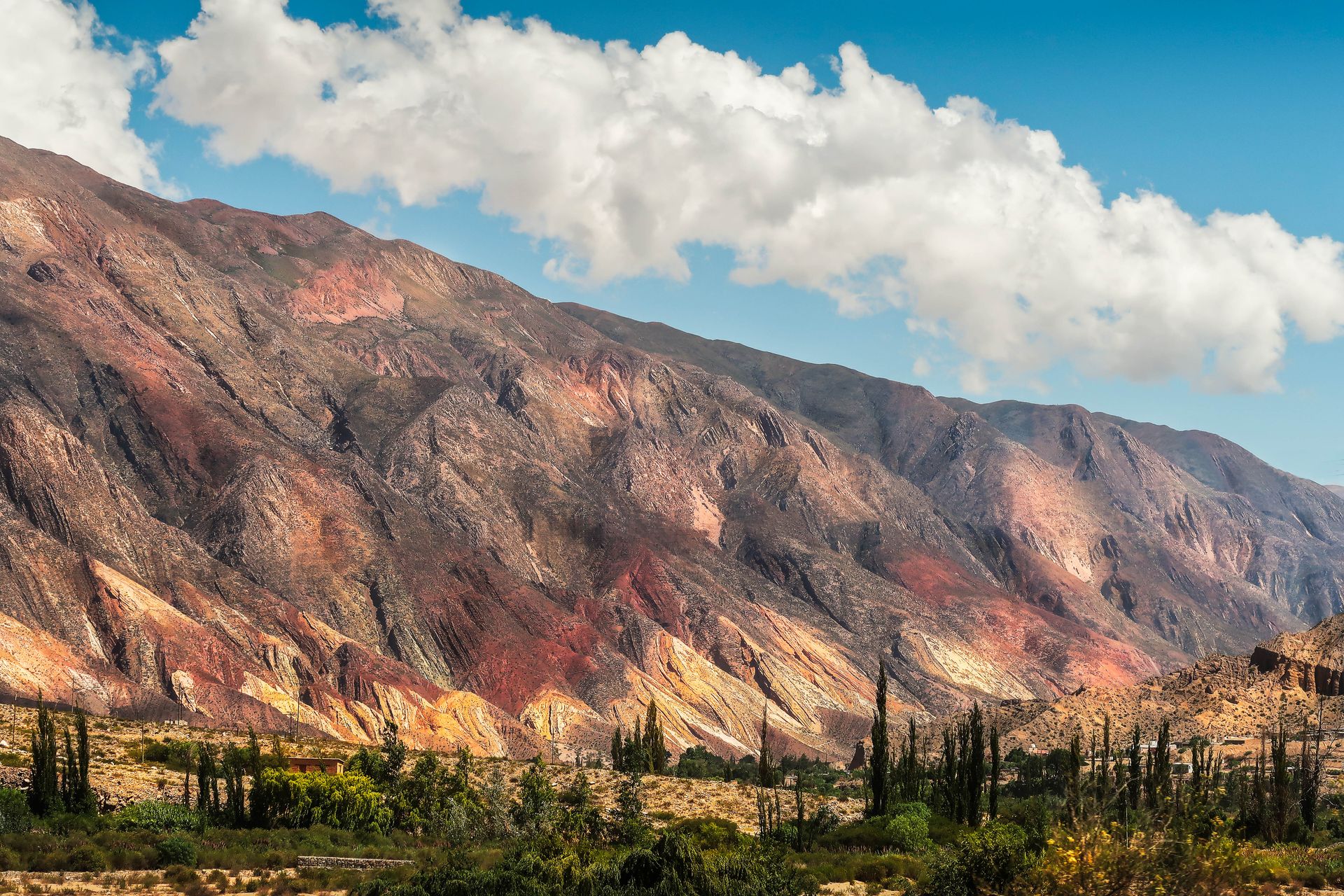
The circuit links Volcán, Tumbaya, Purmamarca, Hornillos, Maimará, and Tilcara along the Quebrada de Humahuaca, a UNESCO World Cultural and Natural Heritage Site.
Each stop has its own distinct character.
In Tumbaya, adobe buildings made with thousand-year-old techniques still stand. In Purmamarca, the route passes the Cerro de los Siete Colores and its artisan market.
In Hornillos, the old colonial way station (posta) is now a museum tracing how this valley has served as a travel corridor since roughly 9,000 B.C.
In Maimará, markets offer regional products and traditional food. The route ends in Tilcara, where the Pucará — a fortress more than 1,100 years old, built by the Omaguaca people — brings the journey to a fitting close.
The Two Ways to Travel
When the train departs, the horn sounds once. After that, the silence is almost total. With no combustion engine, the only sounds are the wind and, on some stretches, an onboard guide talking you through the history and culture of each area along the way.
At every station, local guides lead scheduled tours of the town’s main sights. Passengers who prefer to explore on their own are free to do so, as long as they return in time for the next departure.
The Experiencia 180° is the shorter option. It departs from Purmamarca, lasts about two and a half hours, and includes a 15-minute stop to have a coffee or simply take in the landscape before returning. It’s a good fit for travelers who want to ride the train without giving up a whole day.
The Experiencia 360° departs from Volcán and runs roughly ten hours from start to finish, though the actual time on board is about 90 minutes. The rest of the time is spread across the stops, with free time in each village to walk, visit museums, or eat something local. It’s a full-day journey, designed for those who want to take in all six stations without rushing.
How your day plays out depends on the package you book. Some Experiencia 360° packages include a minibus transfer from Jujuy or Salta to the Volcán station, adding road travel time before boarding.
Prices, Dates, Schedules, and Where to Buy Tickets
Tickets are available at the San Salvador de Jujuy box office, the provincial capital, located at General Belgrano 493, or through the official website.
There are separate rates for domestic tourists, international visitors, children under 12, retirees with a national ID, and residents of Jujuy province, who get the biggest discount.
Prices published in mid-2025 were around 50,000 pesos for the domestic rate and 75,000 pesos for foreign visitors, but Argentina’s inflation means those figures become outdated quickly — confirm current pricing on the official site before traveling.
The San Salvador de Jujuy ticket office is open Monday through Friday from 8 a.m. to 8 p.m. and on weekends from 9 a.m. to 5 p.m.
Getting there: from San Salvador de Jujuy or Salta, the starting point is the Volcán station. For those joining the route at Purmamarca, note that the station sits some distance from the village center, so you’ll usually need a remis — a hired car with a driver.
A Singular Journey Through the Quebrada de Humahuaca
The same 26 miles the train now covers in 90 minutes of actual travel time were, for most of the past 10,000 years, crossed on foot or by mule.
First by hunter-gatherers, then by Inca caravans and colonial merchants, and from 1948 onward by the diesel trains of the freight line that fell silent in 1993.
The solar train is the newest chapter in that same story.


