

Standing on the walkways above Garganta del Diablo—the Devil’s Throat—is an experience like no other. But the falls can be experienced in another way entirely, one that trades the aerial view for something far more immediate.
That’s where the Iguazu Falls boat tours come in.
This isn’t one experience but two distinct ones, each defined by which side of the border you’re on. On the Argentine side, the tour is called Gran Aventura. On the Brazilian side, it is Macuco Safari.
Both promise to take you right up to the base of the falls aboard an inflatable speedboat. But they differ in route, restrictions, and the kind of traveler each is designed for.
If you’re planning to see Iguazu from the water, here is what separates one from the other.
Gran Aventura, the More Extreme Option on the Argentine Side
Gran Aventura unfolds in three legs within Parque Nacional Iguazu: a 3.4-mile ride through the jungle in an open-top 4×4 truck, a segment aboard the park’s ecological train toward Garganta del Diablo, and finally the boat ride—a high-speed inflatable that powers upriver along the Iguazu.
The boat ride itself unfolds in two stages.
First, the craft comes within roughly 2,000 feet of the Garganta del Diablo canyon—the minimum distance authorities permit for safety—and pauses there long enough for photographs.
It then circles Isla San Martin and draws close to the Bosetti, Adán y Eva, Mbigua, and San Martin falls.
The moment that made this tour famous comes only in the final stretch: the boat heads directly beneath the curtain of water at the San Martin and Tres Mosqueteros falls, leaving every passenger completely soaked.
Time on the water lasts between 15 and 20 minutes, though the full experience—counting the 4×4 and train segments—can take up a good part of the day.
There are some restrictions: it is not open to very young children, pregnant women, or those with certain cardiac conditions.
Macuco Safari, the Brazilian Alternative for the Whole Family
Across the border, inside the Parque Nacional do Iguaçu, Macuco Safari follows a similar structure but with its own character.
The trip begins with a roughly 2-mile ride in an open-sided electric tram, followed by an optional 2,000-foot walk along a suspended trail where bilingual guides point out details of the local flora and fauna—orchids, bromeliads, the sounds of the forest.
The boat ride, lasting about 20 minutes, takes place in inflatable boats that approach the falls from the Brazilian side.
Here, a key distinction emerges: Macuco Safari typically offers a “dry” option, which stops about 65 feet from the falls without drenching passengers, and a “wet” option, which pushes all the way beneath the water curtain.
That flexibility, combined with the absence of age or health restrictions, makes this tour considerably more accessible—an obvious choice for families with young children or older adults who would not qualify for the Argentine version.
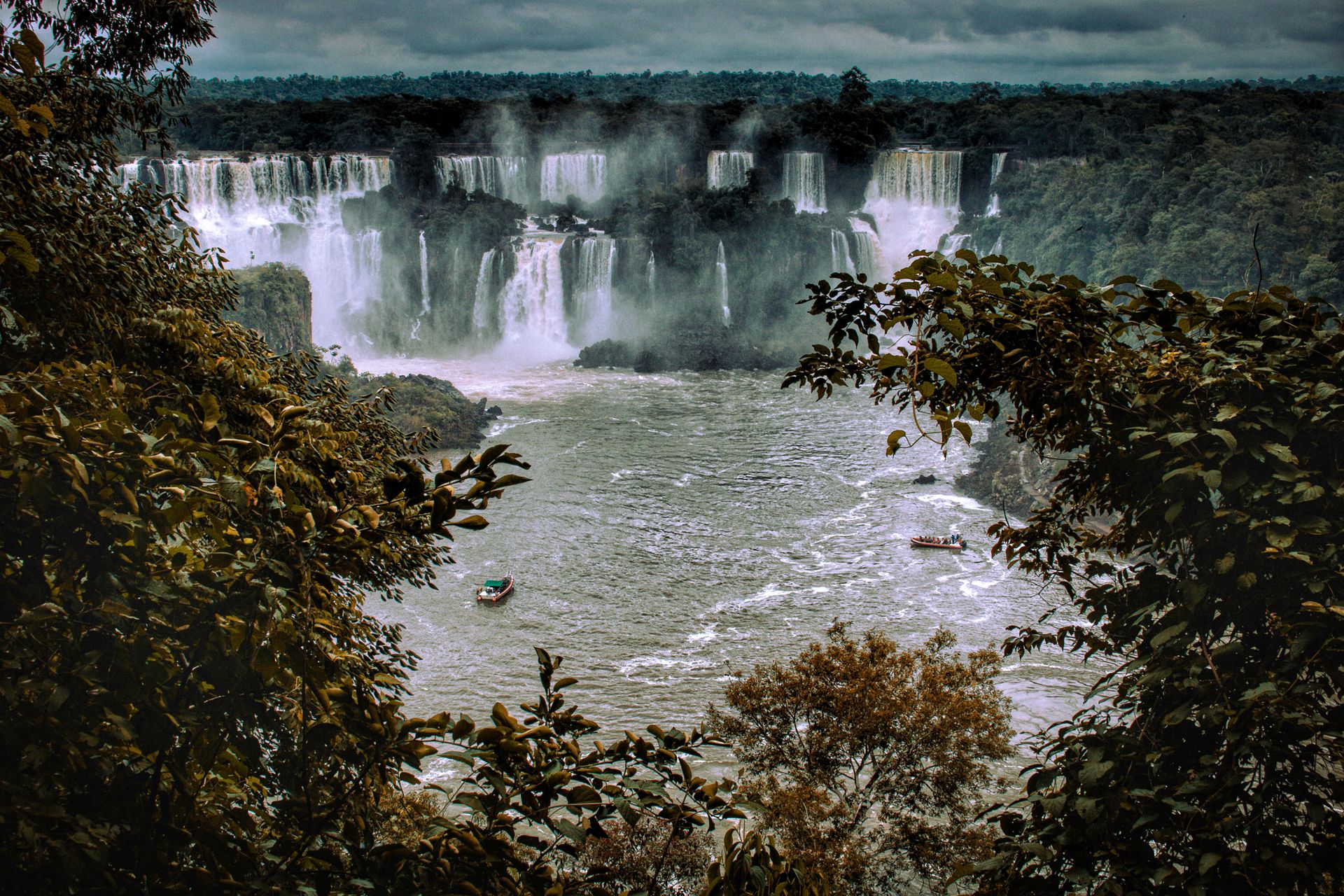
What Really Separates One Tour from the Other
Beyond the names, the essential difference is the vantage point each country offers on its own side of the falls.
From the Argentine side, the boat passes falls visible only from that bank—Bosetti and Adán y Eva among them—perspectives the Brazilian tour cannot offer.
Macuco Safari, by contrast, lets passengers choose how wet they get and bring the whole family along—neither of which Gran Aventura allows.
In terms of duration, both trips run between two and four hours when transfers from the hotel are included, with the boat ride itself lasting between 15 and 20 minutes in each case.
A Quieter Option: River Cruises Along the Paraná and the Triple Frontier
Not every boat trip in the area is built around adrenaline.
There are also gentler journeys along the Paraná and Iguazu rivers, designed for those who prefer to take in the landscape without getting wet.
These trips, lasting roughly an hour, move away from the falls canyon and head toward the point where the two rivers meet—the precise spot where the borders of Argentina, Brazil, and Paraguay converge.
Along the way, passengers can see the Puente de la Amistad, the bridge connecting Brazil and Paraguay, and the Monumento a las Tres Fronteras, as well as the late-afternoon sun shimmering across the water.
Larger vessels with climate-controlled cabins, a bar, and an onboard restaurant cover the same route in far greater comfort—an ideal way to cap off a full day spent exploring the falls’ walkways.
How to Choose
Travelers with enough time to spare often do both, one on each side of the border, since each reveals a different face of the same falls.
For those who can only choose one, the decision usually comes down to two practical factors: who’s in your group, since Macuco Safari accepts everyone without exception, and what kind of experience you’re after, since Gran Aventura offers a longer route with a greater variety of falls visible from the water.
Whichever you choose, pack lightweight, quick-dry clothing and a change of clothes. Both operators provide waterproof bags before the most intense part of the ride—don’t hesitate to use them for your camera and phone.



