In the south of Mendoza, a natural reserve is home to more than 800 volcanoes. Walking there is like traveling to Mars. Welcome to La Payunia.
When you arrive at La Payunia, after stopping at a welcome station with croissants and coffee, restrooms to freshen up, and the customary photo sign, the first sensation is of landing on another planet. No matter where you look, everything is volcano, ash, or snow. Reds, blacks, and whites contrast with a clear sky.
The volcanic cones rise everywhere like sentinels of that planet you are about to discover. There are no defined roads and much of the terrain can only be covered by vehicle.
You arrive, have breakfast, and then embark on exploring black, golden, and copper deserts, covered with snow in parts, even though it is already spring.
The feeling is of being on another planet or in another time.
The wind is intense.
When the tour ends, you sit down to eat at a natural shelter set up amid the stunning landscape.
This landscape in the town of Malargüe, in the province of Mendoza, Argentina, near Patagonia, features one of the largest concentrations of volcanoes in the world.
All of them ceased their activity several millennia ago. Some are considered active because specialized equipment can detect minimal activity, but they are not expected to erupt again.
A volcanic landscape
La Payunia is home to more than 800 volcanoes, an extraordinary number that transforms the landscape into an open-air geological museum, which is why it is a protected area. Some of its volcanoes, such as Payún Liso, reach heights of over 3,000 meters.
The Payún Matrú, standing at 3,750 meters high, has a semi-permanent lagoon fed by snowmelt.
The Santa María, which is smaller than the others, has one of the largest lava flows in the world. These flows are rivers of solidified lava. Its scale is comparable to the lava flows found on Mars.
The area known as Pampas Negras lies southwest of the Santa María volcano, a landscape dominated by craters, lava fragments, and a dark material that, at first glance, appears to be ash but is actually lapilli: black fragments, shiny in the sun, larger and denser.
Another black-tinted site is the Campo de Bombas, featuring circular formations known as volcanic bombs, which are bubbles of molten rock ejected by volcanoes when they were active.
They seem both post-apocalyptic and prehistoric.
Another common stop is the Volcán Morado: with a short walk and a gentle climb, you reach the crater. One side of its rim is open — a gap through which its own dark lava flow once spilled out. It is a spectacular natural viewpoint, offering a panoramic view of the rest of the park, with elevations visible everywhere. At times, it feels like standing at the very mouth of the Earth.
On the way back to the city, on an old stretch of Route 40, you reach La Pasarela. A wooden bridge connects two natural black walls formed by water erosion along a volcanic flow. The result is spectacular. A small, deep ravine where water flows persistently through the remnants of a volcanic past.
It’s not just the number of volcanoes but their density that leaves an impression: the average of 10.6 volcanoes per 100 km² contributes to the sense that, when you’re there, everything around you is a volcano or the trace of its activity.
Marine fossils in the middle of the mountain
Millions of years ago, this region was part of the ocean floor. Therefore, before entering the most volcanically active areas, when you stop for breakfast with tour guides and other visitors, you can see layers of marine fossils in the rocks: snails, shells, and wavy shapes that were once water creatures.
The contrast between the sea’s presence and the subsequent volcanic fury is striking. Mendoza is not near the sea, but rather next to the Andes Mountains.
In a single journey, the visitor can see the marks of fire and water, of the underwater abyss, and the explosion of lava. All this, in an environment that today seems deserted, dry.
The experience feels like inhabiting all eras at once: the ancient sea that no longer exists, the dormant volcanoes that bear witness to the passage of time, and the living flora and fauna — all within a landscape that makes you feel part of something immense: the history of the Earth.
What remains alive in La Payunia: flora and fauna
Although the landscape is desert-like and seems set in another era, you can still see plants and animals among the rocks, as well as scattered traces of volcanic activity. There are, among other plants, grasslands, patches of rushes, several types of jarilla, cactus, and yellowwood, which appear among the stones as a living reminder that the landscape is not static.
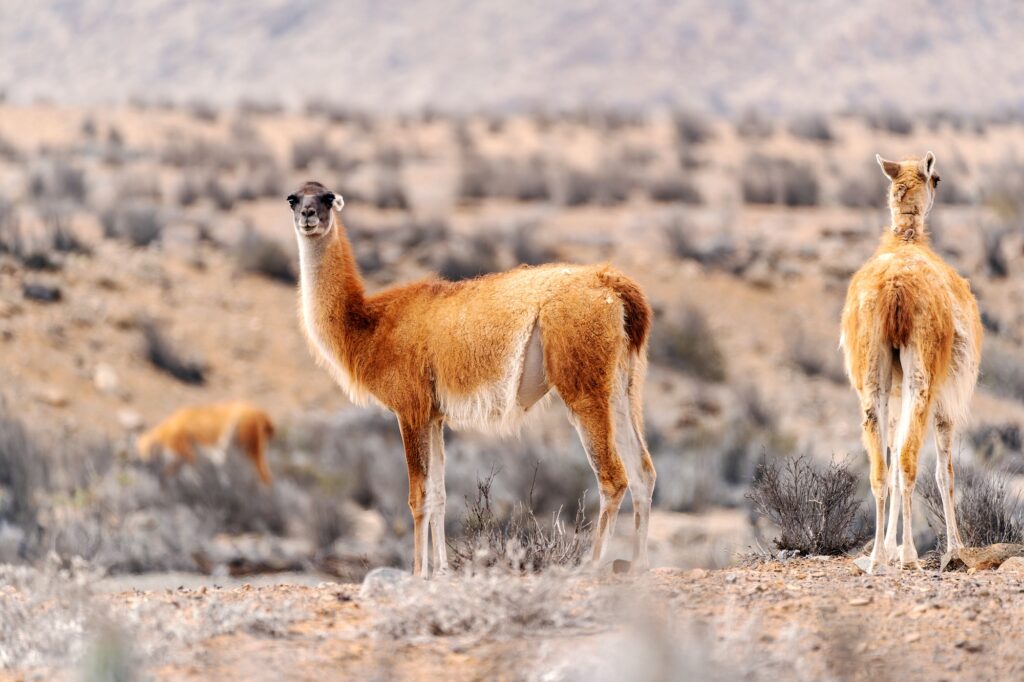
As for wildlife, the most commonly spotted are small groups of guanacos. It’s logical because there are more than fourteen thousand in the area, making it one of the largest guanaco populations in Argentina. There are also gray and red foxes, hares, several types of birds, even rheas and lizards. There are pumas too, but it is rare for a visitor to see one.
La Payunia today: magic, science, and controlled tourism
Declared a provincial reserve and proposed for UNESCO World Heritage Site status, La Payunia is a natural treasure carefully protected. Entry is permitted only with authorized guides, in specially designed vehicles, and along circuits designed to minimize environmental damage.
Visitors experience something unique: walking on ashes, touching solidified lava, contemplating the snow settled on the black ash blanketing the ground and forming ridges, and observing the fauna moving among volcanic cones.
A journey to another world
If you’re planning to visit La Payunia, we recommend stopping in Malargüe, which is beautiful in its own right, with tree-lined avenues, a culinary and cultural scene, and a wealth of tourist attractions.
Many of these relate to volcanoes, but also include excursions to the snow and other geological formations, an astronomical observatory, a volcano named Malacara that can be explored from the inside, caves, cinemas, and activities for all tastes.
In a country like Argentina, full of diverse landscapes, La Payunia stands out for its uniqueness. It is unlike anything else, not even other volcanic regions. It is a place that reframes the scale of things: you feel small in the face of evidence of geological processes.
The tour of La Payunia is a lesson in humility, natural history, and harsh beauty. It is indeed like another world. But here.