
A long layover or a brief stop on a Spanish road trip—either one is reason enough to spend a day in Madrid.
The Spanish capital doesn’t give itself up to those just checking off monuments. It reveals itself to those willing to feel its rhythm. With only a few hours to spare, the move isn’t to spend them inside the Reina Sofía or the Prado—unless museums are your thing.
The key to Madrid in a day is walking its streets and sensing the contrast between an imperial capital and an intimate, human-scale city. This itinerary is designed for exactly that.
First Stop: Palacio Real and the Catedral de la Almudena
The day begins in the Palacio neighborhood, within the Centro district. This is Madrid at its most regal, with the city looking out over the Manzanares valley.
From central landmarks like Puerta del Sol or Gran Via, the best way to arrive is on foot—a 10- to 12-minute walk down Calle Arenal or Calle Mayor. Coming from farther away, Metro Opera (Lines 2 and 5) drops you less than a five-minute walk from Plaza de Oriente.
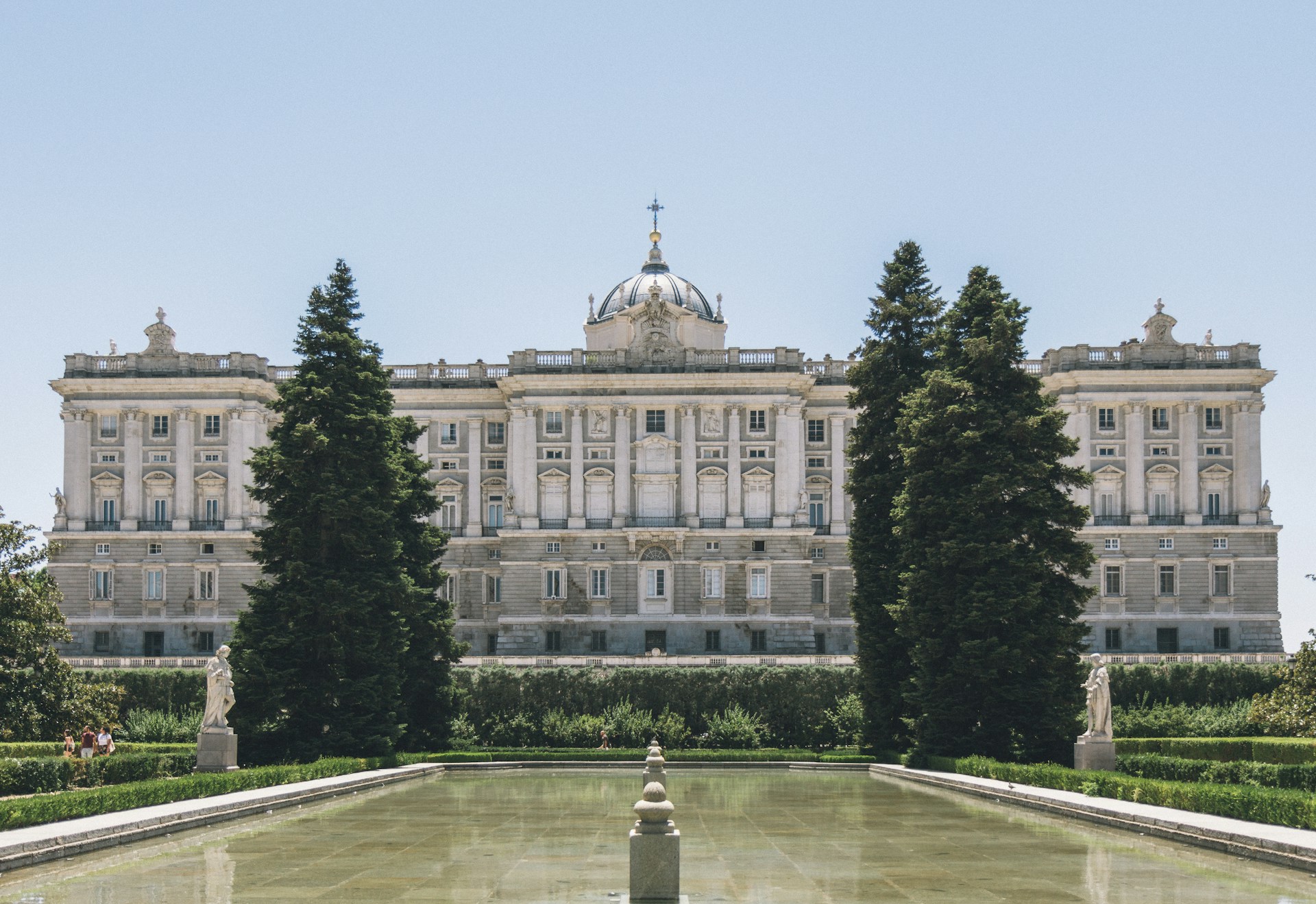
The Palacio Real de Madrid is a colossus of more than 3,000 rooms. For a quick visit, the smartest move is to appreciate the sheer scale of the building from the Plaza de la Armeria, the open esplanade between the palace and the cathedral.
For a quieter—and free—view, the Jardines de Sabatini on the north side offer an excellent vantage point, the palace’s white Colmenar stone mirrored in the garden’s reflecting pools.
Directly across from the palace stands the Catedral de la Almudena, a cathedral that defies expectations of Gothic architecture. Completed in 1993, its interior surprises with vivid color and boldly contemporary stained glass.
Do You Need to Book the Cathedral in Advance?
Unlike the Palacio Real, where online reservations are required to avoid a long wait, the Catedral de la Almudena requires no advance booking.
Entry to the cathedral is free, though a suggested donation of about $1 is appreciated for upkeep. If you want to climb the dome for a 360-degree view of the city or visit the Cathedral Museum, tickets — around $7— are available at the museum box office.
The Historic Heart of Madrid
A few steps from the Palacio Real, the streets narrow and the buildings close in around you. The grand Bourbon-era stonework gives way to a pocket of the Palacio neighborhood where Madrid still follows its 16th- and 17th-century street plan.
Heading down Calle Mayor, the first essential stop is the Plaza de la Villa. The square is ringed by centuries of history: the Torre de los Lujanes (15th-century Mudéjar-style), the Casa de la Villa (the former city hall), and the Casa de Cisneros.
It is a quiet, unhurried space—a welcome breather before stepping into the commercial bustle ahead.
The most atmospheric way to enter the Plaza Mayor along this route is through the Arco de Cuchilleros. Step through it, and the contrast in scale hits you immediately.
If hunger strikes, this arcaded square is the place to join the Madrid tradition of a bocadillo de calamares—a fried squid sandwich—at one of the portico bars. If time is short, a quick stroll around the square to admire the frescoes on the Casa de la Panadería is more than enough.
On the Way to Puerta del Sol
Leaving through Calle de Postas, you arrive directly at the famous Puerta del Sol, where historic Madrid gives way to the modern city. The square is one of the city’s great gathering points, home to three landmarks that every visitor ends up finding.
There’s the Statue of the Bear and the Strawberry Tree, the city’s heraldic symbol; the Casa de Correos clock, whose chimes ring in the New Year across Spain; and perhaps the most iconic marker in the country: Kilometer Zero, the point from which all of Spain’s national highways are measured.
From here, the tangle of alleyways opens up to the grandeur of the Paseo del Prado—Madrid at its most cosmopolitan, along a corridor recently designated a UNESCO World Heritage Site under the name Paisaje de la Luz, or Landscape of Light.
Madrid’s Grand Architecture and Green Spaces
Walking along Calle de Alcalá from Sol, you’ll notice the architecture growing steadily more imposing. Within ten minutes, the Metropolis building looms into view, with the Plaza de Cibeles just beyond.
The Palacio de Cibeles, now the city hall, is one of Madrid’s most beautiful buildings. If time allows, the rooftop terrace on the eighth floor—admission around $3—offers one of the best views of the Gran Vía and Calle Alcalá intersection.
Continuing up Alcalá—barely a quarter of a mile—you reach one of the old royal gates that once marked the entrance to the city.
The Puerta de Alcalá serves as a natural gateway to the Parque del Retiro, Madrid’s beloved park and the perfect way to end any short tour of the city.
After the intensity of the walk, this 309-acre historic garden is a welcome respite. Inside stands the photogenic Palacio de Cristal, its iron-and-glass structure mirrored in the lake—one of Madrid’s most quietly beautiful sights.
If you still have energy, the monument to Alfonso XII at the Estanque Grande is worth the short walk. This is where locals gather at dusk—a fine spot to rest a while before heading to your hotel or back to the airport.

Strategic Places to Stay in Madrid
For a short visit, the right hotel is as much a logistical decision as it is a question of style. Here are two options that combine character with an unbeatable location:
- Palacio de los Duques Gran Meliá: Set in the heart of the Palacio neighborhood, it’s ideal if you want to start and end your day in Madrid’s most historic area.
- Only YOU Hotel Atocha: Right across from Atocha Station, you can reach the airport in 20 minutes on the C1 commuter train, or jump onto Spain’s high-speed rail network in five minutes.
Madrid, unlike most capitals, never quite lets you go. It simply pauses—until next time.