
Every year, photographer and astrophotographer Dan Zafra gathers the 25 most extraordinary images of the Milky Way captured around the world over the past twelve months.
In 2026, the ninth annual Milky Way Photographer of the Year, organized by Capture the Atlas, featured a selection spanning five continents — from Argentina’s Puna to the fjords of New Zealand, from Chile’s Atacama Desert to Poland’s Tatra Mountains and the cliffs of the French Riviera.
What sets this collection apart from a typical night-photography contest is its selection criteria: Zafra prioritizes the distinctiveness of each location, the story behind each shot, technical quality, composition, and above all, authenticity.
Images must show the Milky Way and the foreground captured in the same place at the same time — no composite skies borrowed from other locations or nights. The result is a visual archive that, beyond its aesthetic value, documents precisely which dark skies remain on the planet.
Here are 25 photographs that reveal the beauty of our night skies, taken from some of the most remote corners of the planet.
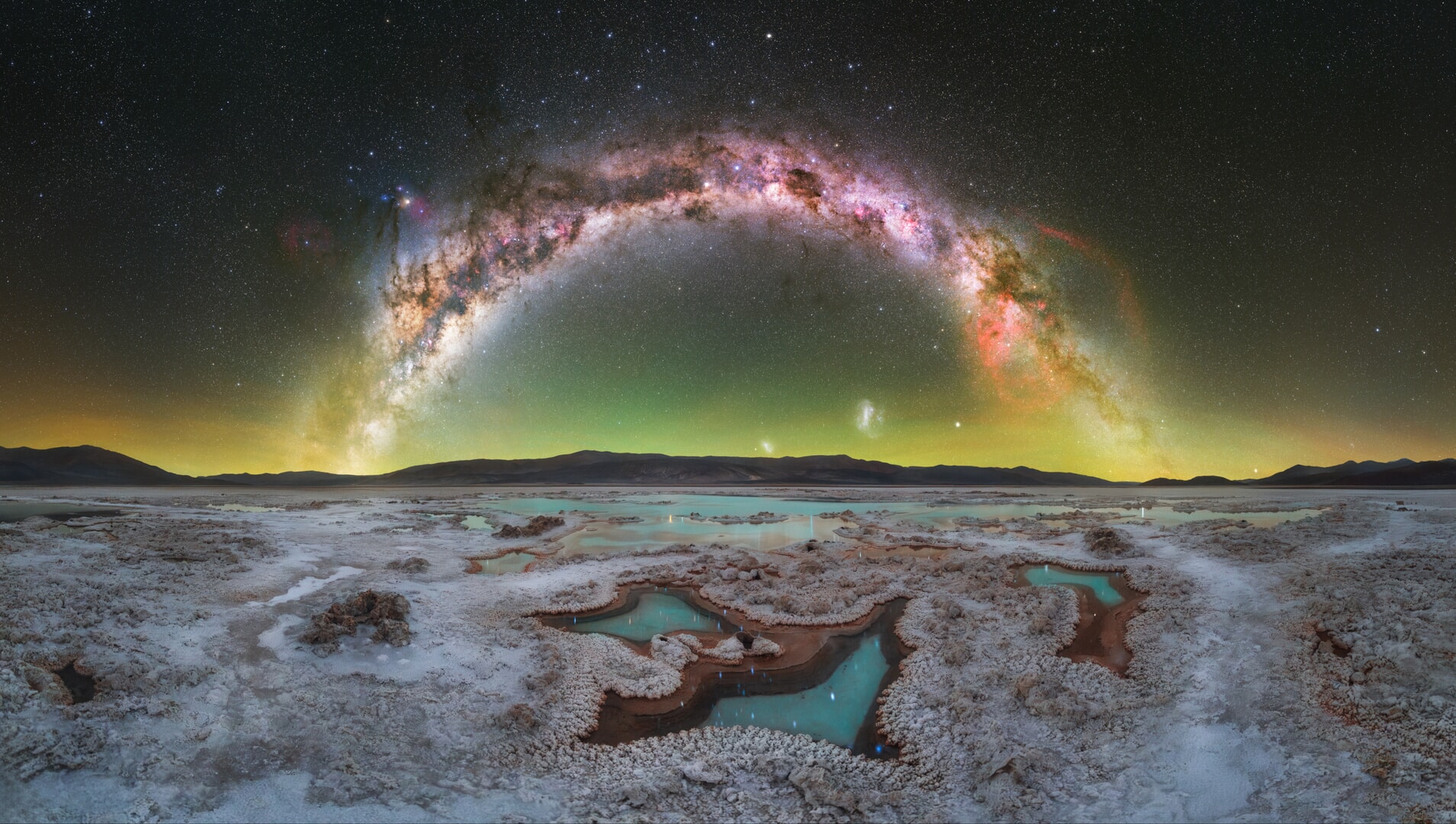
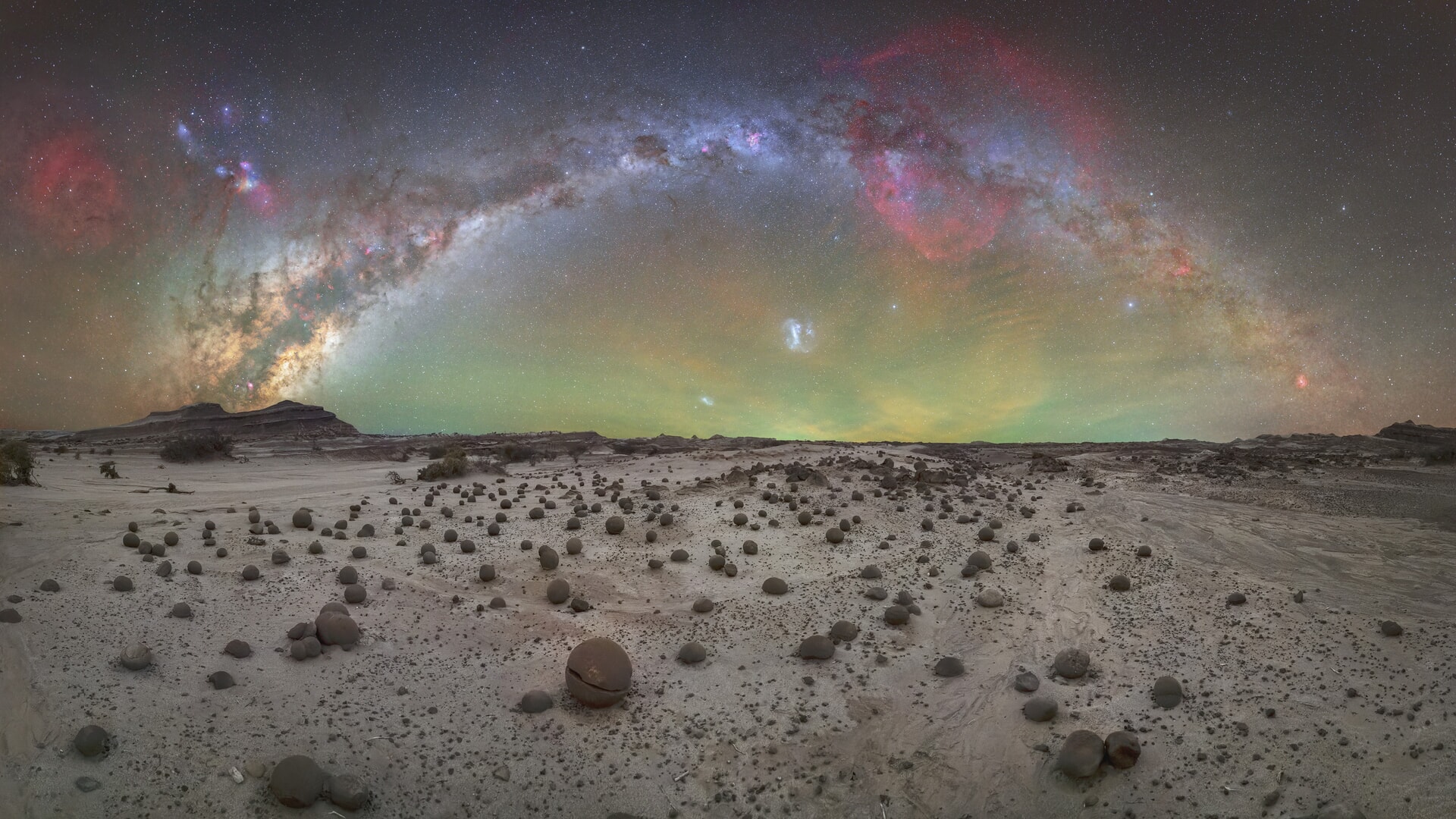
1. “My Perfect Night” — Daniel Viñé García | Catamarca, Argentina
The Puna of Catamarca has some of the most spectacular night skies on the planet. To reach the salt flat where this image was taken, Viñé García had to drive down dirt roads accessible only to four-wheel-drive vehicles.
Antofalla, a village of just 60 residents, is the nearest settlement to the salt flat. At elevations between 11,500 and 13,100 feet, the complete absence of light pollution allowed him to capture the full galactic arc: the center of the galaxy to the left and the Gum Nebula to the right.
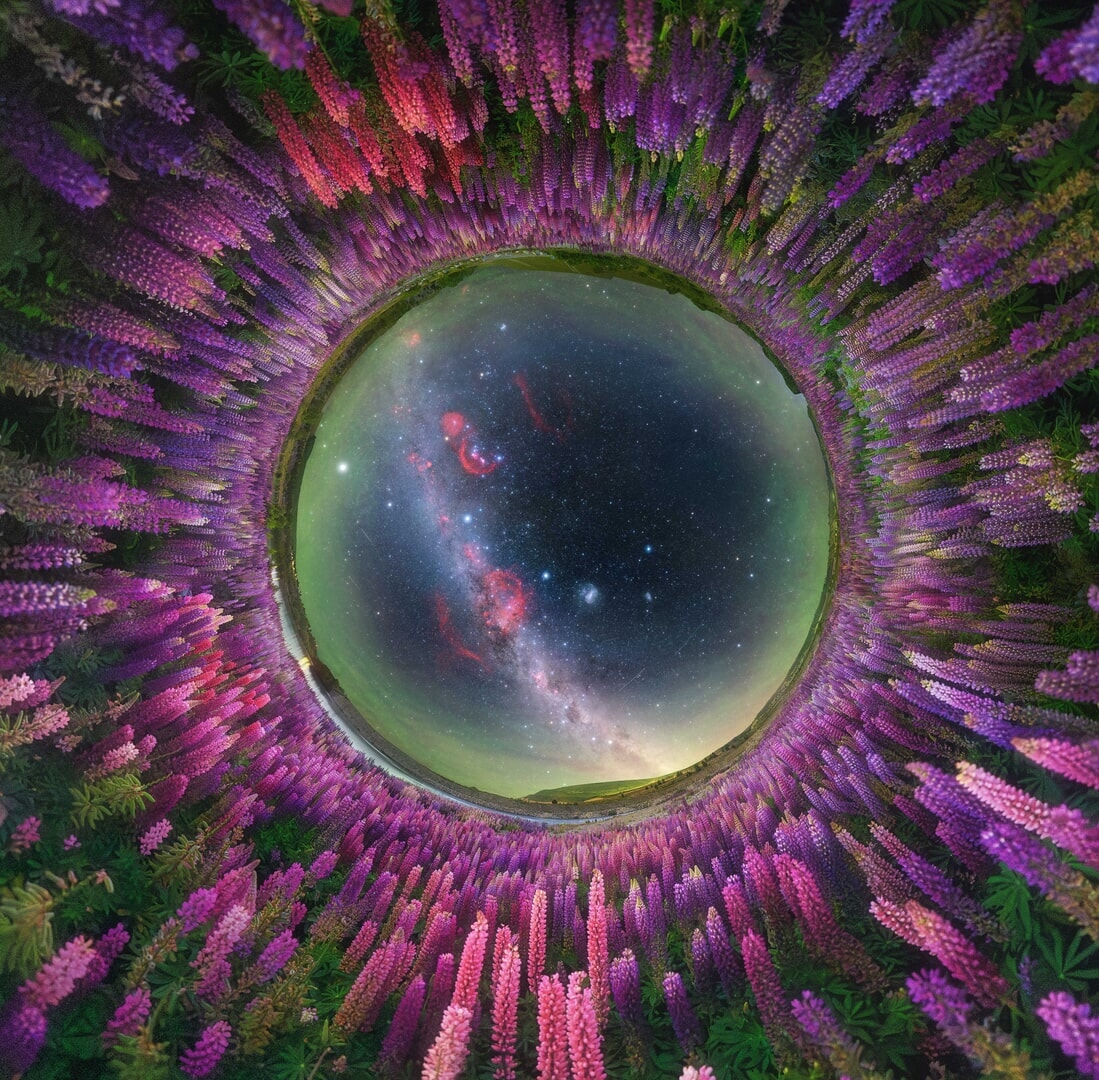
2. “The Milky Way Over a Field of Lupines” — Alvin Wu | Twizel, New Zealand
In November, as New Zealand moves into spring, lupine fields flood the landscape with color — a backdrop Wu used to frame the night sky.
Shooting with a fisheye lens, the flowers encircle the scene and draw the eye upward into the celestial sphere. The result is one of the most balanced images in the selection: earth and sky in direct tension, with nothing wasted.
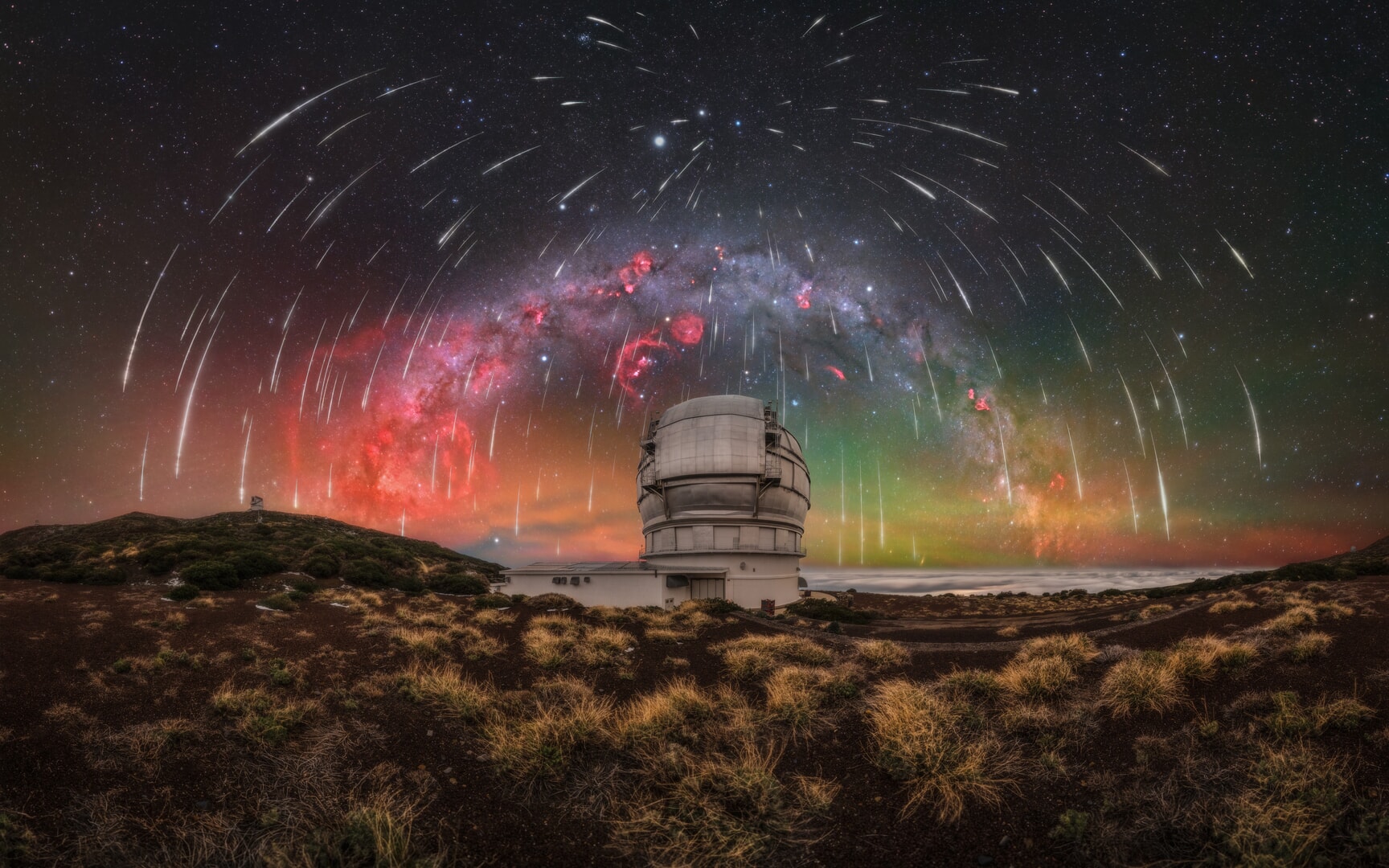
3. “Geminid Symphony Over La Palma’s Guardian of the Sky” — Uroš Fink | La Palma, Canary Islands
Here, the Gran Telescopio Canarias — the largest optical telescope in the world — is surrounded by Geminid meteors and the winter Milky Way.
Fink reached the Roque de los Muchachos Observatory after being stranded at the summit by several days of storms and snow. The final image combines data recorded with six cameras over five nights and comes to roughly 400 megapixels.
The dome had stayed closed due to humidity, but the sky that cleared just after midnight made the wait worthwhile.
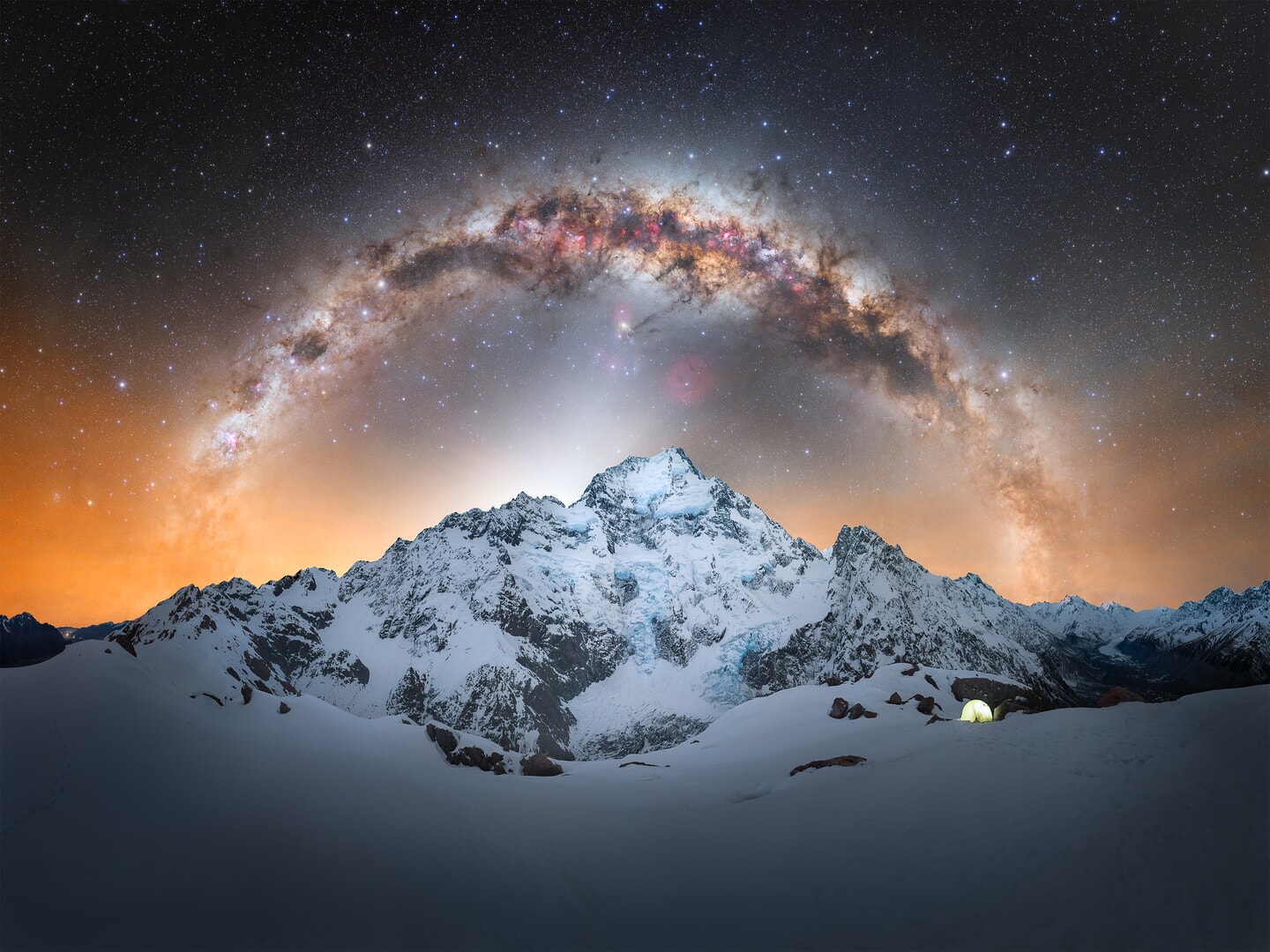
4. “Aoraki Mt Cook” — Owain Scullion | Aoraki/Mt Cook National Park, New Zealand
Reaching the shooting location required climbing rocky terrain and snow-covered slopes in winter conditions, with significant rockfall and sun-softened snow.
Scullion, an alpinist as well as a photographer, waited for the western arc of the Milky Way to align above Aoraki. The cold, stable air at that altitude also revealed the zodiacal light with exceptional clarity. He had only a brief window to capture the scene.
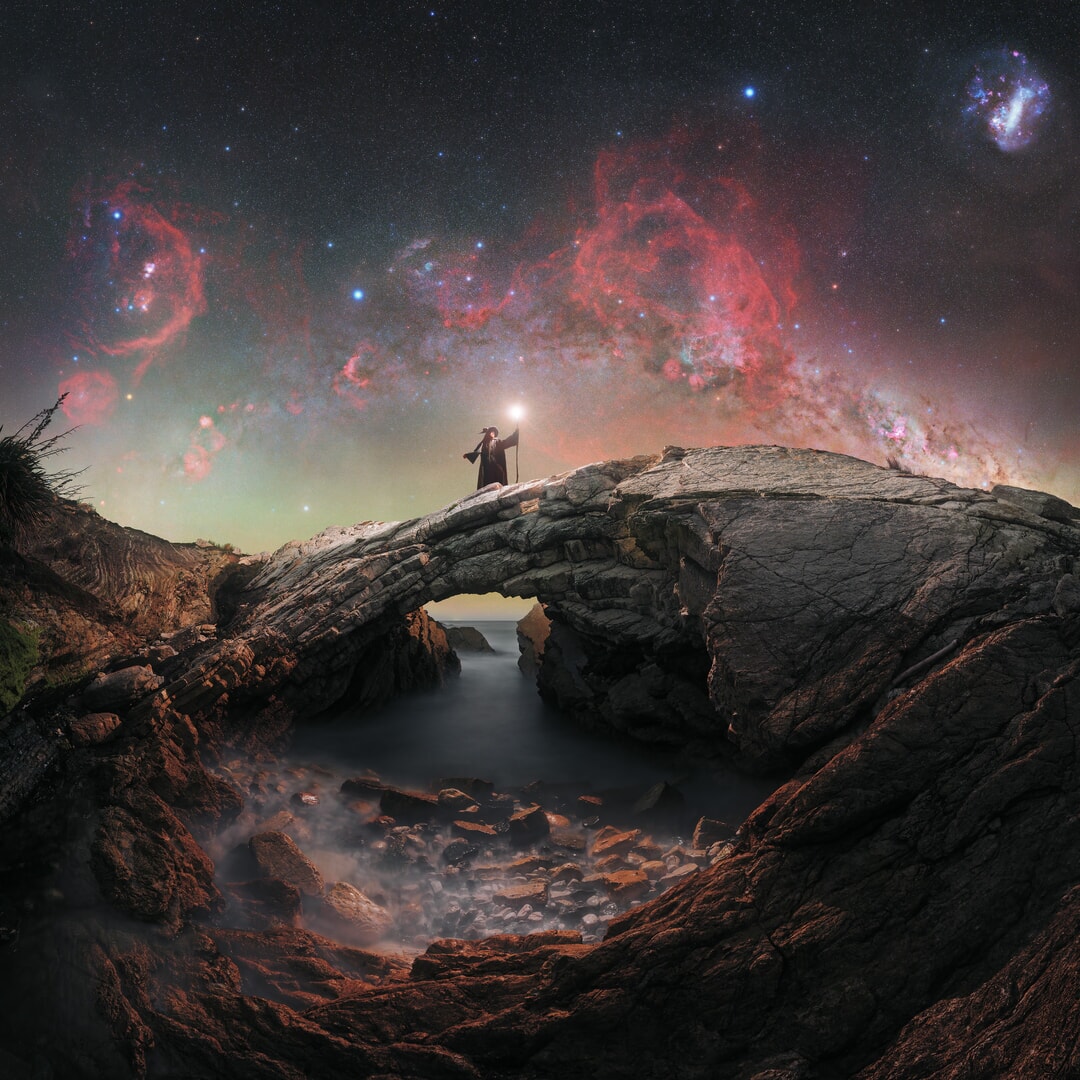
5. “Galactic Gandalf” — Evan McKay | Wairarapa Coast, New Zealand
McKay had planned to set up his tripod at a specific spot along this rocky coastline when he discovered that a fur seal had claimed it and had no intention of moving. The animal eventually shifted slightly but remained in the frame throughout the entire shoot.
The seal is still there in the final image, for those who look carefully. Work on this panorama stretched across several weeks, starting in November, with McKay returning each time conditions allowed.
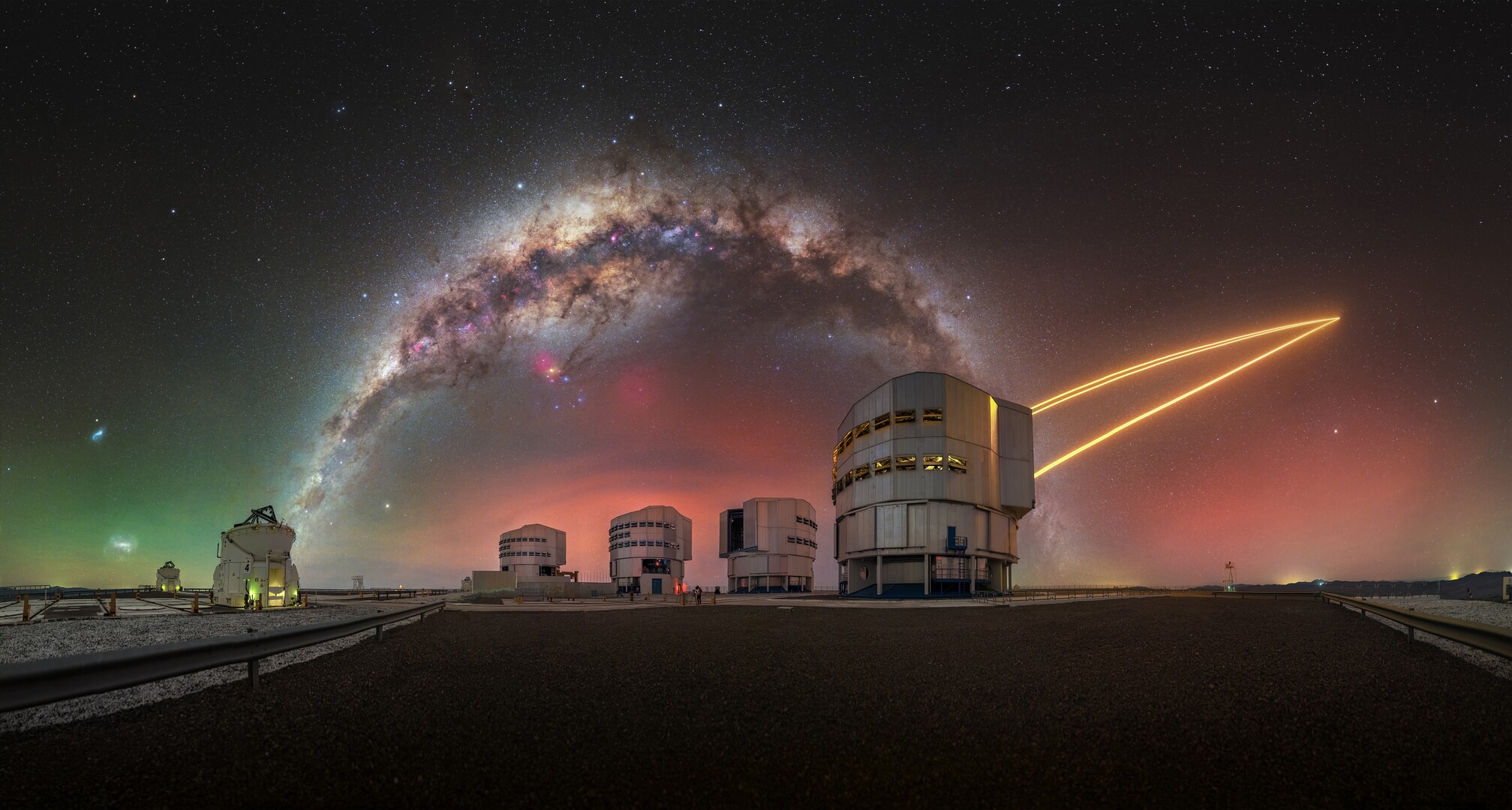
6. “Sodium Milky Way” — Julien Looten | Very Large Telescope, Paranal, Chile
From an elevation of 8,645 feet on Cerro Paranal, in the Atacama Desert, the European Southern Observatory’s Very Large Telescope projects four sodium laser beams into the sky, creating artificial guide stars at roughly 56 miles altitude.
These guide stars allow adaptive optics systems to correct atmospheric distortion in real time. Looten captured a nearly 360-degree panorama — 85 exposures — in which the Milky Way unfolds above the four main telescopes, with the Magellanic Clouds visible to the naked eye in the south. Atmospheric luminescence (airglow) tints the horizon green and red.
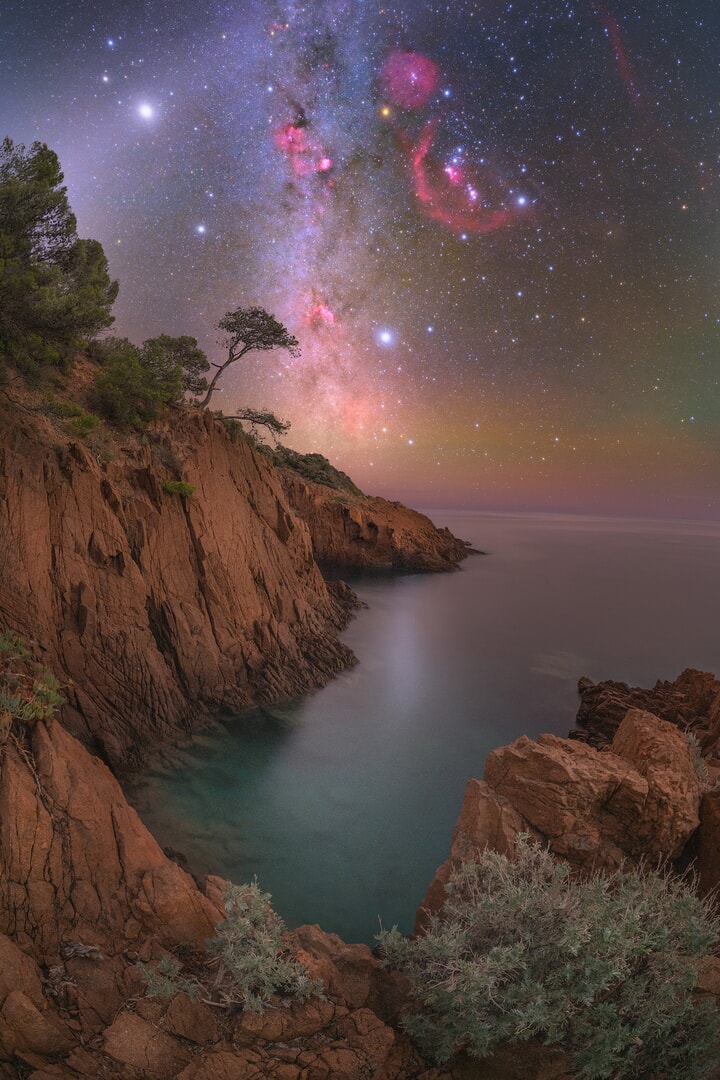
7. “Celestial Light Over Sea Cliffs” — Anthony Lopez | Saint-Raphaël, Côte d’Azur, France
The winter constellations feel different from summer constellations: the air is colder, the silence deeper, and Orion dominates the horizon with a presence the warmer months can’t match.
Lopez captured this image on the sea cliffs near his home in southern France, combining stacked exposures with H-alpha data to draw out as much detail as possible from the nebulae. The deep blue of the winter sky and the texture of the rock contrast with a light that feels almost crystalline.
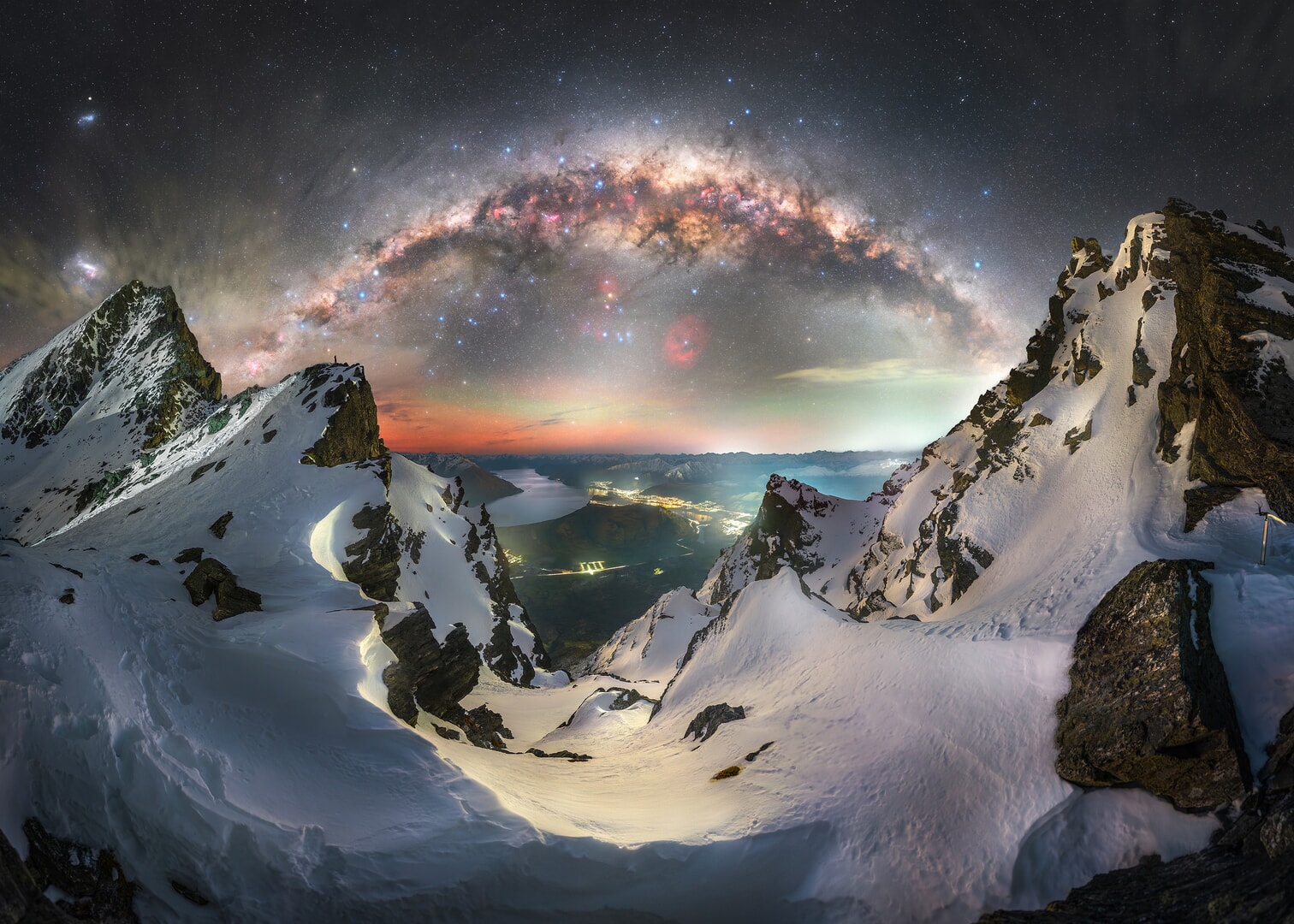
8. “Night at the Remarkables” — Tom Rae | The Remarkables, Queenstown, New Zealand
The winter arc of the Milky Way arches over the Southern Alps while the lights of Queenstown glow far below.
For Rae, that wash of urban light is also a reminder: most of the people sleeping under those glowing rooftops have never seen a sky like the one in this photograph. Reaching the shooting location meant climbing snow and ice, enduring hours of wind and extreme cold, and sleeping on the mountain until dawn. The outcome, he says, remained uncertain for days after the shoot.
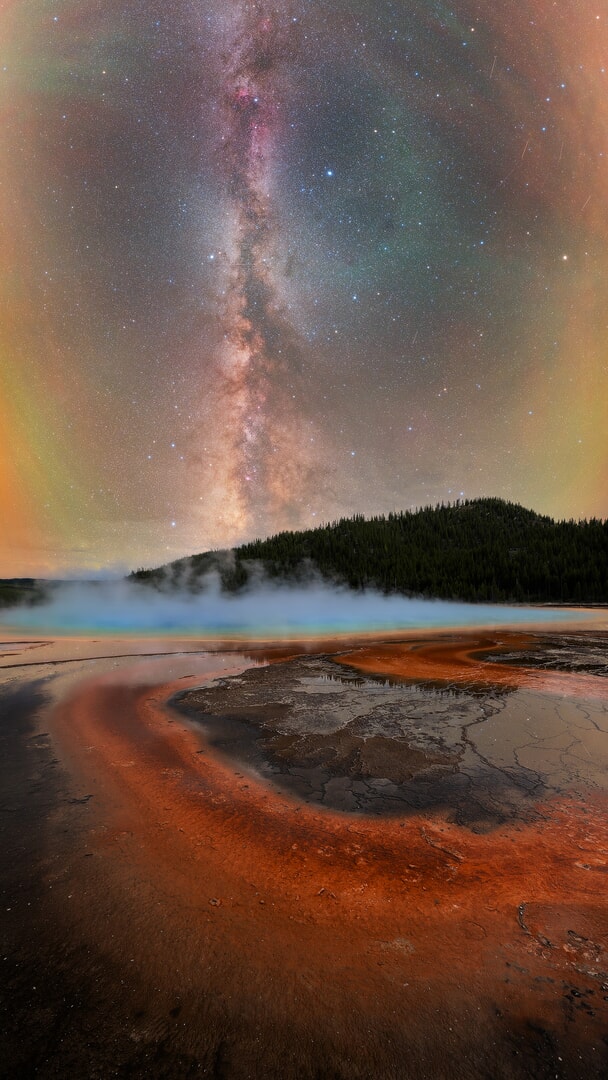
9. “Firewater” — Baillie Farley | Grand Prismatic Spring, Yellowstone, U.S.
Steam from the Grand Prismatic Spring at Yellowstone hid and revealed the stars within seconds. Farley timed the lulls between wind shifts to catch the precise moment when the Milky Way appeared above one of the most intense geothermal landscapes on Earth.
A strong airglow adds depth to the sky. The image captures the brief instant when Earth’s geothermal energy and the vastness of space meet in a single frame.
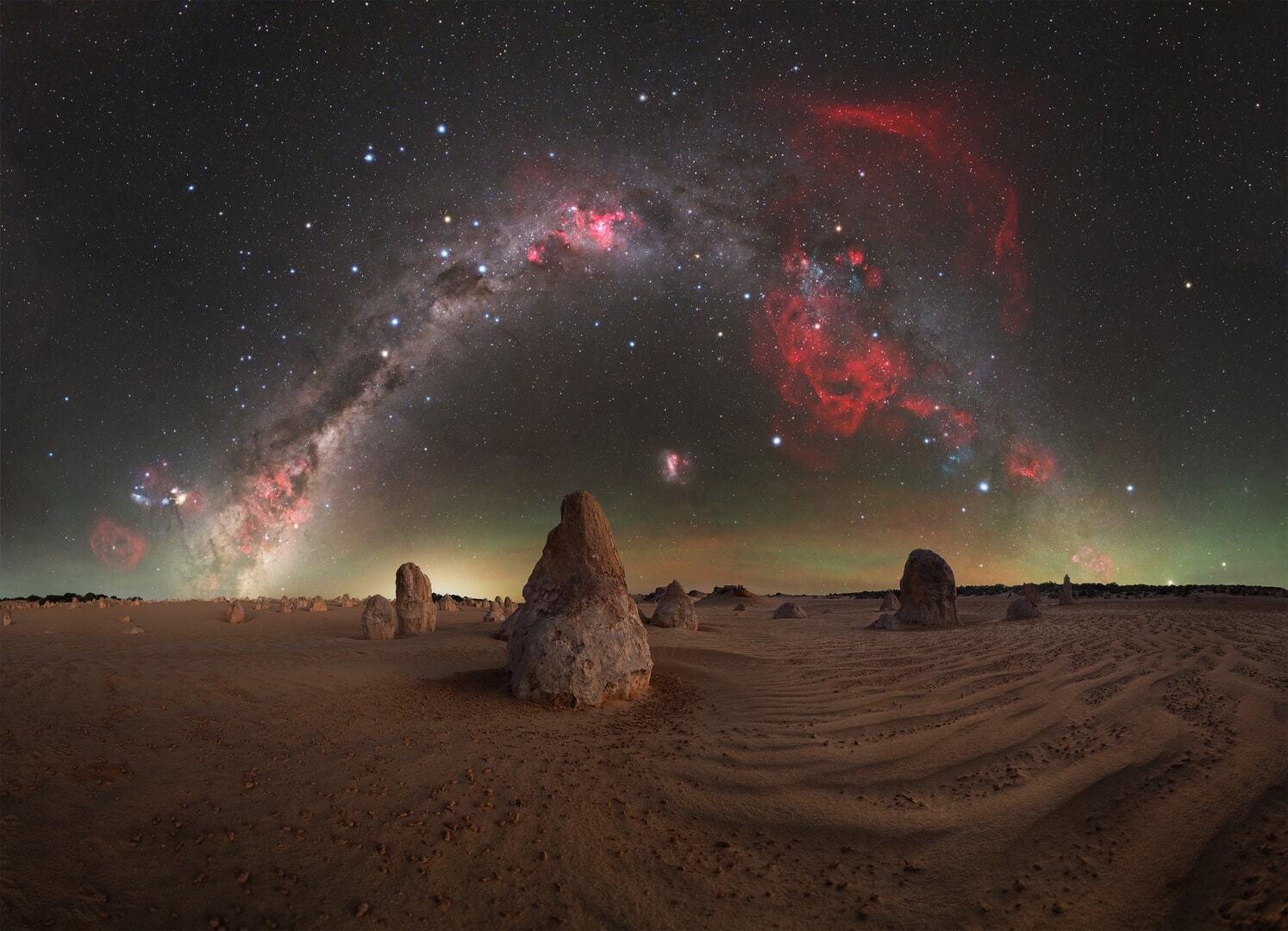
10. “Lost in the Ripples of Space and Time” — Leonel Padrón | Pinnacles Desert, Western Australia
As the sun sinks into the Indian Ocean, the Pinnacles Desert settles into a stillness that Padrón describes as almost extraterrestrial.
The main limestone pillar aligns with the South Celestial Pole, anchoring the composition beneath the rotating sky. To the right, the reddish glow of the Gum Nebula — a supernova remnant — adds scale and deep time to the scene.
Western Australia offers some of the finest night skies in the world, yet it remains largely overlooked by international astrophotographers.
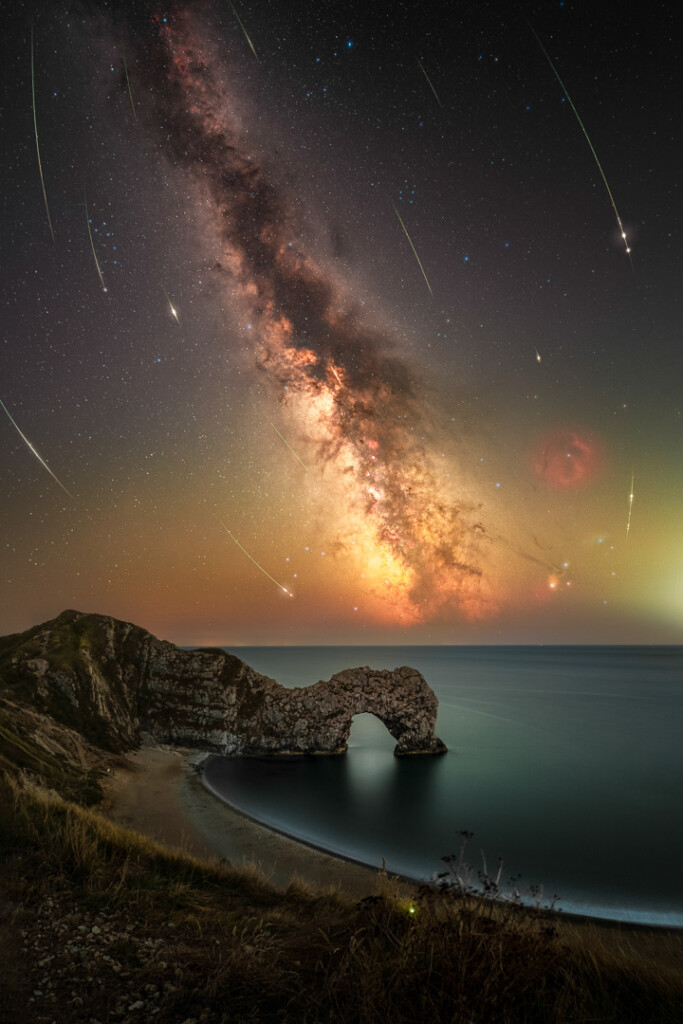
11. “Perseid Meteors Over Durdle Door” — Josh Dury | Jurassic Coast, Dorset, England
Debris from Comet Swift-Tuttle streaked through the atmosphere above the natural limestone arch of Durdle Door during the Perseid meteor shower.
Dury composited 14 confirmed meteors into a single wide-angle image, with a solitary glowworm in the foreground among the reeds at the cliff’s edge.
The photographer also used the image to highlight a growing concern: iconic World Heritage sites are drawing more and more astrophotographers, and preserving the local ecology — using red-filtered lights, respecting restricted areas — matters as much as technique.
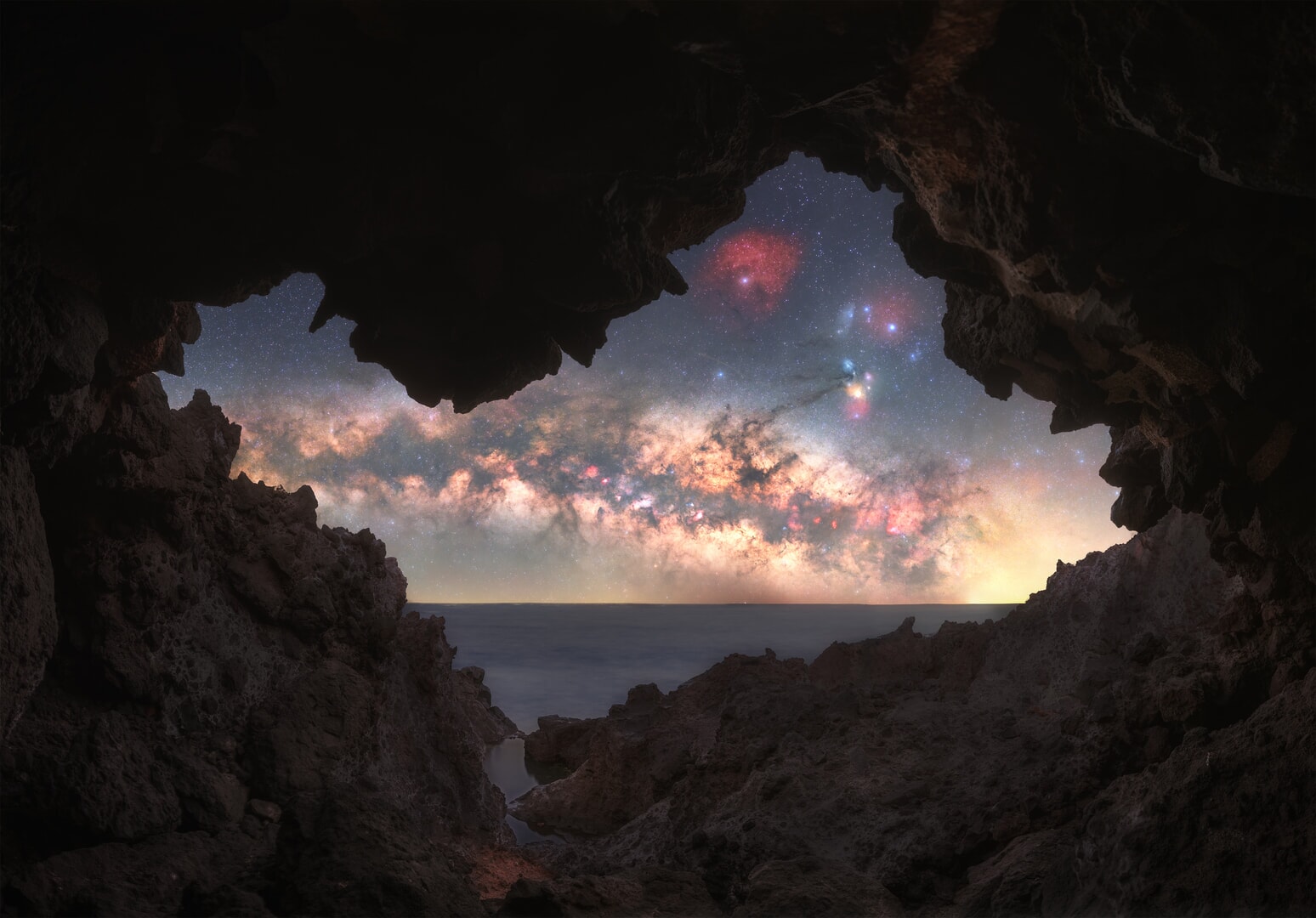
12. “Galaxy on the Rise” — Anastasia Gulova | Tenerife, Canary Islands
Gulova spent nearly four hours scouting this cave, which is only minutes from the parking area. Intense heat and strong wind made getting through the rocks difficult. Once inside, properly lighting the upper section of the ceiling and blending focus across multiple planes — upper arch, horizon, foreground — required painstaking work in near-total darkness.
The Milky Way appears low on the horizon, which required extra effort in both shooting and processing to bring out its color and detail.
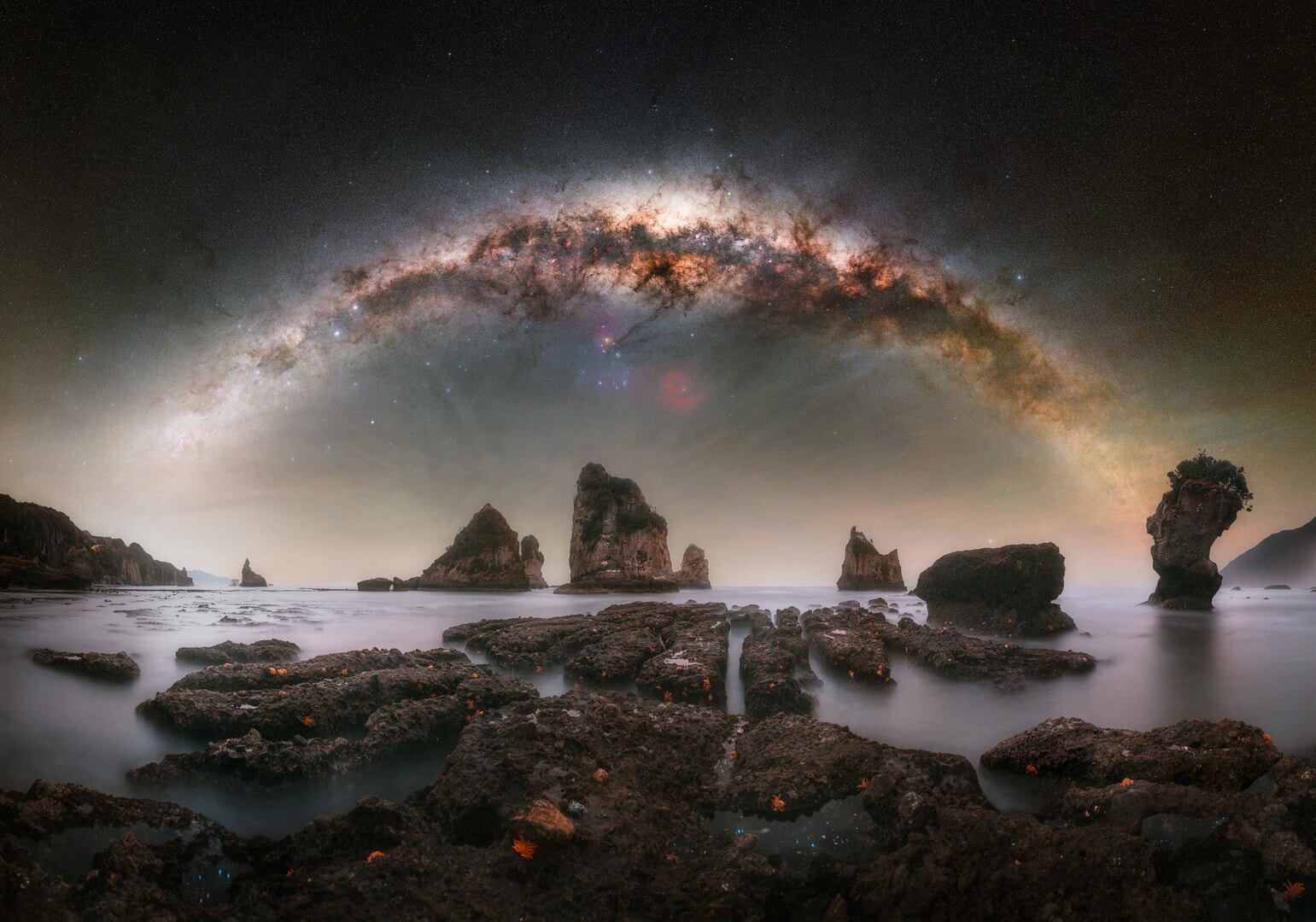
13. “Divinity” — Kavan Chay | West Coast, New Zealand
The starfish-covered reef that anchors the foreground of this image is accessible only during the lowest tides of the year, and even then, the timing must coincide with the right moon phase and clear skies.
On Chay’s visit, everything aligned. The problem was the rising tide: while capturing the upper rows of the panorama from the beach, the lower row had to be shot from the reef itself, with the water steadily rising and the gaps between rocks a constant hazard. He made it back to shore just in time.
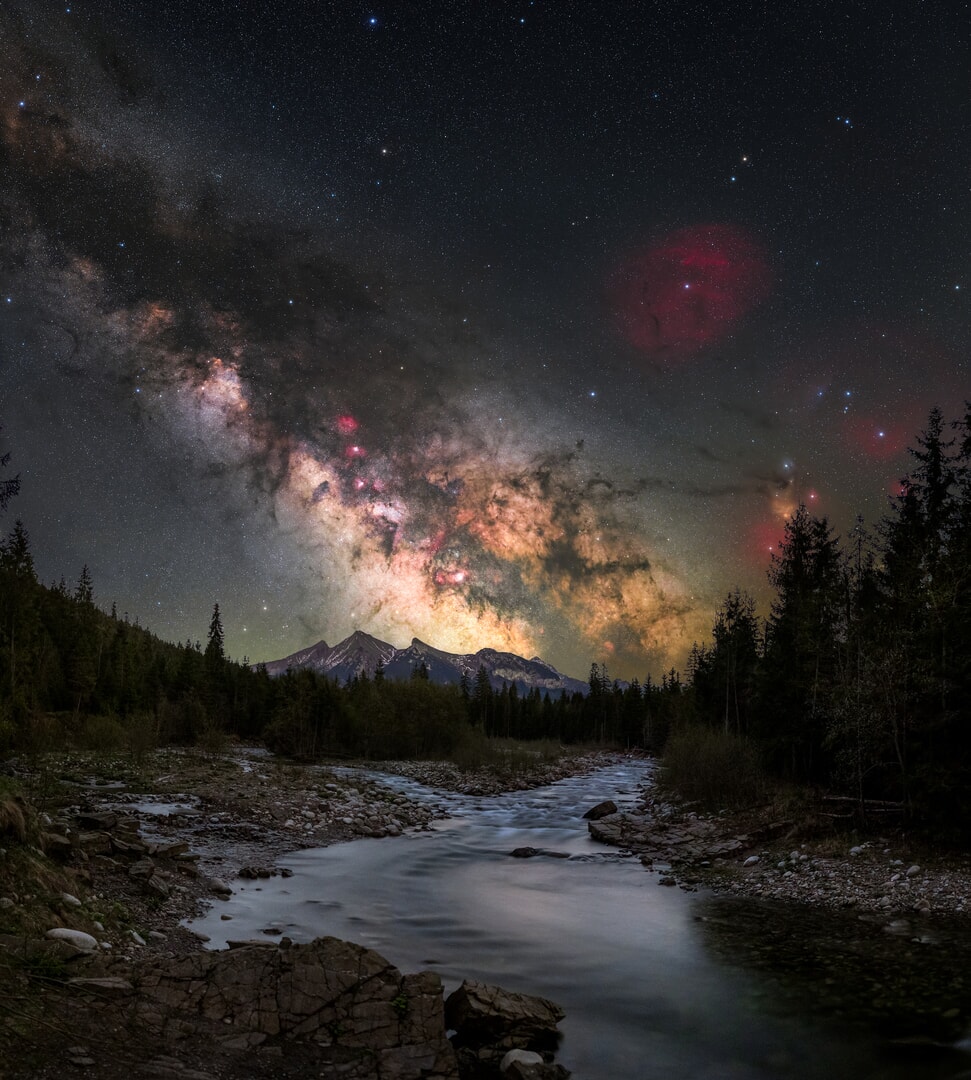
14. “Milky Way Over Tatra Mountains” — Łukasz Remkowicz | Jurgów, Poland
Waiting for the April new moon, Remkowicz returned to the Tatras — a region he photographs regularly — to explore the Białka Gorge at Jurgów for the first time.
The Milky Way rises above peaks that in early spring still hold their winter snow. The river in the foreground acts as a leading line drawing the eye up to the galactic center, which sits directly above the mountain ridge. The Rho Ophiuchi region adds warm reds and golds to the arc.
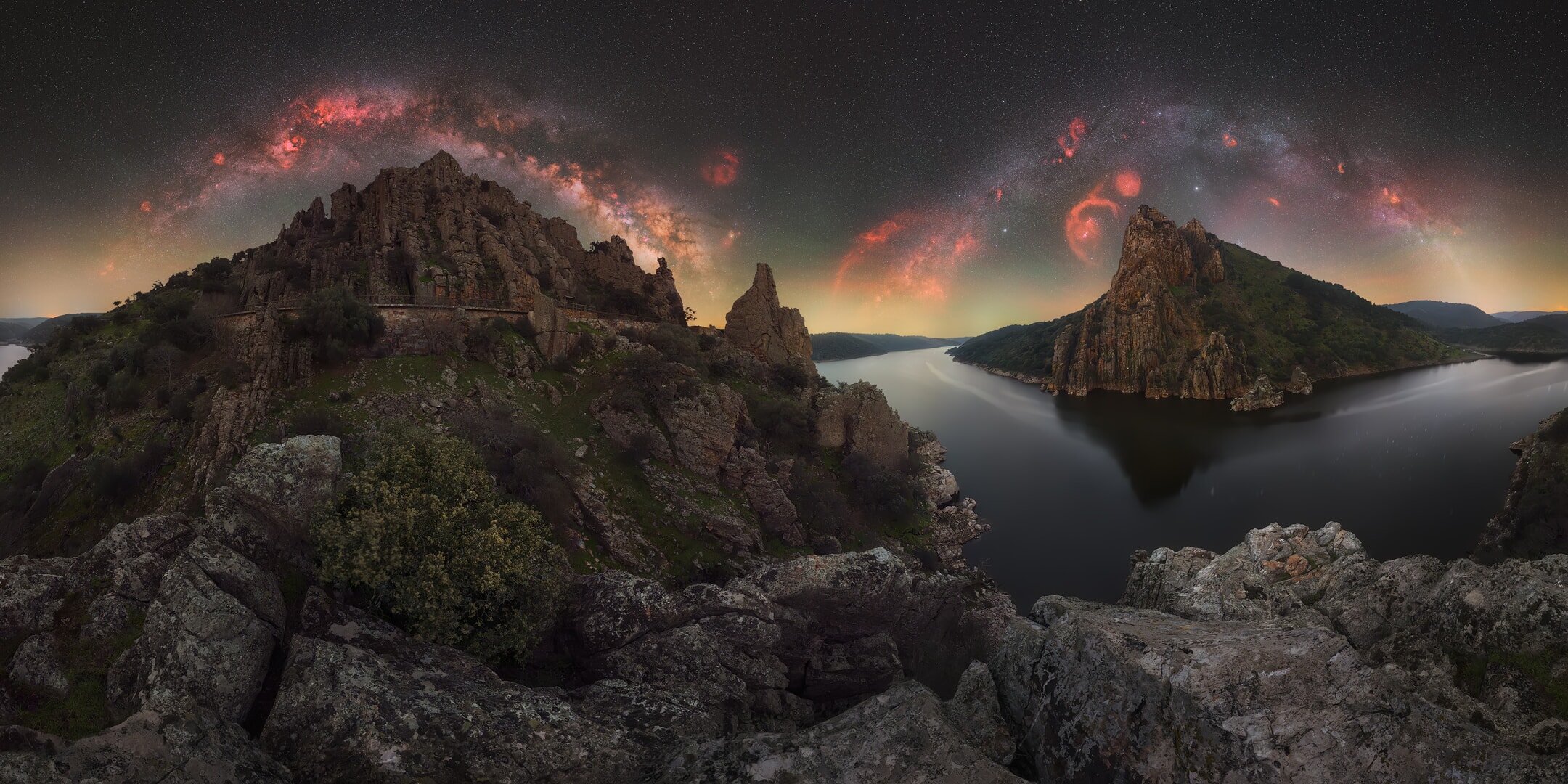
15. “Double Milky Way Over Monfragüe National Park” — Luis Cajete | Monfragüe National Park, Spain
This image captures one of the rarest phenomena in the astronomical calendar: the few nights each year when the winter and summer arcs of the Milky Way can be captured in a single frame.
The final image is a composite that captures the transition over several hours, combining the arc visible at dusk with the one rising before dawn. Cajete describes it as a long-held personal goal. The following morning, he returned to the same spot with his family.
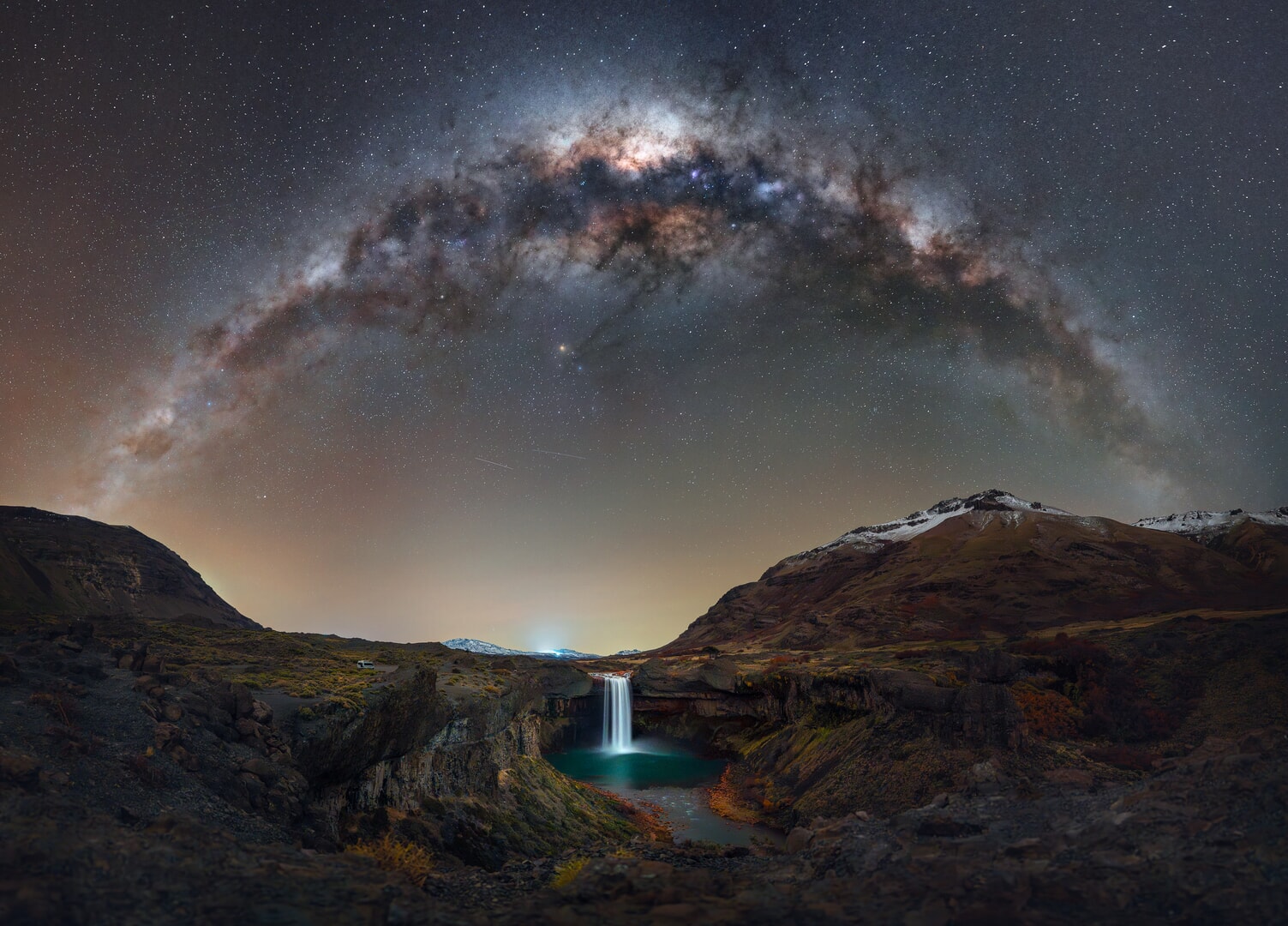
16. “Salto del Agrio” — Alejandra Heis | Caviahue, Neuquén, Argentina
The 148-foot Salto del Agrio plunges into a canyon cut through ancient lava flows from the Copahue volcano. The Agrio River, heavy with iron and sulfur, stains the basalt walls in striking colors.
Heis had attempted the shot before, turned back by snowfall. On this second attempt, cold and strong winds again put the outcome in doubt. She waited for the exact moment when the galactic arc aligned above the falls, tripod set nearly flush with the ground, repeating exposures until she had the image she had long envisioned.
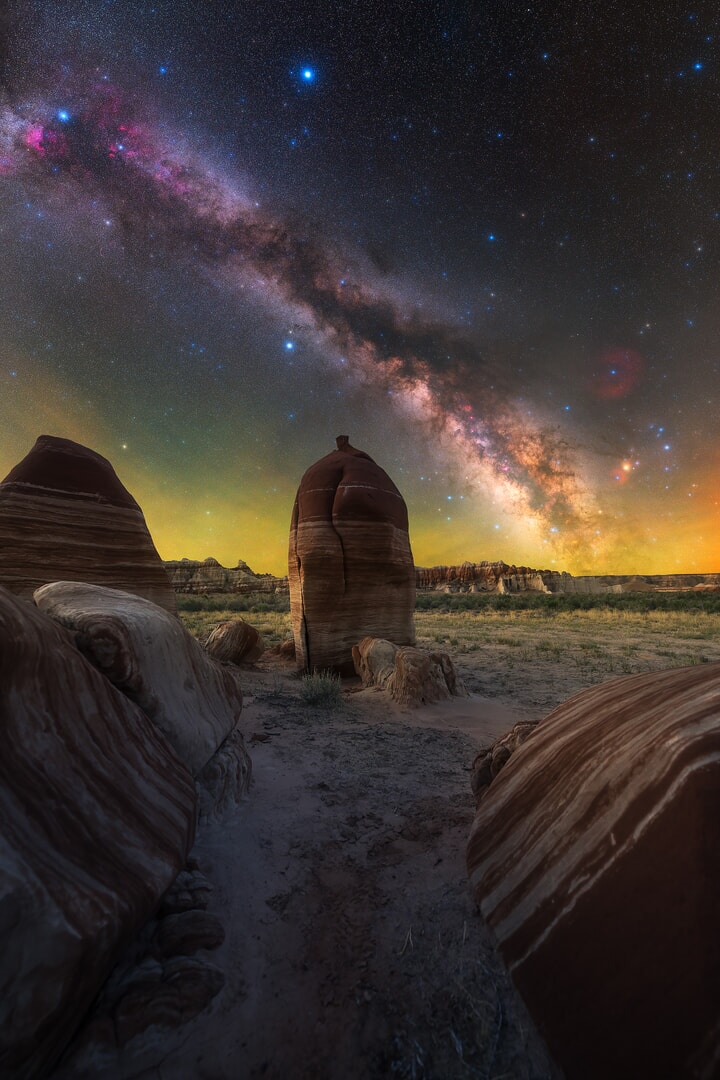
17. “Galactic Spine” — Andrew Imhoff | Hopi Reservation, Northern Arizona, U.S.
From the Hopi Reservation in northern Arizona, Imhoff composed an image in which a vertical column of desert rock echoes the Milky Way’s own vertical sweep above it.
The photographer describes his work as an attempt to spark the viewer’s curiosity — to make whoever sees the image wonder what it would feel like to stand beneath that sky. It’s a perspective that completely upends your sense of scale.
18. “Valle de la Luna, Universo Triásico Ischigualasto” — Gonzalo Javier Santile | San Juan, Argentina
Ischigualasto Provincial Park is the only place on Earth where you can see the complete sequence of the Triassic period, including fossils of the earliest dinosaurs. A UNESCO World Heritage Site, the park preserves rock formations more than 200 million years old.
Here, Santile captured the first complete Milky Way arc ever recorded at this location. Guided by local experts, he took great care not to disturb an environment he describes as irreplaceable. The result is a 20-frame panorama.
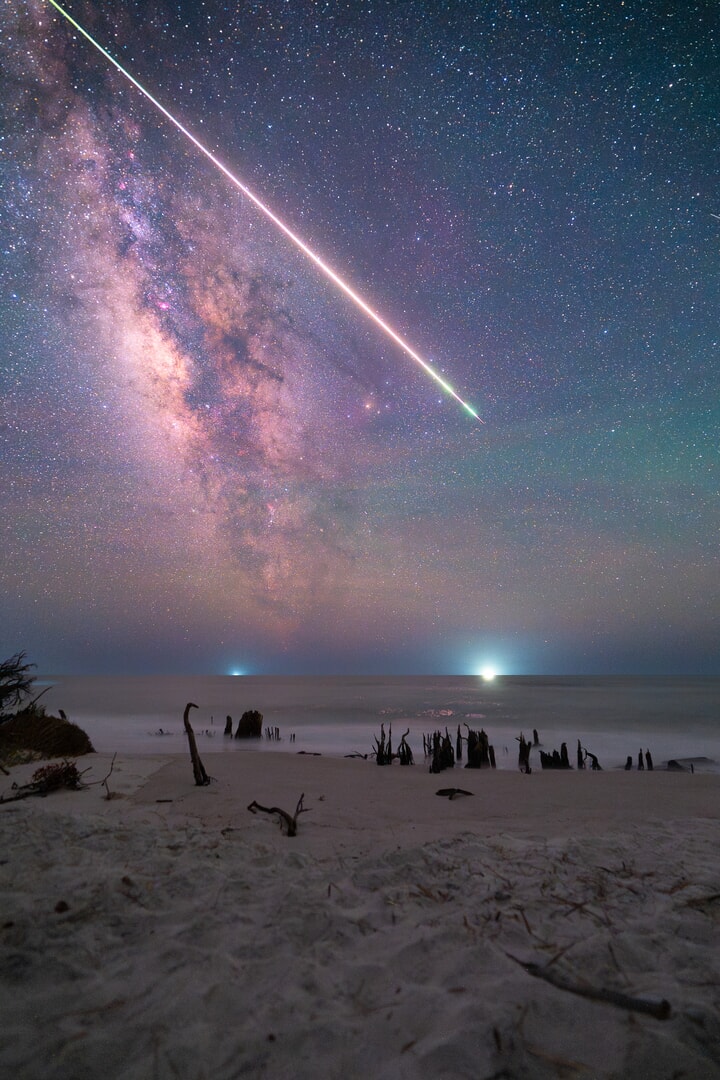
19. “Fireball in Paradise” — Jason Rice | Cape San Blas, Florida, U.S.
Rice hadn’t planned to photograph the beach that night: the forecast called for clouds and rain. He set up his camera to shoot a time-lapse from golden hour and retreated to his vehicle.
After midnight, the sky blazed green around him. He looked up. The meteor that crossed the Milky Way for nearly five seconds was the largest he’d ever seen. The luminous trail it left behind remained visible for fifteen minutes. The image is a single exposure.
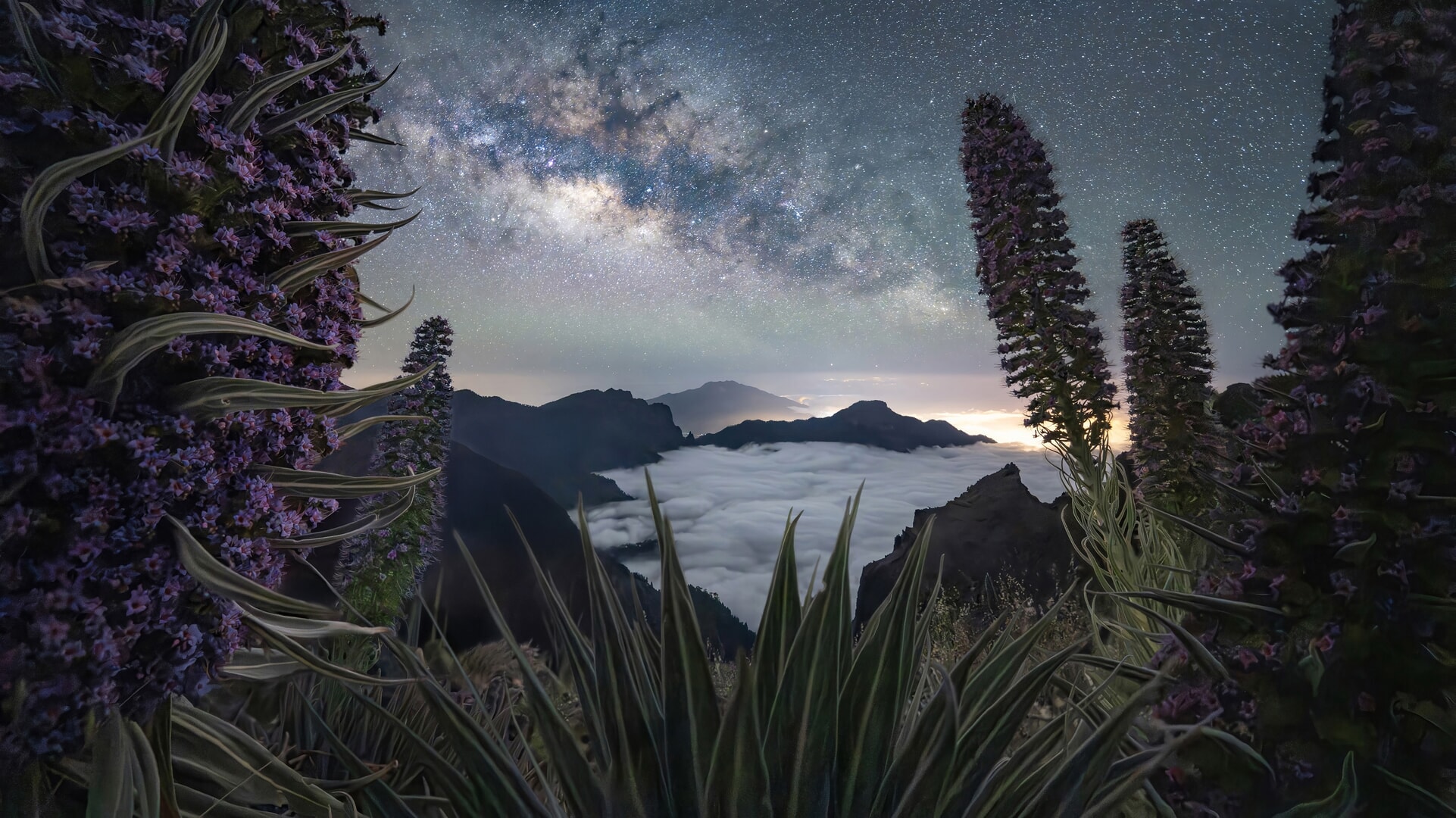
20. “Caldera Galaxy Panorama” — Max Terwindt | La Palma, Canary Islands
At the highest point of La Palma — a volcanic island whose summit forms an open caldera — In the foreground, Terwindt framed the Milky Way’s full arc with blooming tajinaste rosa, a wildflower endemic to the island. The total darkness required extensive focus stacking to maintain sharpness across the entire scene.
It was early summer, the tail end of the blooming season, and he was lucky to find a few flowers still in good shape — and positioned exactly where he needed them.
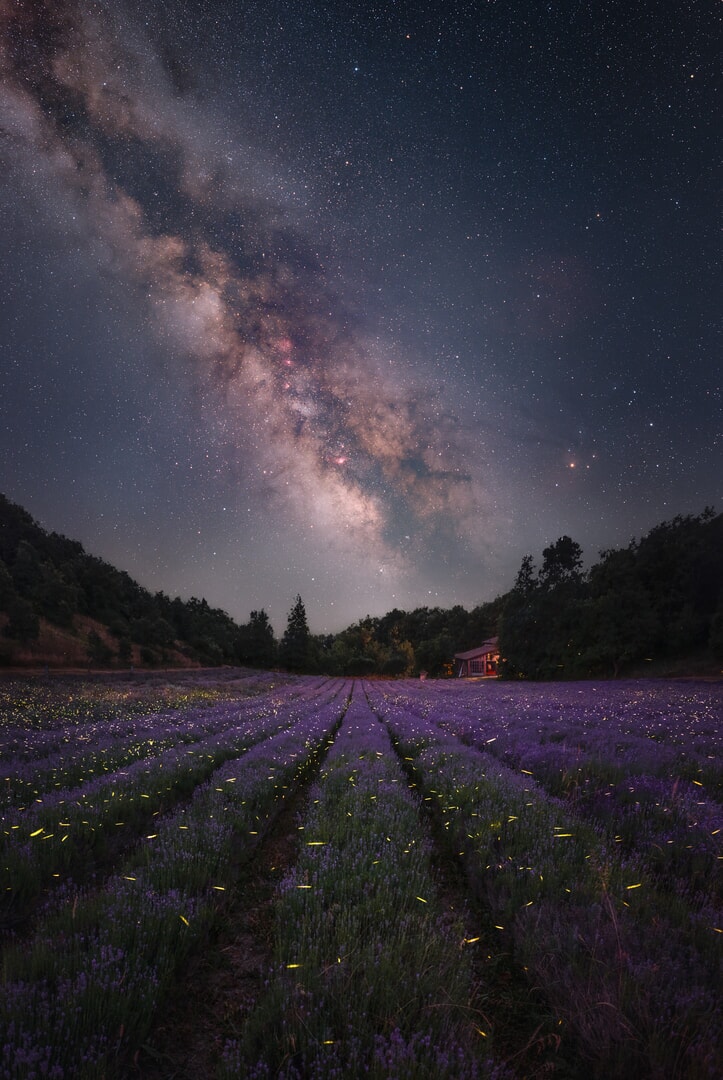
21. “Il giardino delle stelle” — Luca Fornaciari | Bolognese Apennines, Italy
Among rows of flowering lavender, fireflies drifted like tiny lanterns beneath the summer Milky Way. Fornaciari describes astrophotography as an exercise in patience — nights of bad weather, technical setbacks, and failed compositions — punctuated by brief moments when everything comes together at once.
This image, in which ground and sky share the same fleeting quality of light, distills the genre at its best.
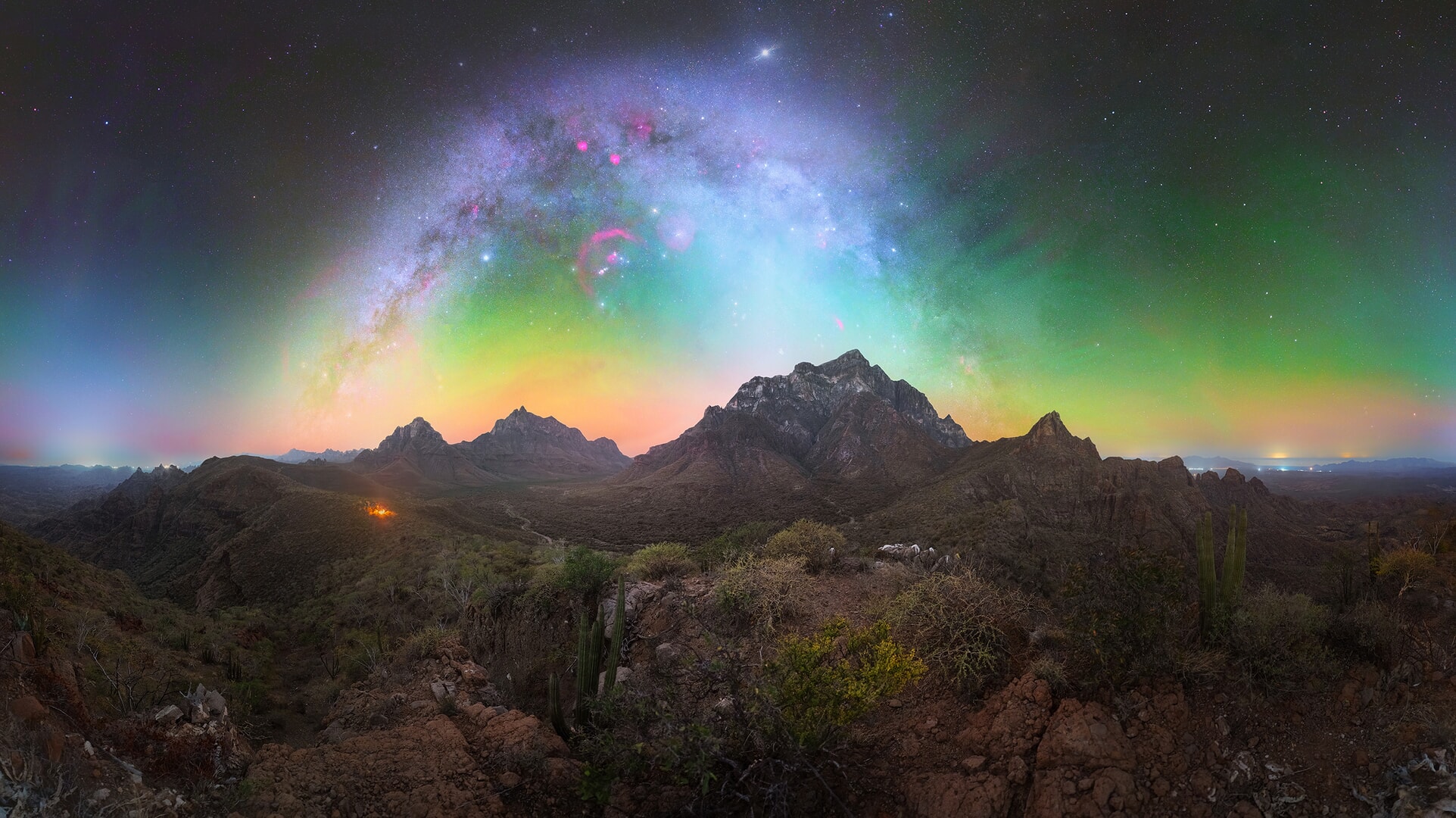
22. “Standing on the Shoulders of Giants” — Nacho Peláez | Sierra La Giganta, Baja California Sur, Mexico
Reaching this location required a two-day expedition from the village of San Juan Londo, with a mule ascent of more than 2,600 feet along a stretch of the historic Camino Real that hadn’t been used in nearly 80 years. The guide, Señor Juan, first came here with his father 65 years ago.
The image is part of a project to document and promote the dark skies of Baja California Sur as an astrotourism destination. At the right edge of the frame, the distant glow of Loreto — the first capital of the Californias — sits roughly 19 miles to the south.
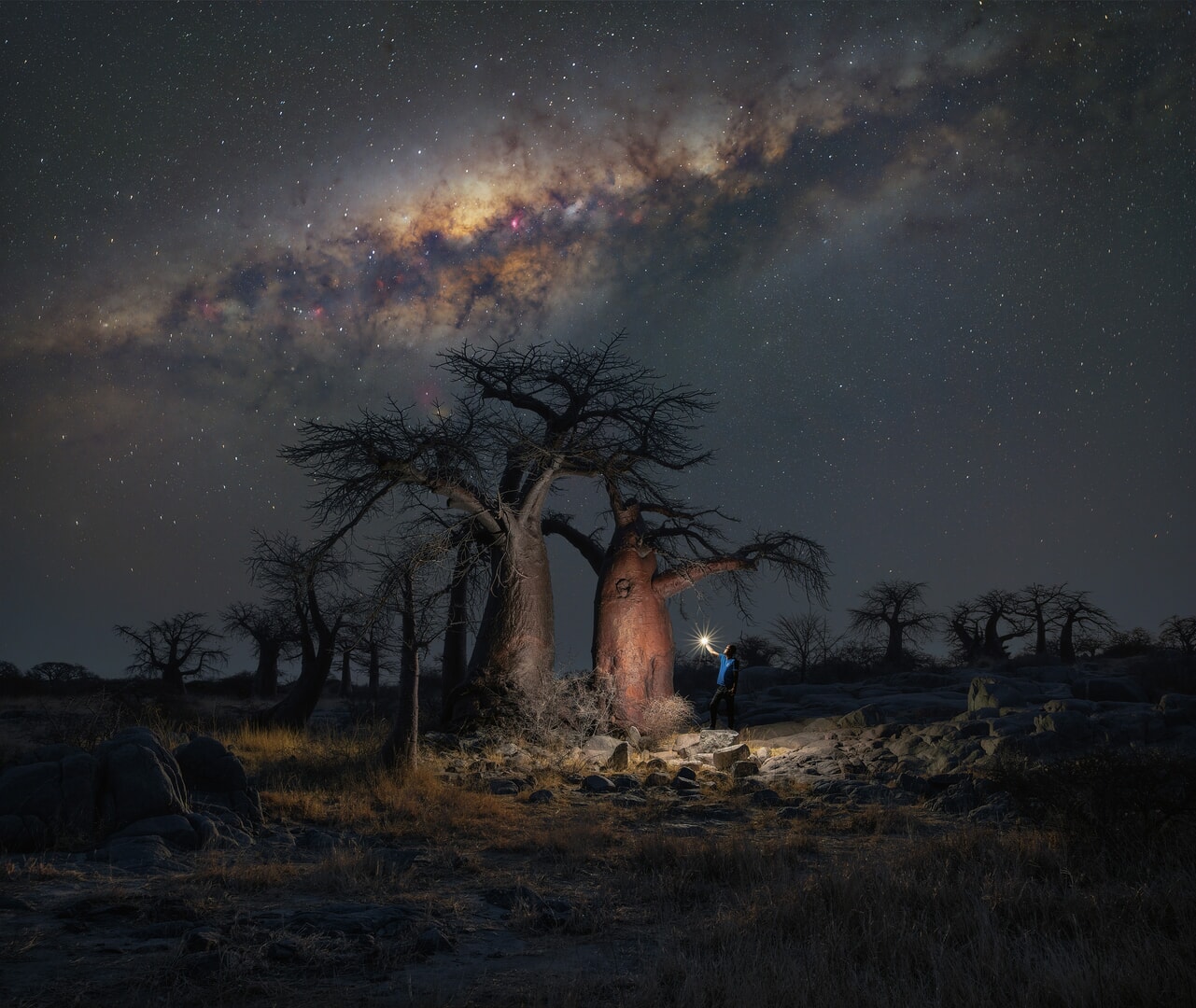
23. “Botswana Baobabs by Night” — Stefano Pellegrini | Botswana
Pellegrini spent ten days driving across Botswana, living out of his vehicle and moving through desert landscapes in complete isolation. He found the baobab island at the center of a vast salt pan almost by accident: he was on the verge of giving up when he spotted two jeeps heading in the opposite direction and decided to follow them.
Three hours later, he was crossing the salt pan, leaving a trail of white dust behind him. The final image combines one landscape exposure, eleven light-painting exposures with a flashlight, and four tracker-stacked sky exposures.
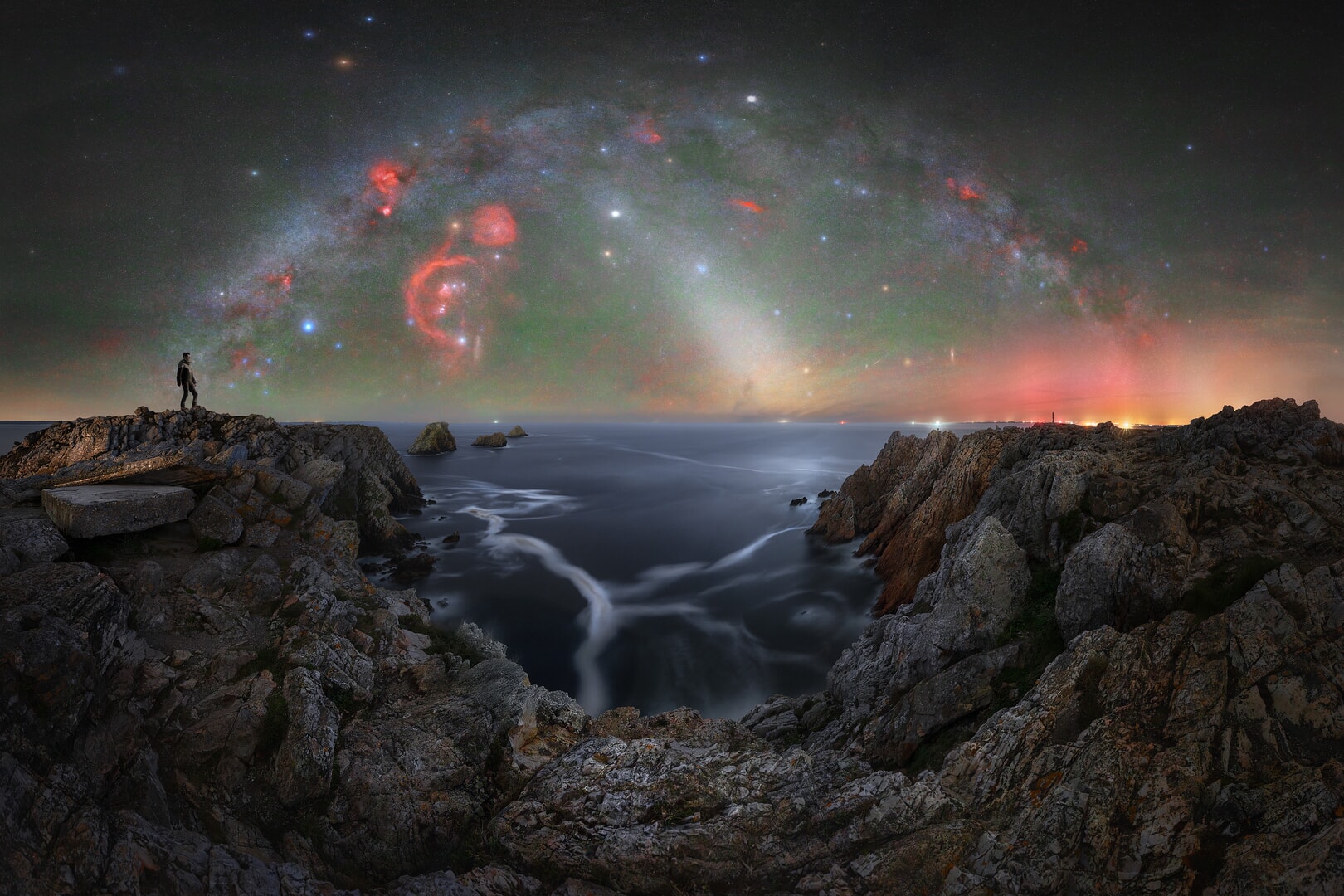
24. “Where Earth Meets the Cosmos” — Andrea Curzi | Pen Hir, Brittany, France
Two weeks of camper-van travel through Normandy and Brittany, under persistent wind and cloud cover, culminated in a single clear night at the Pen Hir peninsula.
While capturing a 200-degree panorama, Curzi noticed an unexpected red glow in one of the frames: the northern lights. He completed the planned sequence and kept shooting as the sky continued to open up.
In a single composition, he recorded the winter arc of the Milky Way, Orion with Barnard’s Loop, the Pleiades, the Rosette and California nebulae, Andromeda, Jupiter, airglow, aurora, and zodiacal light.
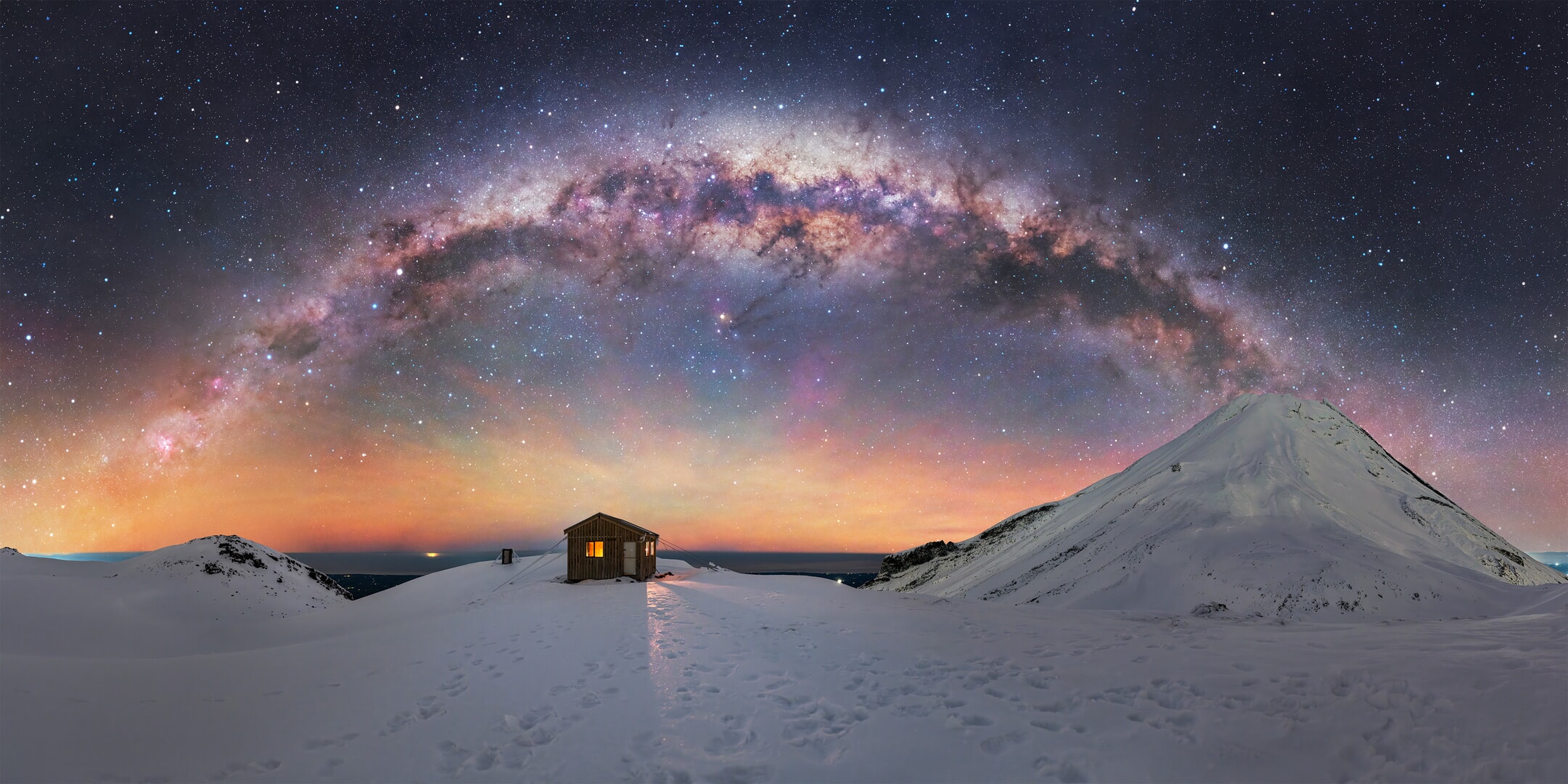
25. “Milky Way Over Syme Hut and Mt Taranaki” — Brendan Larsen | Mt Taranaki, New Zealand
Syme Hut, known as the coldest refuge on New Zealand’s North Island, lies more than five hours away on foot — a climb through snow and ice with a 44-pound pack, in temperatures of 5°F and biting wind.
Once there, Larsen assembled a panorama from 78 frames taken over an hour and fifteen minutes. It is one of the most technically ambitious images in the selection — and the one that best illustrates the ratio of effort to reward in extreme landscape astrophotography.
What These Photos Quietly Reveal
Light pollution is erasing the night sky from much of the planet. According to recent estimates, more than a third of the world’s population can’t see the Milky Way from where they live.
The images in this collection — taken on a salt flat at 13,100 feet, on an Indigenous reservation in Arizona, on a volcanic island in the Atlantic, in a park that preserves Triassic fossils — are more than just photographic records. They are also an inventory of what remains, and an implicit argument about what is lost when cities swallow the dark.
Dan Zafra launched this project in 2018 with that dual purpose: to celebrate the images and to remind us why preserving the night sky matters. Nine years in, the catalog keeps growing, immortalizing breathtaking nocturnal milestones like capturing the Milky Way double arch.