About 90 miles north of the Arctic Circle, the ground beneath the Swedish city of Kiruna is cracking and giving way.
The culprit isn’t nature but the relentless work of the Kiirunavaara underground iron mine, operated by the state-owned company LKAB. Decades of extraction at depths of more than 4,000 feet have deformed the earth above it, opening cracks in the ground that now threaten to swallow the old city center whole.
To prevent that from happening, LKAB and the Kiruna municipal government are carrying out a sweeping relocation that will move homes, businesses, and historic landmarks roughly three miles east.
The engineering effort, funded by the mining company at an estimated cost of more than $3 billion, involves dismantling entire city blocks and moving landmark buildings in one piece.
The goal: to save a city founded in 1900 around an ore body that now supplies roughly 80 percent of the European Union’s iron ore.
The Century-Old Church That Moved on Wheels
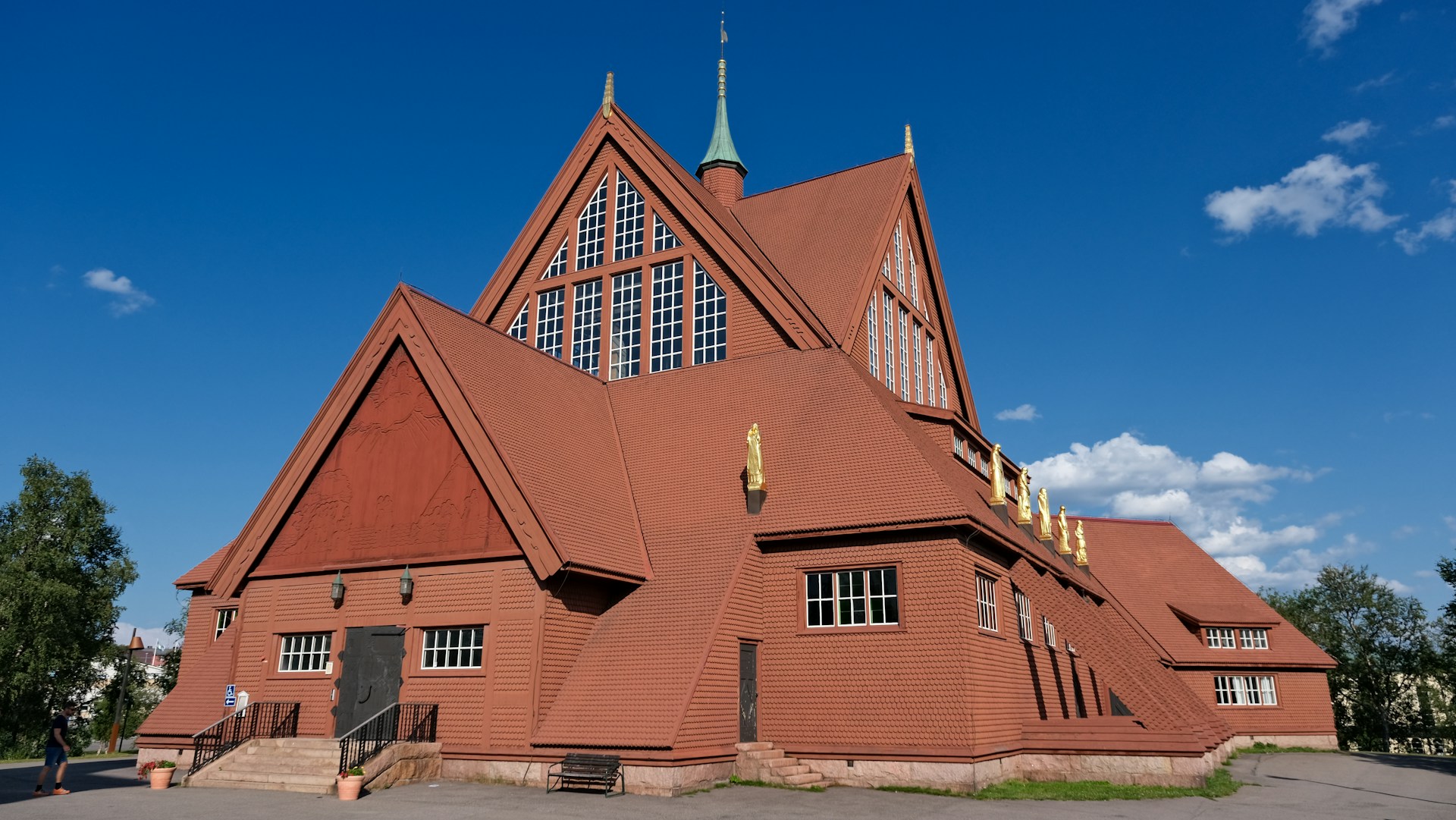
On Aug. 19 and 20, 2025, residents witnessed one of the project’s most technically demanding feats: the relocation of Kiruna Church.
The wooden building, constructed in 1912, weighs 672 tons and is 131 feet wide.
Rather than demolish it, engineers lifted the entire structure onto steel beams and loaded it onto heavy-duty transport vehicles, which carried it intact about three miles along a specially prepared route to its new site between the town cemetery and the new city center.
During the move, the structure was rotated 180 degrees so that the main entrance would face the center of town, in keeping with the traditional orientation of Swedish vernacular churches.
The church will remain closed while utilities are hooked up and interior restoration is completed. It is expected to reopen by the end of 2026. In addition to the church, 22 other listed heritage buildings are being moved or rebuilt piece by piece to preserve the town’s architectural character.
The Human Cost of Moving a City
But moving Kiruna is about far more than heavy machinery. At heart, it is an enormous social undertaking.
The resettlement directly affects nearly 6,000 people and 2,700 homes. Property owners are offered either compensation equal to market value plus 25 percent, or a comparable home in the new downtown.
About two miles east of the old center, the new downtown officially opened in September 2022, anchored by its city hall, Kristallen (“The Crystal”), a circular building designed to capture as much of the Arctic winter’s scarce natural light as possible.
Beneath the newly laid streets, pipes carry waste heat from the mine, keeping sidewalks clear of snow through the long winter months.
LKAB and the municipality expect the main phases of the relocation to be finished by 2035. As old neighborhoods are vacated, demolition crews clear the structures that cannot be moved, turning the land into a green buffer zone, a monitored park where engineers can track the gradual subsidence of the ground before it eventually collapses into the mine’s tunnels.
Rifts on Ancestral Sami Land
The expansion of mining operations and the construction of new urban infrastructure have deepened tensions with the Sami, who have herded reindeer across Swedish Lapland for generations.
New roads, rail lines, and the safety perimeters drawn around the subsidence zone have cut across the herds’ migration routes and broken up their calving grounds and lichen pastures.
Local Sami organizations say that the combined pressure of the mine, new housing developments, and renewable energy projects is steadily shrinking the land left for their traditional way of life.
LKAB says it is in ongoing talks with the herding districts to coordinate reindeer crossings and offset lost grazing land. Still, Europe’s growing demand for critical raw materials is colliding with efforts to protect indigenous heritage in the Arctic.
A City in Flux
As iron from deep inside Kiirunavaara keeps Europe’s heavy industry running, the map of Kiruna is being redrawn, day by day, across the tundra.
Entire streets vanish beneath the treads of excavators, exposing the foundations of neighborhoods that had stood for a century.
Daily life plays out between two overlapping realities: a past being swallowed by the mine, and a new city racing to take root in the snow.
Kiruna is moving east, leaving its old self behind in a quiet race against the void opening beneath it.