









Out on the open water of Lake Onega, in the Russian republic of Karelia, lies Kizhi Island.
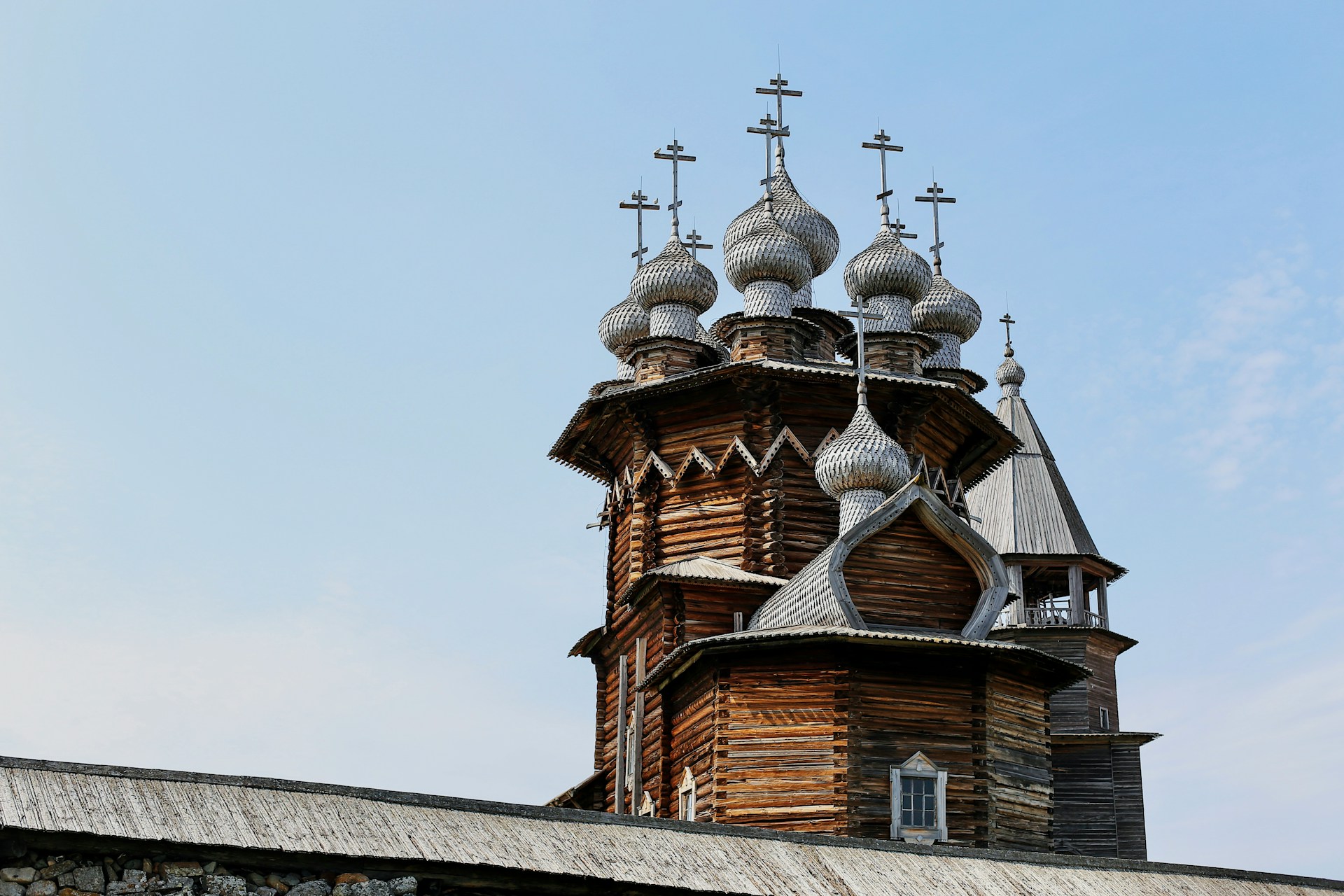
At one end stands a church 121 feet tall, crowned by 22 domes. Eighteenth-century carpenters assembled it log by log, without a single metal nail in its main structure. Around it cluster peasant houses, granaries and mills built on the same principles of craftsmanship.
Unlike the grand stone monuments of Moscow or St. Petersburg, this outpost, about 42 miles from Petrozavodsk, holds the architectural memory of the rural communities of Europe’s far north.
Its buildings reveal how people in a land of vast forests and subfreezing temperatures met the needs of both faith and daily survival with the one material they had in abundance: wood.
A Lightning Strike in 1693 and the Building of the Church of the Transfiguration
The parish enclosure as it looks today, known as a pogost, was born of disaster. In 1693, lightning struck the island and set off a fire that burned the old medieval churches on the site to the ground. Those churches are documented in 16th-century Russian chronicles.
Rather than abandon the place, local villagers paid for the rebuilding themselves and carried it out on the same ground.
The Church of the Transfiguration was completed in 1714. It was designed as a summer church and so had no heating. In the warmer months, entire families came by boat from islands and villages across Lake Onega to attend services.
To raise it to its full height of 121 feet, master carpenters fitted pine logs together with precisely cut notches. The joints allow the wood to swell and shrink with shifts in humidity without losing stability.
The 22 tiered domes are covered with some 30,000 small shingles carved from aspen. Over the years, sun, rain and snow have weathered the wood into a silvery skin that changes color as the light shifts.
The oral tradition of Karelia credits the work to a master carpenter named Nestor, who is said to have built the church with nothing but his ax and not a single nail.
As the legend goes, when the building was finished, Nestor stood on the shore, studied the outline of the domes and declared: “There never was, there is not, and there never will be another like it.” Then he hurled his ax into the lake so that no one could ever repeat his work.
Historical records indicate the church was actually the work of a crew of anonymous local craftsmen. Even so, the story of Nestor remains woven into the island’s cultural identity.
Decades later, in 1764, the Church of the Intercession joined the ensemble. With nine domes and heating stoves, it allowed services to continue through the winter. An octagonal bell tower, raised in 1862, completed the enclosure.
In 1990, UNESCO added the Kizhi pogost to the World Heritage list.
Houses Designed to Withstand Karelian Winters
The secular buildings surrounding the churches now form the Kizhi open-air museum, and they are also part of the island’s visual appeal.
Beginning in the mid-20th century, conservationists moved dozens of traditional houses, or izbas, along with chapels, windmills and storehouses from villages across Karelia to the island to save them from decay.
These homes were shaped by the climate demands of the Russian north. Instead of putting up a separate building for every task, peasants gathered everything under a single gabled roof: the family’s living quarters, the livestock barn, the tool workshop and the storerooms for hay and grain.
That way, the warmth of the animals helped heat the main rooms, and the household could go about its daily work without stepping out into winter blizzards.
The facades still bear hand-carved window frames, wooden balconies and layered roofs left free of any industrial coating.
Seen up close and from the inside, the ensemble serves as a tangible record of daily life in Karelia. Here, the running of a household, farmwork and travel across the lake all depended on technical knowledge that carpenters handed down from one generation to the next.
How to Reach Kizhi Island, Russia, and What to Know Before Visiting Its Churches
No bridges or roads link the island to the mainland. The usual starting point is Petrozavodsk, the capital of Karelia, about five hours by high-speed train from St. Petersburg or an overnight journey from Moscow.
During the navigation season, from mid-May to mid-October, fast hydrofoils leave daily from the Petrozavodsk river port. The trip takes 75 to 90 minutes each way, which leaves roughly four hours on the island.
In winter, when the surface of Lake Onega freezes solid, access is limited to organized excursions by helicopter or by hovercraft gliding across the ice.
The open-air museum is open year-round, with longer hours in summer, from 8 a.m. to 8 p.m. Entering the Church of the Transfiguration requires a separate ticket in addition to general admission, and it is possible only in the milder months, since the building has no heating. In winter, religious life and indoor visits shift to the Church of the Intercession.
No cars or other motor vehicles are allowed on Kizhi. Visitors get around on foot along marked trails that connect the pier with the church enclosure and the reconstructed villages, or by bicycle, rented beside the dock, to reach the far corners of the island’s 3.7-mile length.
When the last boats of the afternoon pull away from the pier and the wind once again takes hold of the silence over Lake Onega, Kizhi returns to the solitude in which it was conceived.
Its silver domes and log houses still stand after more than three centuries of ice, rain and northern sun. They remain a reminder of a time when architecture did not seek to dominate the landscape but to hold a conversation with it.