






To cross the Corinth Canal is to enter a peninsula where the shape of the land has dictated the course of civilizations for thousands of years.
The jewels of the Peloponnese are not isolated monuments. They are responses to an extreme geography—sealed valleys, jagged coastlines, terrain that forced every city and sanctuary to negotiate with stone and altitude.
The evidence of that negotiation begins the moment you leave the coast behind.
As you move inland toward the highlands of the Argolid, the landscape quickly turns austere. A succession of dry, rolling hills opens up, and visibility—the ability to see and be seen—becomes the most valuable asset a civilization could possess.
It is here, on one of those commanding ridges, that the citadel of Mycenae rises. It was the nerve center of the first great advanced civilization on the Greek mainland.
The ruins of the citadel of Mycenae stand as testimony to an era of splendor that dominated the Aegean from 1600 to 1100 B.C.
This jewel of the Peloponnese was the epicenter of Mycenaean culture—the same culture that gave rise to the Homeric legends and laid the foundations of the Greek language and religion. To walk through it is to understand that you are standing inside one of the greatest feats of Bronze Age engineering.
The first thing you feel upon arriving at Mycenae is that its location was a matter of absolute control. From the top of the hill where the citadel sits, the entire plain stretches toward the sea—a permanent watch kept over everything below.
The main entrance, the Lion Gate, makes that power explicit. Erected around 1250 B.C., it guarded a city protected by walls nearly 26 feet thick. But what stops visitors cold is the construction itself: stone blocks so massive that classical-era Greeks concluded only the Cyclopes could have stacked them.
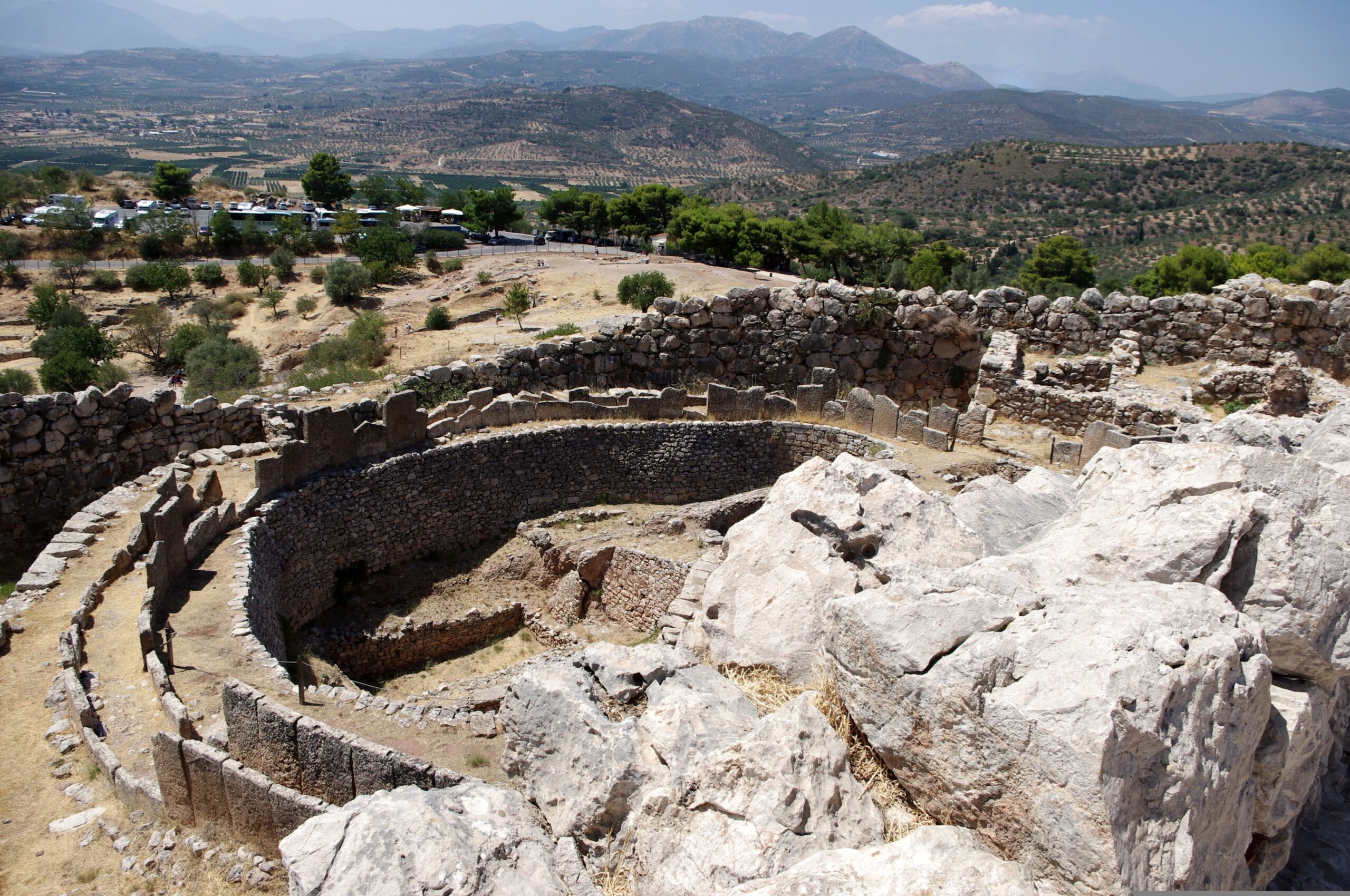
Beyond the walls, the Treasury of Atreus—also known as the Tomb of Agamemnon—is the site’s most astonishing element.
This tholos tomb is a circular underground structure whose corbeled dome was, for more than a thousand years, the tallest and widest in the world. Its stones fit together with such precision that no mortar was needed, and none has been needed since. A marvel of prehistoric architecture that survived the collapse of civilizations and the force of earthquakes, it still commands the kind of reverence that only stone, at its most deliberate, can produce.
A few miles to the east, the same constructive discipline that served defense at Mycenae takes on an entirely different character.
As you leave the citadel and descend toward the Argolid valley, the landscape softens. The terrain becomes gentler, more sheltered—a different kind of place shaped by different intentions.
This is where Epidaurus stands, a site that embodies the Greek conviction that healing the body was inseparable from harmony with the natural world.
The complex, dedicated to Asclepius, the god of medicine, was built in a valley whose low surrounding hills created a microclimate of clean air—considered essential to the healing protocols of antiquity. Geography here was placed in service of what we might now call a holistic vision of health, one in which rest and the beauty of the surroundings were part of the treatment itself.
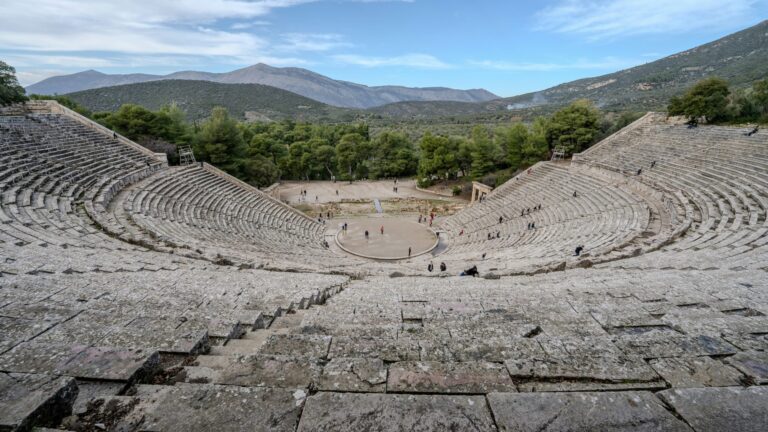
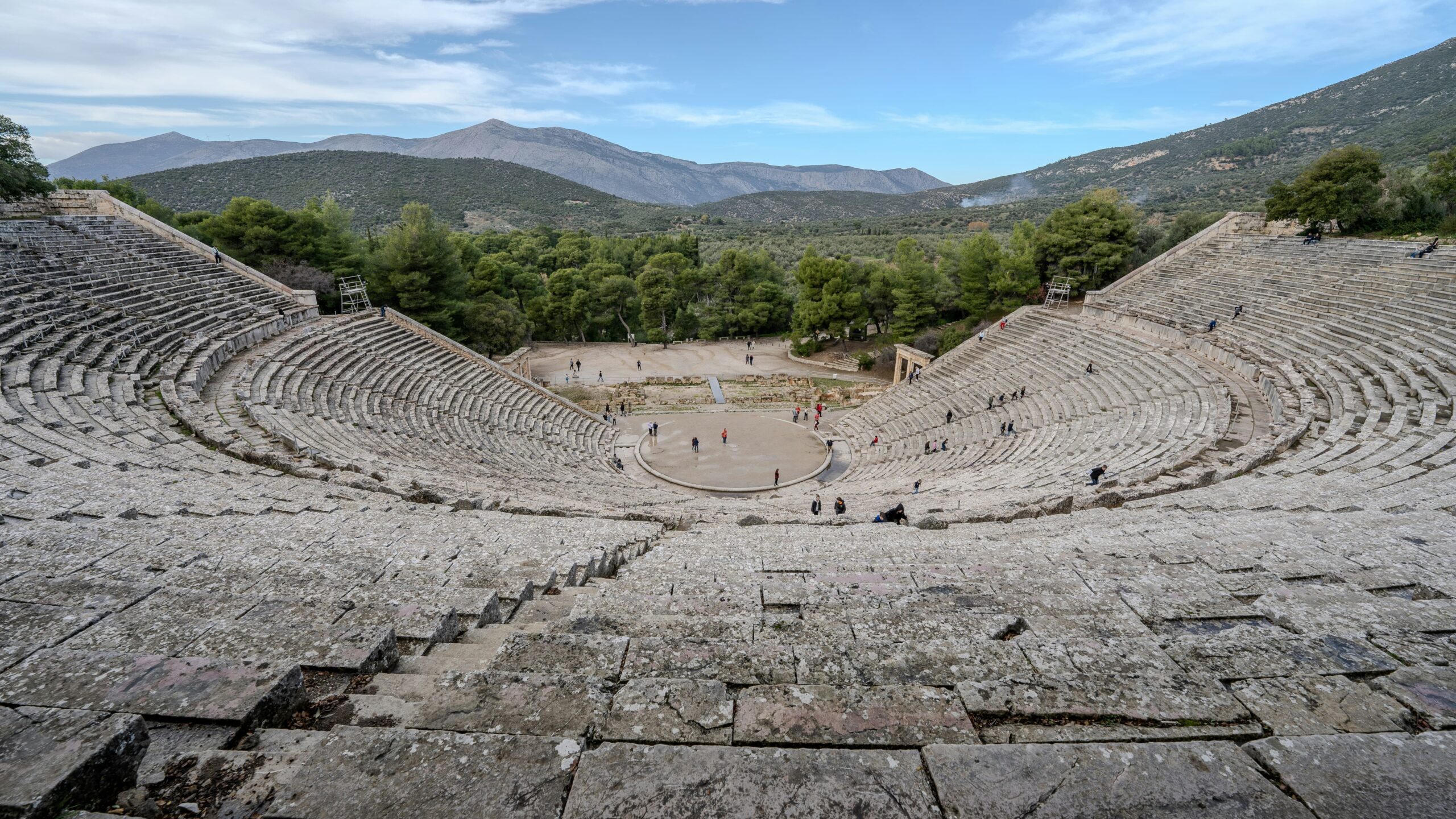
The centerpiece of the site, and the reason Epidaurus commands worldwide attention, is its theater.
Built in the fourth century B.C. by Polykleitos the Younger, it represents the culmination of geometry applied to acoustics—and to medicine, since it was conceived to provide entertainment to patients as part of their therapy.
Unlike the Mycenaean fortresses, the theater does not impose itself on the landscape. It integrates into the slope of Mount Cynortion, using the natural incline to seat 14,000 spectators.
What makes this open-air theater extraordinary is the physics of its design. The angle of the seating tiers and the use of porous limestone absorb low-frequency sounds—the ambient murmur of a crowd—while projecting high frequencies toward the uppermost rows. The most delicate sounds reach the farthest seats with complete clarity.
But the ancient Greeks are not the only ones who have enjoyed its performances. Designated a UNESCO World Heritage Site, the theater has served since 1955 as the stage for ancient tragedies performed during the Athens and Epidaurus Festival.
Leaving the theater’s perfect acoustics behind, the road pushes into the interior of the peninsula, where the plains give way to mountain ranges and the terrain grows sharper.
The journey south requires skirting Mount Taygetos, a wall of rock that functions as the spine of the region. On its slopes lies a jewel from a different era: Mystras, the final testament to Byzantine splendor before the empire’s disappearance.
Founded in the 13th century by the Franks and reclaimed shortly after by the Byzantines, it became the second most important city in the empire after Constantinople.
What makes Mystras a defining site of the Peloponnese is that, unlike the classical cities, it was designed to be impregnable.
Its streets are steep labyrinths winding between churches with reddish domes. The Church of St. Demetrios and the Monastery of Pantanassa stand out in particular, preserving frescoes whose technique would later influence the Italian Renaissance.
Its strategic position was equally decisive. From the Palace of the Despots, at the upper reaches of the city, the entire valley of the Eurotas River lies open below. That vantage point enabled military defense and, just as importantly, an isolation that allowed philosophers like Plethon to revive the thought of Plato.
Today, Mystras is a silent city where Byzantine stone merges with the vegetation of the Taygetos, marking the boundary between administrative Greece and the untamed Greece that begins just to the south, on the Mani Peninsula.
As the road winds through the southern foothills of the Taygetos, the vegetation thins and limestone begins to take over everything.
This is the approach to Mani, the central peninsula of the southern Peloponnese—a territory that functioned for centuries as a political and social island unto itself. Here, a geography of near-total isolation produced an architecture found nowhere else in the Mediterranean: the tower houses.
Mani is, arguably, the most untamed jewel of the Peloponnese. Its value lies in its nature as a time capsule. Because its terrain made land invasion nearly impossible, its inhabitants developed a clan culture built on self-sufficiency and defense.
The silhouette of villages like Vathia and Kita is unmistakable. Instead of open plazas, the landscape is punctuated by stone towers reaching up to 65 feet high—family fortresses built for clan warfare and the surveillance of the horizon.
To visit Mani is to understand how human beings learned to survive in a hostile environment. At places like Cape Matapan—the southernmost point of the Greek mainland, where the ancients believed one of the gates to the underworld stood—there is an unmistakable sensation of having reached the end of the road.
Here, geography forged a spirit of independence that neither the Ottomans nor the pirates ever fully managed to break. It is the logical conclusion of a map in which the land has always had the final word.
To travel through the jewels of the Peloponnese is to understand that the history of this peninsula is not a sequence of dates. It is a continuous adaptation to the terrain.
Every landmark here answers a need dictated by the ground beneath it—and the human ambition to leave something eternal in stone.