
Flying can be exhilarating. It can also be genuinely terrifying when the aircraft starts to shake. Turbulence rarely poses any real danger, yet fear can escalate quickly, and in that state of anxiety, staying calm can feel like a matter of sheer willpower rather than a learnable skill. Still, pilots, clinical psychologists, and aviation specialists all agree that there are proven ways to stay calm during turbulence — and that staying calm is a skill anyone can develop.
The first thing to understand is that there’s a significant gap between what passengers feel and what’s actually happening during turbulence. For most people in the cabin, any sudden movement triggers an immediate alarm reaction. For pilots, it’s almost always a minor inconvenience — the airborne equivalent of a bumpy road.
According to Professor Paul Williams, an atmospheric science specialist at the University of Reading, at cruising altitude, only about 3% of the atmosphere contains light turbulence at any given moment, 1% moderate turbulence, and just a fraction of a percent severe turbulence. “Your safety is practically guaranteed,” he says.
The problem isn’t the aircraft. It’s how your brain interprets what’s happening. According to a psychologist consulted by Gulf News, overexposure to news coverage of aviation accidents can trigger what is known as availability bias: a mental shortcut that makes dramatic events seem more common than they are, simply because they come to mind so easily.
With that in mind, here are ten techniques experts recommend for getting through turbulence without letting anxiety take over.
1. Understand What Is Actually Happening
The first step is replacing fear-based assumptions with facts. Commercial aircraft are built to withstand extreme turbulence, and pilots are trained to fly through it skillfully. Injuries during turbulence are rare and typically occur when passengers are out of their seats or not buckled in.
What feels like free fall in the cabin is usually a drop of just a few feet. For pilots, “light chop” is as routine as flying through a patch of clouds. Turbulence is not an in-flight emergency.
2. Watch the Crew
Yulanda Armstrong, a flight attendant and air transport instructor, recommends paying attention to cabin announcements. Pilots typically warn passengers when they expect rough air, and that warning helps passengers understand what’s happening instead of treating it as a threat.
If the flight attendants are calmly going about their work, that’s a clear signal there’s no cause for alarm. The crew is trained to recognize when turbulence is genuinely severe — and that’s rarely what the average passenger is experiencing.
3. Take Control of Your Breathing
Psychologist Christine Scott-Hudson recommends a specific technique: inhale deeply through your nose, letting your abdomen expand, then exhale for twice as long as you inhaled. This pattern stimulates the vagus nerve and activates the parasympathetic nervous system, which releases acetylcholine, a neurotransmitter that promotes a sense of safety.
Anxiety quickens your breathing, which in turn reinforces the sensation of danger. Breathing more slowly interrupts that cycle before it escalates.
4. Stop Resisting the Movement
Deliberately releasing muscle tension — unclenching your jaw, dropping your shoulders, and letting your body move with the aircraft — breaks the physiological anxiety cycle and signals to your nervous system that the situation is uncomfortable but safe.
Bracing against the movement does nothing to stabilize the plane, but it does amplify the sensation of instability. Going with the motion instead of bracing against it is among the most common pieces of advice from specialists.
5. Reframe the Thought, Don’t Suppress It
One of the most effective strategies for reducing panic is changing how you interpret the event. Rather than thinking “something is wrong,” try reframing it as “my body is reacting to uncertainty.” That shift in thinking can reduce panic almost immediately.
Another technique psychologists call “cognitive curiosity” involves observing the experience in detail rather than trying to block it out: how the seat supports your body, how the aircraft tilts slightly, how your breathing changes. Curiosity shifts your brain from survival mode into analytical mode, which naturally reduces anxiety.
6. Choose Your Seat Wisely
Seats over the wings or toward the front of the aircraft tend to be the least affected by turbulence. The tail section, by contrast, tends to make the turbulence feel more pronounced.
It’s a small thing, but a practical one — especially for frequent travelers who know turbulence triggers their anxiety. A more stable seat won’t make the fear go away, but it can take some of the edge off.
7. Use Music, White Noise, or Familiar Movies
Sound can unsettle you, but it can also soothe you. Listening to familiar music, a calm podcast, or a guided relaxation recording gives your brain something steady to focus on when everything around you feels unpredictable.
Movies you’ve already seen work better than new content. Your brain doesn’t have to process new information and can settle into something familiar. Noise-canceling headphones are also genuinely useful, since they muffle the engine sounds that some passengers mistake for signs of trouble.
8. Avoid Caffeine and Alcohol Before Boarding
Both substances amplify the body’s anxiety response. Caffeine raises your heart rate and heightens alertness, making you more likely to read ordinary sensations as threats. Alcohol, on the other hand, can create a false initial sense of calm that gives way to greater disorientation and a diminished sense of control — especially at altitude.
Drinking plenty of water is what most experts recommend instead. Flights are dehydrating, and dehydration can heighten how your body registers physical discomfort.
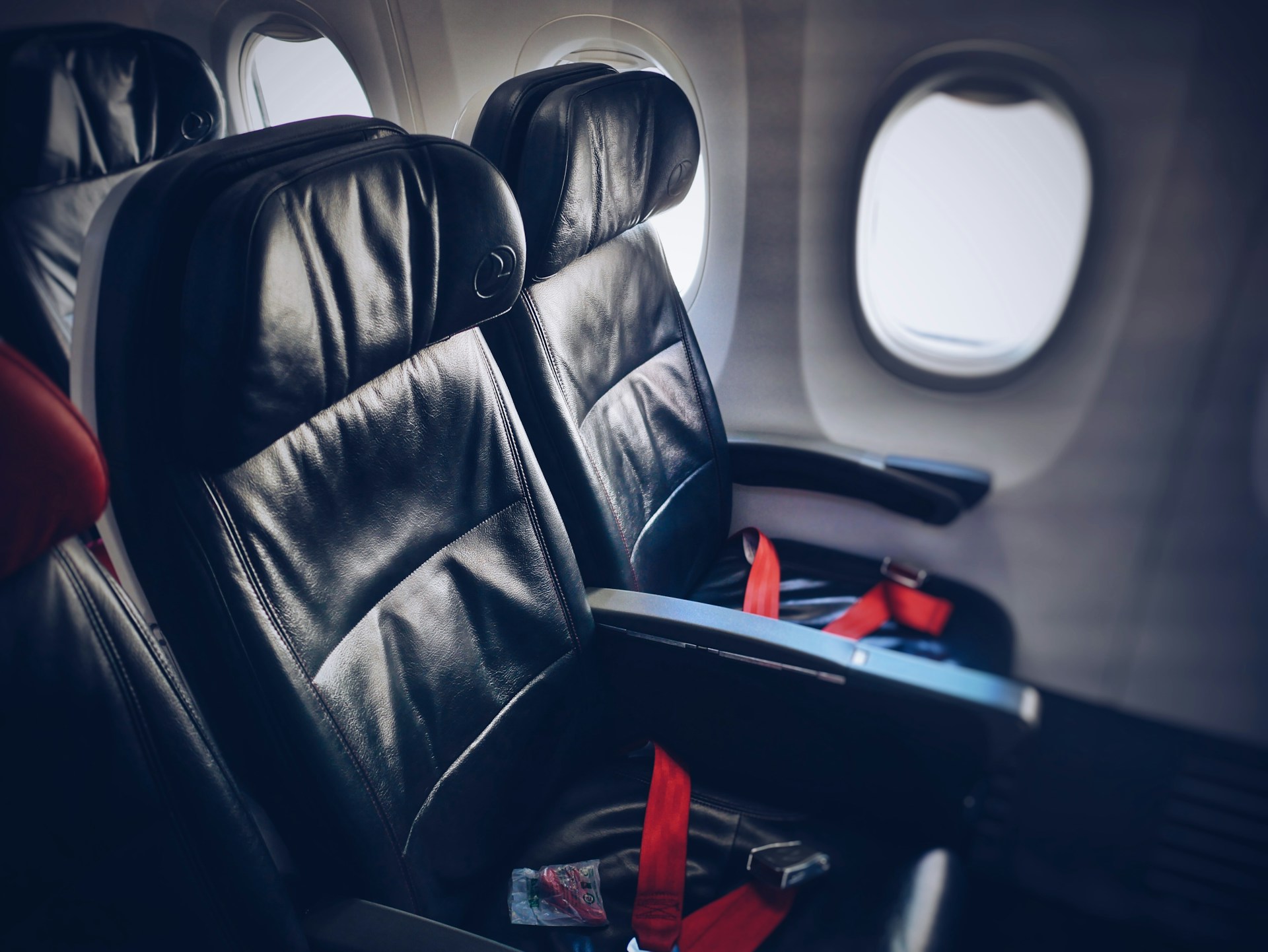
9. Keep Your Seatbelt Fastened Throughout the Flight
According to a 2021 report from the National Transportation Safety Board, the majority of passengers seriously injured by turbulence were not wearing their seatbelts at the time, typically because they were in the lavatory or walking through the aisles.
Keeping your seatbelt fastened at all times — even when the sign is off — is also the most commonly given, and most commonly ignored, recommendation in commercial aviation. Beyond being the single most effective safety measure, it also gives you a physical sense of being anchored, which in itself can ease anxiety.
10. Remember the Actual Numbers
This isn’t about reading more — it’s about reading the right things. The availability bias that feeds fear of flying thrives on dramatic stories and accident headlines. Hard data works differently: it appeals to reason rather than emotion, and it’s exactly what anxiety specialists recommend as the antidote to that kind of thinking.
In 2024, there were seven fatal accidents across 40.6 million flights worldwide. The IATA noted that, despite several recent high-profile incidents, accidents remain extraordinarily rare, and the long-term safety trend shows continuous improvement.
Aviation remains the form of transportation with the lowest accident rate per mile traveled.
Turbulence may be the most uncomfortable part of a flight, but for any modern aircraft, it falls well within the limits the plane was built to handle. Pilots fly through it dozens of times a month. For them, it’s just part of the job.