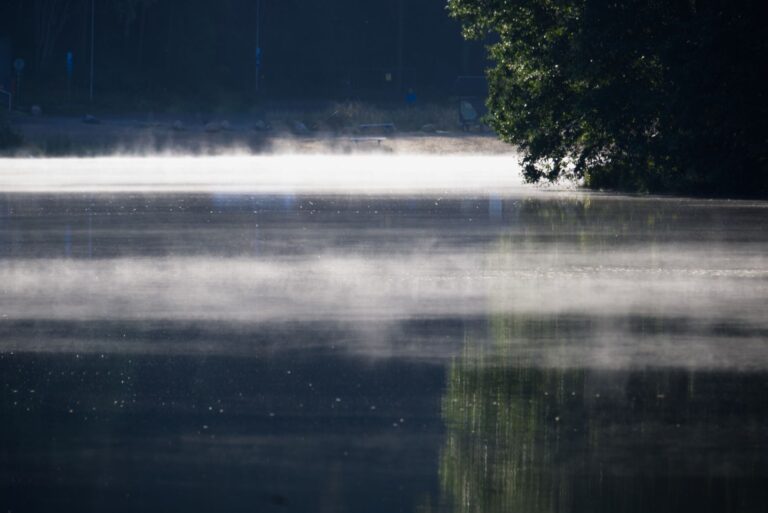




Deep in Peru’s central rainforest, a river steams. This is no modest hot spring or lukewarm pool. It is a full-size waterway, visible from a distance, and in places so hot that any animal unlucky enough to fall in dies within seconds.
Its name is Shanay-timpishka, though nearly everyone calls it the Boiling River. And the most baffling thing is what is missing from the landscape around it: a volcano.
Where It Is and What It’s Like
The Boiling River lies in the province of Puerto Inca, in the Huánuco region, deep in the Peruvian Amazon. The river runs about 5.6 miles in all, but the hot stretch, the part that leaves visitors amazed, covers nearly 4 miles.
It begins as a cold stream beside an enormous boulder shaped like a serpent’s head. As it flows on, however, the water heats to an average of 187 degrees Fahrenheit. At some points, readings have topped 194 degrees. That is close to boiling, though it never quite gets there.
The heat is not uniform. Cold streams feed into the river along its course, so some sections are far more bearable than others. Even so, the sight of steam drifting over the jungle stops people in their tracks.
A Legend That Turned Out to Be True
For centuries, the river has held a place in the spiritual traditions of the region’s Indigenous peoples, including the Asháninka and the Shipibo. Its name, rooted in Quechua, means “boiled by the heat of the sun.” According to tradition, it was created by Yacumama, a giant serpent known as “the mother of the waters.”
Andrés Ruzo didn’t first encounter the story in books. He heard it from his Peruvian grandfather, who told it to him as a boy.
In the tale, Spaniards searching for gold heard rumors of a river that could boil. Ruzo grew up, became a geoscientist and for years dismissed the story. Boiling rivers, he believed, existed only near volcanoes.
That changed in 2011. Ruzo, then a doctoral student at Southern Methodist University in the United States, was working on the first detailed map of Peru’s heat flow, aimed at assessing the country’s geothermal potential. When he asked his family about the river, his aunt assured him it was real. She had been there herself.
That November, he traveled with her to Mayantuyacu, a jungle healing center that serves as the river’s steward. There he asked the shaman for permission to study the river and take samples.
He became the first scientist to receive it. Wearing only sandals, he picked his way across the rocks, taking the water’s temperature at different points. The results confirmed what had seemed impossible: The legend was true.
How Can a River Nearly Boil Without a Volcano?
That is the central question. The nearest active volcano lies about 435 miles away, and no magma chamber is known anywhere in the region. With volcanoes ruled out, Ruzo had to test another possibility: that the heat came from oil operations in the area. That was not the answer either.
The most widely accepted explanation can be summed up in a single image. Rainwater seeps through permeable rock and sinks thousands of feet underground. At that depth, the Earth’s internal heat warms it. The water then rises back to the surface through faults and cracks, much like water in a giant coffeemaker.
Scientists describe it as a nonvolcanic hydrothermal system fed by a fault.
What makes it extraordinary is its scale. Ruzo says he knows of no other nonvolcanic geothermal system this large anywhere in the world, and other geothermal experts have not disputed the claim.
Life in Hot Water
One of the most striking discoveries was that the water, despite its heat, supports life.
DNA analysis turned up extremophile organisms, including algae, adapted to conditions that would kill nearly any other living thing.
Researchers are also studying the trees and plants along the riverbanks to see how they respond to the heat. To some, the river is a kind of natural laboratory, a place to glimpse how a rainforest might behave on a warmer planet.
A Treasure Under Threat
The river does not lie within a national park. It sits in a region where deforestation, logging, and oil interests are putting mounting pressure on the forest. Ruzo watched the clearings spread, and the charred trunks creep ever closer.
That is why he founded the Boiling River Project, a nonprofit dedicated to studying and protecting the river, the surrounding forest and the communities that live there.
According to the Boiling River Project, the local community now legally owns the land, and the campaign for formal government protection continues.
How to Visit
The usual starting point is Pucallpa, one of the major cities of the Peruvian Amazon, reachable by plane from Lima. From there, the journey continues by road for about two and a half hours to the town of Honoria, then by boat along the Pachitea River, and finally on foot, on a roughly hour-long hike through the jungle.
The river isn’t open to just anyone. Visits must be arranged through the groups that look after it, such as the Mayantuyacu center and the Huistín Sanctuary, or booked as an organized day trip from Pucallpa that includes transportation and a guide.
The terrain is rough, so going on your own isn’t advisable. One rule is non-negotiable: do not touch the water. Ruzo himself warns that putting a hand into the hottest stretches can cause severe burns within seconds.
Visitors are also expected to respect the sacred nature of the site.
The Boiling River is a reminder of something both simple and humbling: There are still enormous natural wonders, hiding in plain sight, that Western science is only beginning to understand.
The people who have cared for it have known this for generations. The rest of the world needed a journey, a question, and a thermometer to learn that, once again, the legend had been right.