
A few miles from Puno, out on Lake Titicaca, there is an archipelago you will not find on any geological map.
No volcano formed it. No erosion shaped it. It was woven by hand, generation after generation, by the same people.
These are the Uros islands: dozens of floating platforms built from a single aquatic plant, home for centuries to one of South America’s oldest peoples.
A Sacred Lake Long Before a Tourist Destination
To understand the Uros, you first have to understand the lake they live on.
Titicaca is a vast sheet of water straddling the border between Peru and Bolivia. It is the world’s highest navigable lake, more than 12,500 feet above sea level, and one of the most sacred places in Andean cosmology.
Its name is commonly translated as “stone puma.” According to Inca mythology, it was here, in these waters, that the creator god Viracocha brought the sun, moon, and stars into being, then sent Manco Capac and Mama Ocllo to found Cusco — and with it, the Inca Empire.
But that symbolic weight does not belong to the Incas alone. For the Uros, the lake is far more than a natural resource: it is the very ground of their identity.
They call themselves “water people” — Jas Shoni in their ancestral language — or “people of the lake,” and in their tradition, they are the original owners of Titicaca’s waters, here long before the Incas arrived.
Why They Ended Up Living on the Water
The islands were born of strategy, not whimsy.
According to Uros oral tradition, their ancestors originally lived on dry land along the lakeshore.
As more powerful peoples closed in — first the Tiwanaku and the Colla, then the Incas, and later the Spanish — the Uros did something no one else had attempted: they retreated into the lake’s totora reed beds and built a homeland of their own, out of reach of any army that did not know how to navigate those waters.
That decision, made centuries ago, became a permanent way of life. Today, roughly 70 to 90 islands are scattered across Puno Bay, grouped into communities such as Uros Puno, Uros Kapi, Uros Titino, and Uros Chulluni.
Each island typically belongs to a single clan, with three to ten families living on it.
How to Build an Island from a Single Plant
The raw material for this entire floating world is totora, an aquatic reed that grows abundantly in the lake’s shallows.
The reed gives the Uros the ground beneath their feet and the material for their homes and boats — and they even eat the youngest, most tender part of the stalk.
Construction begins underwater. Large blocks of interwoven totora roots, known as khili, are cut and anchored to the lake bed with stakes and logs to keep them from drifting. These serve as the floating foundation of the island.
On top of those blocks, layer upon layer of dried reeds is laid in alternating directions until it forms a firm surface more than three feet thick.
That base, however, does not last forever. The reeds touching the water rot from below, so every few weeks a fresh layer of dried reeds has to be added on top to make up for the decay.
In practice, that means constant maintenance. A Uros island is never truly finished, though it can last for decades as long as its inhabitants keep renewing it.
Life on Ground That Sinks a Little Every Day
Living on a totora island changes your relationship with your surroundings in a way no village on dry land can match.
The homes, also built from reeds, cluster around shared spaces where families cook, weave, and welcome visitors. Fishing and hunting waterbirds were the backbone of the Uros economy for centuries, supplemented by trading totora crafts with mainland communities.
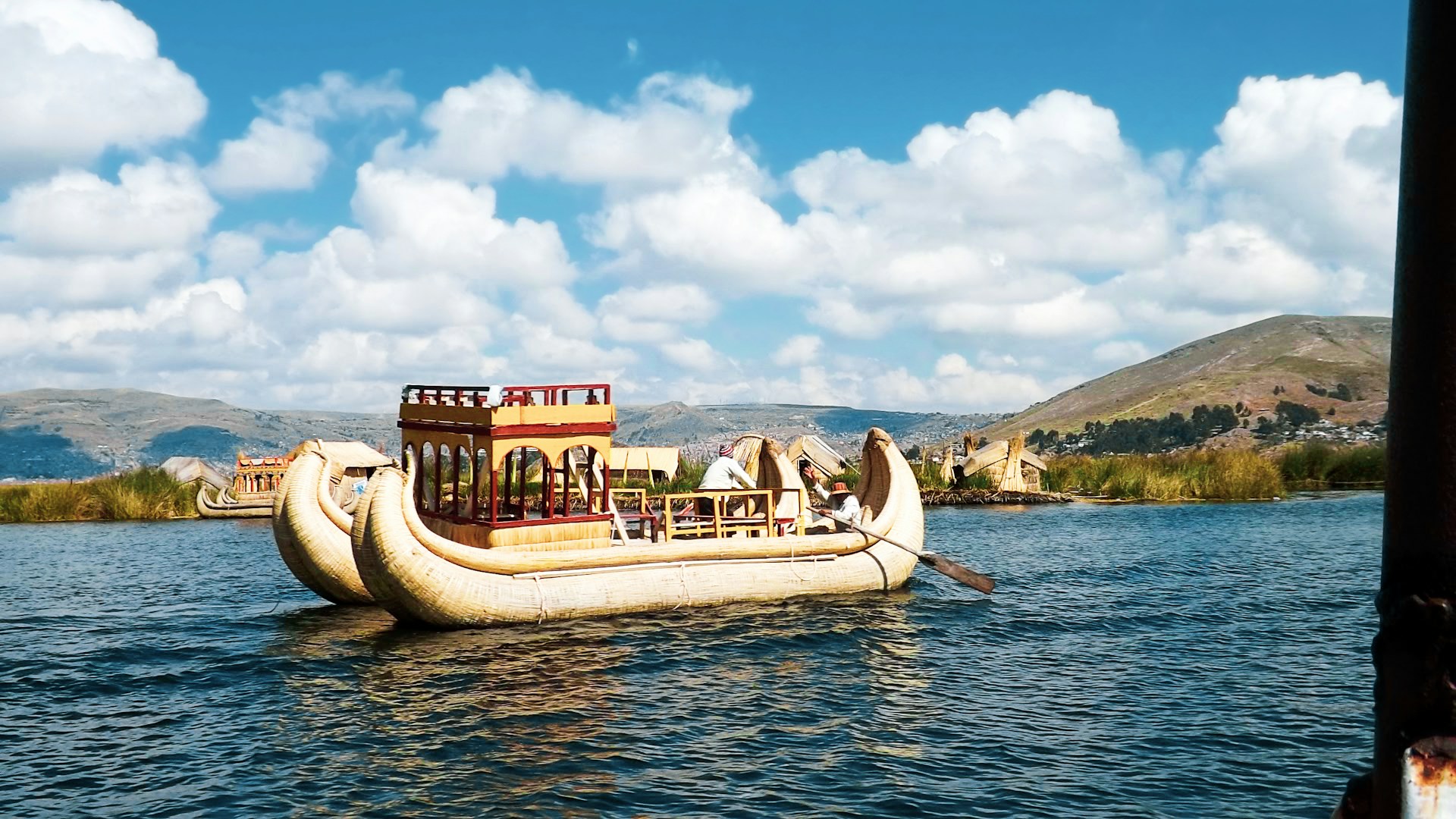
Reed boats, made from the same plant as the islands themselves, remain the traditional way of getting from island to island, though motorboats are now used for longer trips.
The rise of tourism, which took off in the 2000s, has reshaped much of that economy.
Many families now combine fishing and crafts with hosting visitors. Several islands have solar panels, radios, and even cell service — all alongside a way of life whose material foundations have barely changed in generations.
How to Visit Uros Islands
The Uros islands are usually visited on half-day boat trips from the port of Puno, less than six miles away.
Most tours include a demonstration of how an island is built, the chance to ride a totora reed boat, and time to meet some of the families who live there and make a living, in part, by selling handmade crafts.
For a more immersive experience, lodgings such as Uros Qhantany Lodge let guests spend the night on a floating island, take in the lake at different times of day, and get to know the Uros communities.
It is best to book through a local agency in Puno and, as with any community that depends on tourism, to visit respectfully. This is not a theme park. These are the real homes of families who still weave, every few weeks, the ground they walk on.