






In northern Tanzania, 112 miles west of the city of Arusha, the rolling volcanic highlands break off without warning and fall away into a vast circular basin ringed by sheer walls.
Formed roughly 2 million years ago when a colossal volcano exploded and then collapsed in on itself, the Ngorongoro Crater is the largest intact, unflooded volcanic caldera on the planet.
More than 1,960 feet deep, with a flat floor that stretches more than 11 miles across, this 100-square-mile basin functions as an isolated natural enclosure.
Its steep walls catch the moisture of clouds drifting in from the Indian Ocean, feeding springs that never run dry. The result is a self-contained world that is home to one of the greatest concentrations of wildlife on the African continent.
The Geological Origins of a Collapsed Mountain
Geologists estimate that before it collapsed, the original volcano rose to a height comparable to Mount Kilimanjaro, topping 16,400 feet above sea level.
Successive eruptions drained its magma chamber, and the summit caved in on itself. What remained was a nearly symmetrical ring of rock, wrapped in cloud forest and high-altitude savanna.
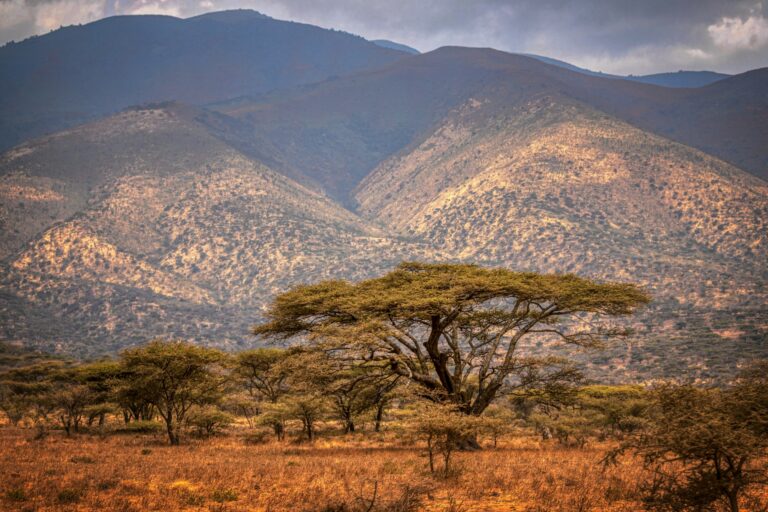
On the caldera floor, eroded volcanic ash produced mineral-rich soils that now sustain broad grasslands, acacia woodlands and marshes fed by the Munge and Lerai rivers. In the southwest lies Lake Magadi, a shallow alkaline lake whose waters draw thousands of lesser flamingos and wading birds during the dry season.
What Animals Live in the Ngorongoro Crater?
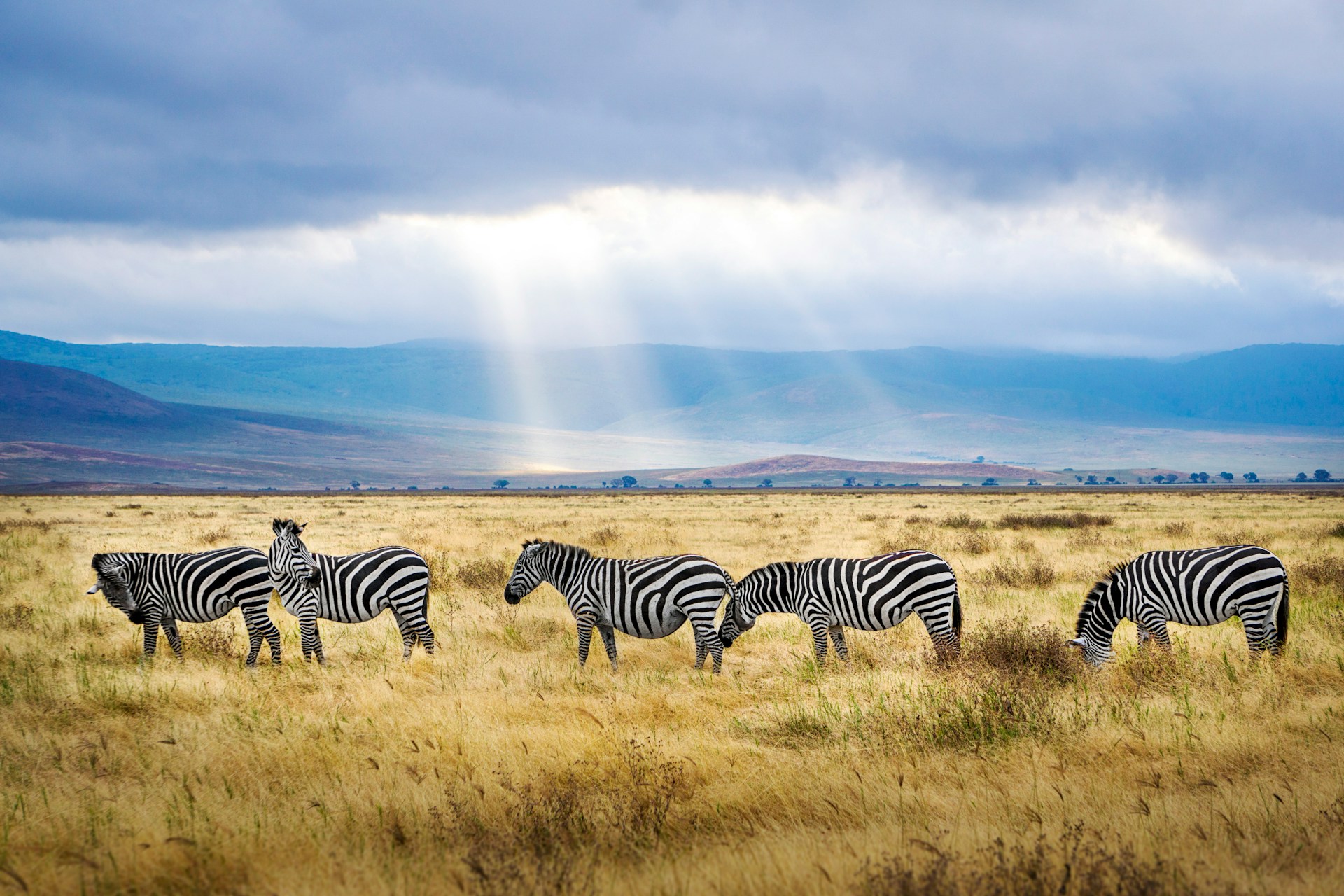
The crater’s enclosed topography shapes the lives of the species within it. On the neighboring plains of the Serengeti, millions of herbivores set out each year on long seasonal journeys in search of grass and water. Inside the crater, a steady supply of pasture and water allows close to 25,000 large mammals to stay put year-round.
Herds of wildebeest, zebras, Thomson’s gazelles and Cape buffalo share the terrain with one of Africa’s densest populations of lions and spotted hyenas.
The crater also shelters one of the last populations of black rhinoceros in northern Tanzania. Critically endangered, the animals live under constant guard among the dense thickets of the caldera floor.
The Maasai People’s Historic Coexistence With Wildlife in the Conservation Area
The crater lies within the Ngorongoro Conservation Area, a 3,202-square-mile territory designated a UNESCO World Heritage Site in 1979.
Unlike Africa’s national parks, where permanent human settlement is prohibited, the area was conceived as a multiple-use zone. Maasai pastoralist communities are allowed to live in the surrounding highlands and graze their cattle there.
Fossil sites at nearby Olduvai Gorge and Laetoli, both within the same protected area, show that early hominins inhabited this volcanic region more than 3 million years ago. That unbroken presence of humans and megafauna makes this corner of the Great Rift Valley a living archive of biological and cultural evolution.
Access, Routes and Rules for Visiting the Caldera
The conservation area is reached mainly by road from Arusha, along a paved route that passes through the towns of Makuyuni and Karatu before climbing through forested slopes to the Loduare gate.
Those arriving by light aircraft usually land at the Lake Manyara airstrip, about 37 miles away, or on the small dirt strip at the crater rim, which links to other reserves on Tanzania’s northern circuit.
From the rim, perched 7,500 feet above sea level, four-wheel-drive vehicles wind down narrow, steep tracks to the floor of the basin.
Regulations permit drives inside the crater only in closed four-wheel-drive vehicles. Stepping out is strictly forbidden except at designated rest areas beside the Ngoitoktok spring and the Lerai Forest.
Beyond wildlife viewing on the caldera floor, visitors can set out on walks led by armed rangers along the western rim and into the neighboring Olmoti and Empakaai craters. Empakaai cradles a deep alkaline lake encircled by forested walls.
A typical itinerary also includes a stop at Olduvai Gorge, where a small museum beside the excavation site displays replicas of the hominin fossils unearthed by paleoanthropologists Louis and Mary Leakey. With permission, travelers can also visit the traditional villages, or bomas, of the Maasai communities who inhabit the highlands.
To limit the environmental toll of the more than 600,000 visitors the area receives each year, the Ngorongoro Conservation Area Authority caps time inside the crater at six hours per permit.
Vehicles may travel only in daylight, between 6 a.m. and 6 p.m. The restrictions prevent crowding at predator-viewing spots and preserve the nighttime stillness of the animals that live inside the ancient volcano.
If those rules are followed, Ngorongoro will remain what it has long been: an intact window onto the natural dynamics that once governed the savannas of East Africa, before the landscape was fragmented.