
Volcanoes are among the most extraordinary geological wonders on the planet. Some are celebrated for their near-perfect conical silhouettes, others for their sheer height, and still others for the crater lakes nestled within them. But one stands apart for something far more unusual: the color of its flames.
Deep in the interior of the island of Java, the Kawah Ijen volcano looms in brooding silence — a colossus whose fire burns not red, not orange, but electric blue, almost spectral. Here, chemistry produces a landscape that seems conjured out of another world.
And yet, behind this science-fiction backdrop lies one of the rawest human realities in all of Southeast Asia.
Kawah Ijen’s Volcano: The Chemistry Behind The Blue Flames
Java, part of the Indonesian archipelago, sits squarely within the Pacific Ring of Fire — one of the most seismically and volcanically active zones on Earth.
Indonesia alone has 143 active volcanoes. But none of them produces anything quite like this.
Understanding the blue flames of Kawah Ijen means resisting the urge to mysticize it. What happens inside this caldera, perched at 7,828 feet above sea level, is an extreme chemical reaction — nothing more, nothing less.
Sulfur dioxide escapes through volcanic fissures under immense pressure, at temperatures exceeding 1,112 degrees Fahrenheit. When that gas meets the oxygen in the open air, it ignites, producing tongues of blue flame that can reach heights of 16 feet.
The spectacle is best witnessed as daylight fades. Under a canopy of stars, Kawah Ijen is at its most spectacular.
At dawn, the magic fades, and the volcano’s true anatomy comes into focus. The blue recedes, replaced by a deep sulfurous yellow — the mineral cooling, condensing, and crystallizing along its path in dense amber-colored blocks.
At the heart of the crater rests a vast acid lake, the largest of its kind in the world. Its color is a beguiling turquoise, but don’t be seduced. The water here is extraordinarily toxic, with a pH near 0.5 — close to that of battery acid — a cocktail of sulfuric and hydrochloric acid capable of dissolving metal within hours.
Thick vapors rise from the lake’s surface, wrapping the surroundings in an almost perpetual haze.
It is an ecosystem where life seems impossible — except for those who have made this abyss their workplace.
The Sulfur Men: The Other Face of Kawah Ijen
Behind the extraordinary blue flames of Kawah Ijen lies a brutal reality — the miners who descend here day after day, hauling blocks of raw sulfur on their backs.
This is not a summit you climb and conquer. It is a colossal natural amphitheater whose treasure — sulfur — lies buried at the bottom of its throat.
Everything begins at Paltuding, the base camp at an elevation of roughly 6,230 feet. From there, workers set off on a nearly 2-mile trek up a steep, winding trail that climbs the volcano’s outer flank to the rim of the caldera.
What follows is no easier: a near-vertical descent of nearly 1,000 feet into the crater, down toward the acid lake below.
The path the Java miners follow is barely a path at all — more a suggestion traced through loose volcanic rock. As they approach the lake, the overwhelming stench of hydrogen sulfide — like rotten eggs — fills the air.
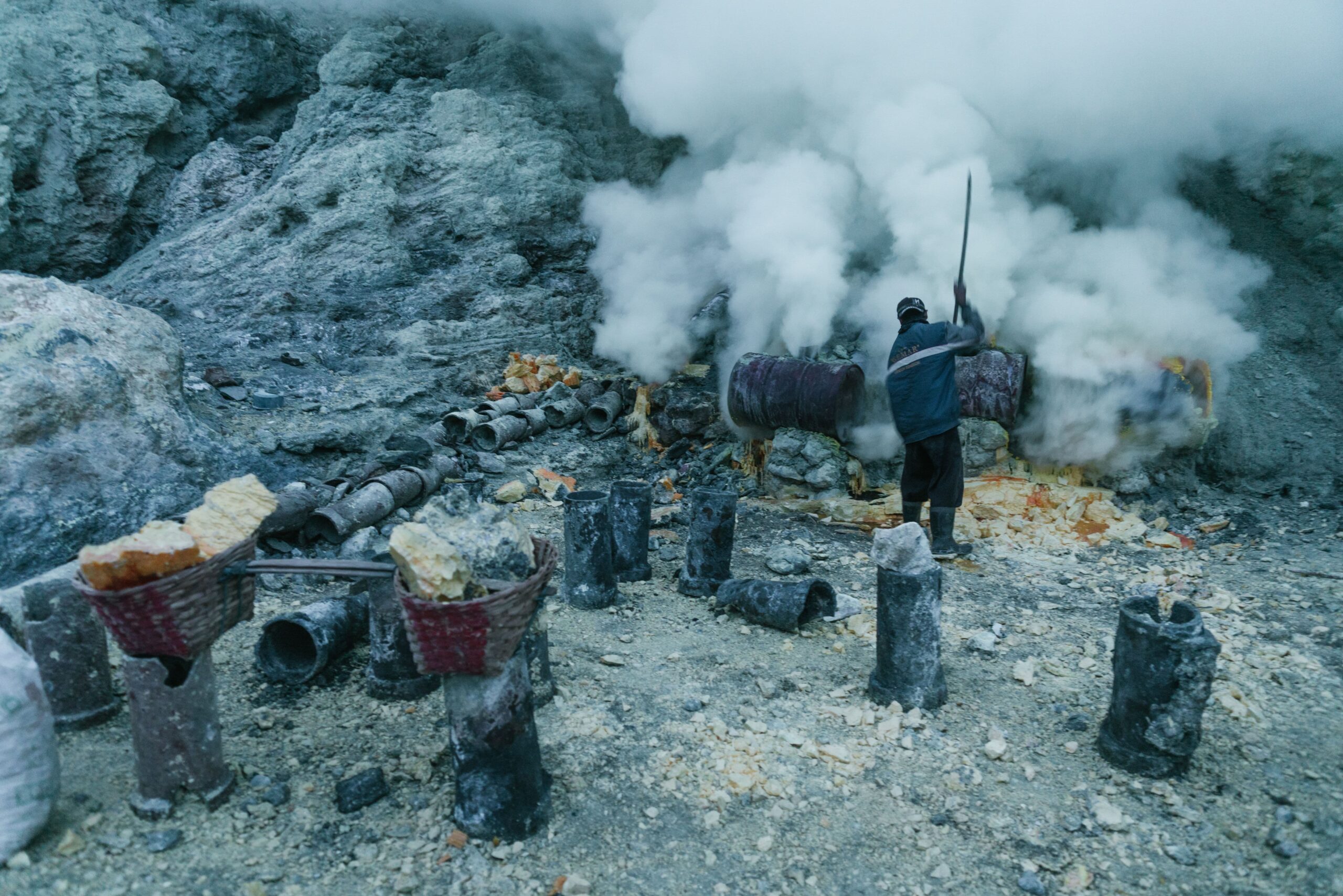
At the water’s edge, volcanic gas is channeled through handmade ceramic pipes, where it condenses into liquid, cools, and solidifies into the yellow rock the miners then break apart with iron bars.
But the real ordeal comes on the way back. Each miner loads between 175 and 200 pounds of mineral into bamboo baskets and hauls that weight back up the near-vertical crater wall — nearly 1,000 feet of ascent under a load that would buckle most people’s knees.
Once they crest the crater rim, they still face the nearly 2-mile descent back to base, where the sulfur is weighed and logged.
There are no machines here. There is only human muscle and an extraordinary force of will.
The miners pay for this work with their health. Arthritis, chronic back injuries, and persistent eye and throat irritation from constant gas exposure are among the most common consequences. Most descend into the crater with little more than a damp cloth held between their teeth as protection.
For all of this, they earn between $4 and $9 a day. And yet, for many, working at Kawah Ijen remains one of the most viable economic options available.
This labor — carried out by methods that seem almost prehistoric by contemporary standards — feeds a global industry. The sulfur extracted here is used to manufacture everything from dynamite to battery fluid to cosmetics.
Kawah Ijen produces roughly six tons of the mineral every day. It is an inexhaustible source, one that ensures that as long as the world demands these products, the men of Java will keep descending into the blue flames, carrying on their shoulders the weight of a geology as beautiful as it is merciless.