
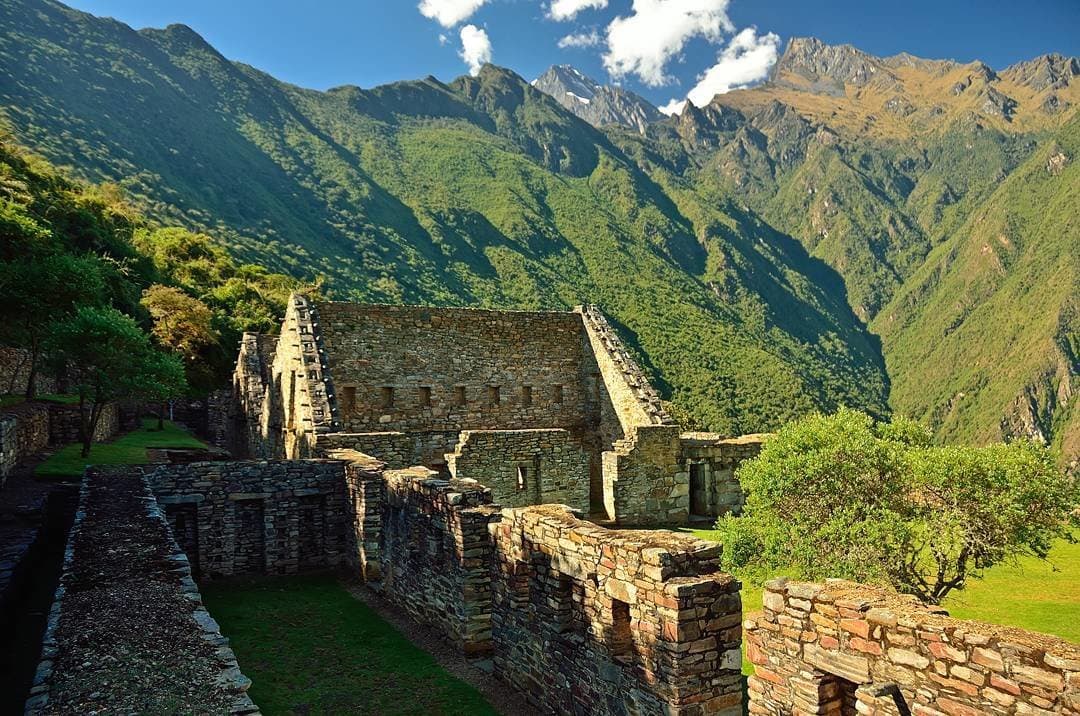
In southern Peru lies an archaeological site that few travelers ever get the chance to see: Choquequirao.
While the rest of the world fixes its gaze on the iconic silhouette of Machu Picchu, this stone citadel remains guarded by the Apurimac Canyon, beyond the reach of mass tourism.
In recent years, social media has brought it a measure of visibility, but the ruins scattered along the Sacred Valley continue to draw the overwhelming majority of visitors.
That relative isolation is precisely what has allowed Choquequirao to endure as one of the greatest legacies of an empire that once ruled the highlands of Peru, Chile, Ecuador, Bolivia, and Argentina.
Today, these ancient ruins offer a window into daily life and the Inca worldview. In that sense, Choquequirao, the unknown sister of Machu Picchu, reads like an open book.
Hidden in a remote corner of the Salcantay snowfields, the site can be reached only by an expedition that rivals — and in many ways surpasses — the legendary, overcrowded Inca Trail.
For those seeking authentic experiences in Peru, Choquequirao delivers.
The Story of Resistance Behind the Ruins
Approaching an archaeological site without first understanding its history is like trying to decipher a poem in a language you don’t speak: you can admire the calligraphy, but the meaning escapes you entirely.
Beyond its setting, what truly elevates Choquequirao is everything concealed within its ruins.
Much of the site remains unexcavated, but archaeologists believe its strategic position and scale point to a major administrative and control center within the empire.
That theory is reinforced by its similarities to Machu Picchu. Both share a layout divided between ceremonial and agricultural sectors, a precise astronomical orientation, and a system of terracing that seems to defy the laws of physics.
According to historical chronicles, Choquequirao took on vital strategic importance around 1536. It served not only as a link between Pisac and other sacred centers but also as the epicenter of resistance.
As Cusco fell under European control, this remote citadel became a refuge for the Incas of Vilcabamba. The Spanish never found it — a failure that allowed the city to remain hidden and to become the final stronghold of an empire that refused to vanish.
In time, Choquequirao was abandoned and forgotten, only to be rediscovered centuries later.
A number of archaeologists and explorers passed through its terraces over the years. Among them was Hiram Bingham, who walked its stones in 1909, several years before the world had ever heard of Machu Picchu. Ironically, Bingham failed to recognize its significance at the time.
Archaeological authorities were similarly unmoved by the find.
It was not until the late 20th century that the Peruvian government launched its most significant excavations and began serious restoration and conservation work.
Those efforts yielded a remarkable discovery: the Llamas of the Sun, a collection of 22 figures carved into white stone along the walls of the agricultural terraces. It is the only known Inca site where this type of rock art has been found integrated directly into the architecture — a clear sign that this was a ritual center of the highest order.
Today, the Peruvian government faces a persistent dilemma. On one hand, it hopes to avoid repeating what happened at Machu Picchu, a site whose popularity ultimately cost it some of its magic. On the other, it is pushing forward with development projects, including a proposed cable car.
For now, Cachora, the small town closest to the ruins, remains untouched by mass tourism. But no one knows when it might become the next Aguas Calientes — the bustling gateway village to the world’s most famous Inca citadel.
For the moment, silence and mist still own this place.
/ Wikimedia Commons / CC BY-SA 4.0
Getting to Choquequirao: An Epic Journey Through the Peruvian Mountains
Many travelers opt for the Inca Trail, but reaching Machu Picchu is, in truth, relatively straightforward — a train departs from Cusco or Ollantaytambo and handles most of the work. Choquequirao offers no such convenience.
Seeing this city for yourself means walking three to four days along one of the most demanding trekking routes in the region.
The journey begins in the beautiful, chaotic city of Cusco. From there, travelers make their way — independently or through a tour operator — to Cachora, the small village where the trek to Choquequirao officially begins.
Anyone who has walked the Inca Trail will find that this route is considerably more challenging, requiring a full crossing of the Apurimac River canyon. The slopes are steep, and the altitude is unrelenting. It is a test for the lungs, the legs, and the mind — and a gift to the soul.
The route unfolds over several days, passing a sequence of memorable landmarks. The first is the Capuliyoc viewpoint, which offers sweeping views of the Apurimac and the distant ruins of Choquequirao.
The next stop is Chiquisca, where trekkers spend their first night under canvas. The second day is the most punishing: after roughly eight hours of hard walking, the archaeological site finally comes into view.
Travelers camp near the ruins that night and begin the return to Chiquisca on the third day, passing spots like Playa Rosalina.
The final leg covers the remaining stretch back to Capuliyoc, from which a shared van returns to Cusco.
Round trip, the trek covers 38.5 miles and a total elevation change of 5,577 feet — first descending steeply, then climbing back through the Peruvian highlands.
Guided Tour or Independent Adventure?
This is, without question, the biggest decision every traveler faces. The good news is that both options are viable; it simply depends on the kind of experience you are after.
The appeal of organized tours is clear: they include a guide, transfers to and from Cusco, and, in many cases, meals and mules to carry the heavy gear. Going independently means shouldering everything yourself — trekking clothes, sleeping bag, tent, and cooking equipment — in a single pack. The freedom is absolute, but so is the weight.
Whichever path you choose, the emotional impact is the same. If Machu Picchu gave you chills, standing inside Choquequirao without the crowds — without the selfie sticks and the tour buses — will reach somewhere deeper.
Whether these ruins retain what made them extraordinary — the silence, the wildness, the sense of a place that history forgot — will depend on the Peruvian government, on local communities, and on the travelers who find their way here. It will depend on whether all of them choose to protect the last stronghold of Inca resistance, rather than simply consume it.