In the heart of the Jordanian desert, there is a portal.
The entrance to Petra is not just a doorway. The Siq, a narrow gorge more than one kilometer long, is flanked by rock walls that seem to pulse with life.
Its layers in shades of pink, red, and ochre transform with the light before your very eyes. To walk through those colored walls is like finding a crack in time, where each step deepens the silence and the air grows heavy with anticipation.
Suddenly, after walking through shadows and multiple turns, the gorge opens up, and the Treasury suddenly comes into view: Al-Khazneh, carved into the rock with impossible precision.
It is not just architecture, or at least not only that. Among the pink sandstone veins and the forms carved in what feels like another age entirely, the Treasury of Petra stands as a testament to human defiance against the passage of time in the middle of the desert.
An Oasis-City in the Desert
Petra was the capital of the Nabataeans, a people who mastered hydraulic engineering. They channeled rainwater and springs into reservoirs and cisterns. In this way, they made life possible where everything seemed hostile and uninhabitable.
Petra, between the Red Sea and the Dead Sea, between life and death, between tremors, water, and sandstorms. With a diet that included fish in the desert. Sheep and goats, and crops. Fountains and ponds carved into sandstone.
A struggle against nature and a breaking of the possible. A miracle city.
When Petra Lived and When Petra Slept
Petra was also a vital hub for more than five caravan routes that carried spices, incense, and silk to other cities. The Nabataeans levied substantial taxes on this trade.
Thanks to these luxury products that required their routes, the city prospered, along with the rulers and merchants who invested in building the stone-carved structures.
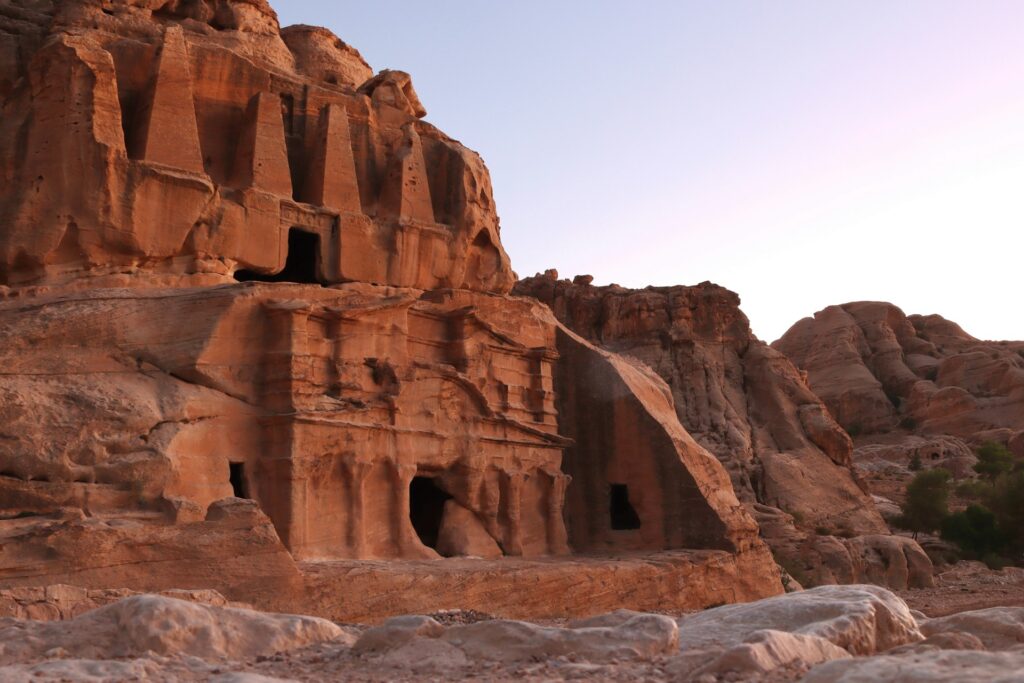
Filled with palace-like structures, homes, businesses, temples, and warehouses, with workshops and public spaces for leisure, Petra was also a city alive with constant activity. A city open to travelers from faraway places, even then. Its location might suggest it was a hidden refuge or a city that hoarded its secrets, but it was not so.
As centuries passed, trade shifted, routes were displaced, earthquakes struck, floods and sandstorms followed. Petra was abandoned.
The desert covered it like one body sheltering another.
Its ruins were not “rediscovered” by the West until the 19th century, but for local tribes, they had always been there, like a sleeping giant.
Even today, only a small portion of the lost city is known. The rest of what Petra has to tell still lies buried beneath its natural shelter.
The Echo of the Sacred
Petra is a natural amphitheater of stone and sand. As you walk through it, every facade tells a story.
There are temples, royal tombs where kings competed in death as in life — vying with one another, and even with the gods, to build the most magnificent eternal dwelling — stairs that climb into the sky, and roads that seem to lead nowhere.
The Monastery, higher and more solitary than the Treasury, crowns an ascent that can be exhausting. But the climb is well worth it: the journey itself is remarkable, and the views are not to be missed. Once there, the desert wind envelops everything, and fatigue gives way to reverence.
The city seems built to endure and vanish at the same time.
To walk through it, as with anything eternal, is to feel time as something vast and living — a force that connects us to something greater, destined to outlast us all.
A Heartbeat Beneath the Sand
Petra is not just an archaeological site: it is a place that breathes. A place that could well have emerged from a dream, inviting visitors to lose themselves among the landscapes that appear between the canyons, its buildings, and its panoramic views.
The desert surrounds it like a motionless sea, and at sunset the stones glow in shades ranging from gold to crimson. Nights are cold and starry, and sometimes the entire site is lit by thousands of candles to receive visitors.
In that moment, the entire city seems to awaken and reclaim its full, ancient glory.
It knows the same as we do: that it is one of the seven wonders of the New World.
The experience of visiting Petra speaks to that ineffable quality — the very thing that keeps literature alive — because it defies description. At dawn and dusk, it radiates, magical. Each step reveals a marvel. Left behind are the routines and rationalities of everyday life. Within its walls, something stirs — a spirituality we keep buried, like the desert itself, like that body that settles over another to protect it.