
Explore the villa
Inside the House of the Vettii
Four rooms the Vettii brothers used to stage their arrival. Select a space on the plan — or a room below — to read what Roman guests saw when they stepped inside.

Illustrated reconstruction of a Pompeian domus. Rooms indicated are those named in the text.
Room 01 · Fauces
Priapus at the threshold
The god Priapus greeted every visitor, weighing his phallus on a scale against a bag of gold. Not merely erotic: for Romans this was a symbol of protection, fertility, and — most pointedly — the wealth the Vettii brothers had amassed. The first thing guests saw was a declaration of fortune.
Room 02 · Exedra
The room of myths
The grand reception hall where the Vettii staged their most important gatherings. The walls dramatize scenes from mythology: Daedalus presenting the wooden cow to Pasiphae, a young Hercules proving his divine strength. Painted in the Fourth Pompeian Style, these frescoes earned the villa its modern nickname — the Sistine Chapel of Pompeii.
Room 03 · Triclinium
The dining room in black
A deliberate shift in register. Where the exedra dazzles with color and scale, the dining room retreats into black grounds and small-scale scenes — naval battles, everyday labor, miniatures that reward the close look. The intimacy was the point: dinner guests lingered among details.
Room 04 · Peristyle
Twelve fountains, one statement
The colonnaded garden at the heart of the house was an engineering feat: twelve ornamental fountains fed by a complex hydraulic system, framed by marble and bronze sculpture. For two freedmen who had once been slaves, it was the ultimate proof of arrival — a private Eden in the middle of Pompeii.
Roughly 2,000 years ago, the fury of Vesuvius devastated Pompeii, one of the most prosperous cities in southern Italy and a favored retreat for Romans escaping the bustle of the capital.
Today, legendary Pompeii serves as a living record of ancient Roman life.
Its most celebrated attraction today, the Casa dei Vetti, stuns visitors with its extraordinary frescoes. It is almost impossible to believe that these walls endured temperatures of 750 degrees Fahrenheit and lay buried for 2,000 years beneath a blanket of ash.
After 20 years of painstaking restoration, the villa has reopened, cementing its place as the crown jewel of Pompeii.
But its value goes beyond aesthetics. Its story is a testament to the Roman dream of social advancement.
The Day That Changed Pompeii Forever
The history of this city, which flourished within reach of the capital, changed dramatically on the morning of Aug. 24, 79 A.D. — or perhaps in October, according to more recent findings — when Mount Vesuvius erupted.
A violent explosion shattered the lives of Pompeii’s inhabitants. Hours later, a column of ash nearly 12 miles high rose above Vesuvius.
Disoriented and frightened, residents took shelter in their homes, unaware that the disaster had barely begun.
As the day wore on, the sky darkened and the wind carried the eruption column, which had now risen to nearly 22 miles.
By then, the prosperous and cosmopolitan Pompeii was buried under a hail of ash, pumice, and rock.
Many fled. Others stayed, unwilling to abandon their homes. Finally, Vesuvius delivered its deadliest blow in the early hours of Aug. 25.
Pompeii and the neighboring city of Herculaneum were buried beneath a pyroclastic surge of ash and debris at temperatures reaching 750 degrees Fahrenheit. Nothing would ever be the same.
At least not for a time — because centuries later, Pompeii would come to light again.
Ironically, the same pyroclastic cloud that brought death also ensured survival. The porous pumice sealed in the mineral pigments of the frescoes, shielding them from moisture and oxygen for nearly 2,000 years.
The first ruins were discovered in 1550, but excavations did not begin until 150 years later.
Today, Pompeii stands as the best-preserved first-century Roman city in human history and one of Italy’s most visited sites.
Millions walk its restored streets each year — a number that grew significantly after the 2023 reopening of the Casa dei Vetti, arguably Pompeii’s greatest artistic legacy.
Casa dei Vetti: The Story of Its Owners
The Casa dei Vetti was one of the most refined homes in Pompeii — but unlike the city’s other grand mansions, it did not belong to the old aristocracy.
Its owners, Aulus Vettius Conviva and Aulus Vettius Restitutus, were not born into privilege. They were liberti — freed slaves — who, after gaining their freedom, used the wine trade to climb the social ladder.
In this way, their home became something more than a residence: a declaration of status.
In a world where lineage was everything, the Vettii used their sprawling villa to demonstrate that money and commercial success could buy the respect their origins had denied them.
What Do the Murals of the Casa dei Vetti Tell Us?
The vivid paintings covering the walls of the Casa dei Vetti draw on the mythology of the era, depicting characters and scenes from ancient Roman life.
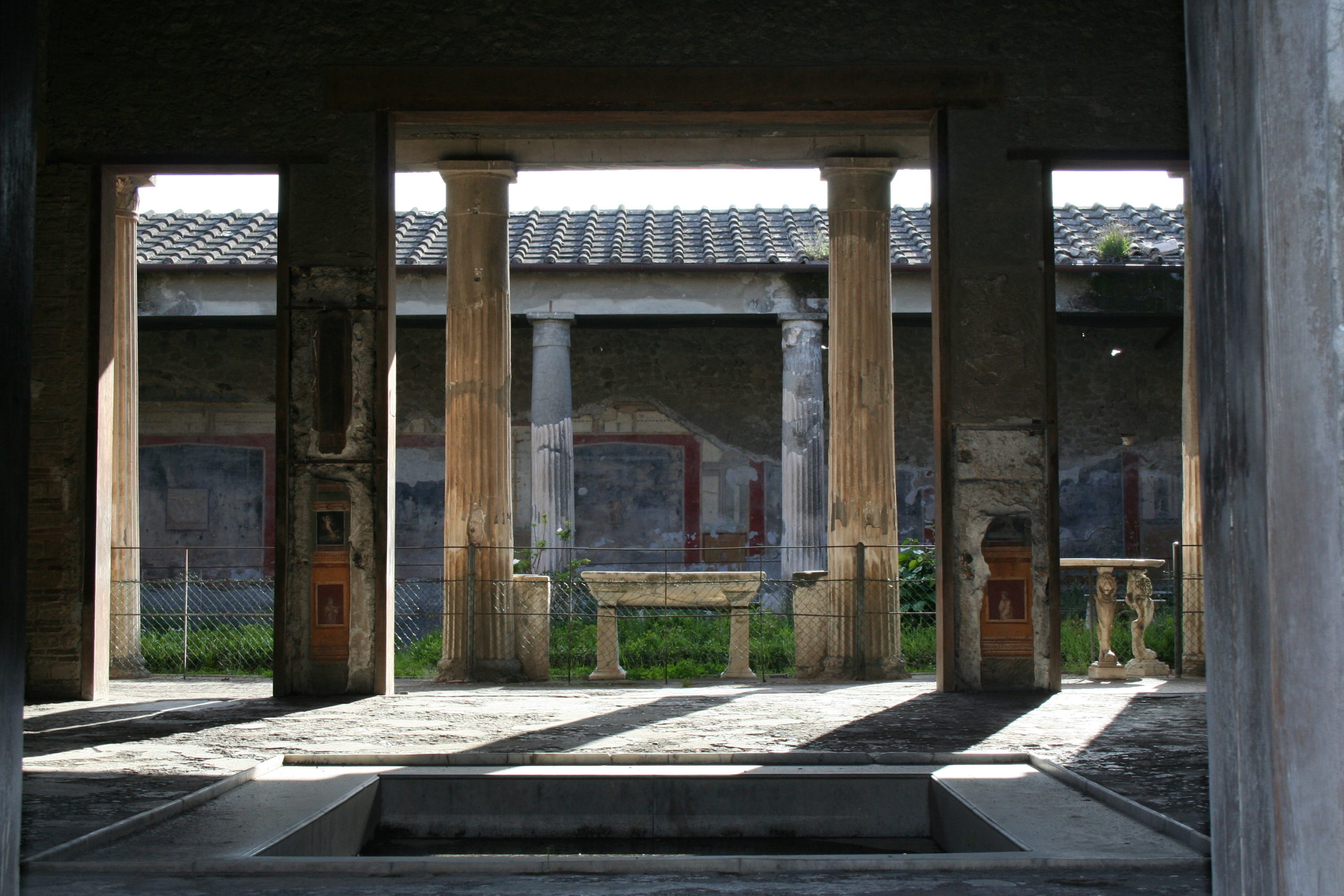
Often called the “Sistine Chapel of Pompeii,” the Casa dei Vetti is the finest surviving example of the so-called Fourth Pompeian Style.
Using modern conservation techniques, restorers removed more than a century’s worth of wax and ash that had dulled the frescoes, revealing a palette of startling vibrancy — almost impossible to imagine surviving from the first century.
At the villa’s entrance, the god Priapus greets visitors by weighing his enormous phallus on a scale against a bag of gold. It is not merely an erotic image; for Romans, it was a symbol of protection, fertility, and above all, the immense wealth the two brothers had accumulated.
In the Exedra — the hall where Romans held important gatherings — the walls come alive with dramatic scenes of Daedalus presenting the wooden cow to Pasiphae and the young Hercules displaying his divine strength.
The triclinium, by contrast, forgoes bright color. Black dominates, punctuated by small images depicting naval battles and scenes of daily labor.
If the interior was impressive, the central courtyard — the peristyle — was a feat of engineering. The Vettii installed an elaborate hydraulic system that supplied 12 ornamental fountains, flanked by marble and bronze sculptures.
Walking through this restored garden today, with its period plantings, makes it easy to understand why Pompeii was the preferred escape for those fleeing the chaos of Rome.
How to Visit Pompeii and the Casa dei Vetti
Visiting Pompeii is an experience that stays with you from the very first moment.
Just 19 miles from Naples and easily reached by train from Rome, the ruins draw more than three million visitors a year.
A general admission ticket covers the main archaeological areas, but if you want to visit the Casa dei Vetti, check the official website of the archaeological park before you go to confirm it is open — access is occasionally restricted for maintenance.
While the site can be explored independently, a guided tour is essential for spotting the graffiti and hidden details that reveal the daily lives of the slaves who worked for the Vettii.
One final note: to get the most from the experience, arrive early, wear comfortable shoes, and bring water and sunscreen. Pompeii can be as stifling as it is extraordinary.
Places like the Casa dei Vetti remind us that Pompeii is more than ruins. It is a record of human ambition, artistic expression, and history’s refusal to be forgotten.