
Antoni Gaudi was a visionary who transformed Catalan modernism and left his most enduring legacy in Barcelona. Among his many works, none carries more weight — architecturally, spiritually, or symbolically — than the Sagrada Familia, a basilica whose soaring silhouette — and whose story — has become inseparable from the city itself.
If you have visited Barcelona, you have almost certainly seen the lines stretching around the block, the crowds craning their necks at the facades, the phones raised in every direction. The fascination is understandable.
But what draws people is not simply the height of the towers or the way light pours through the stained glass. It is the symbolic weight of every element, the sense that nothing here was placed by accident, that every detail — down to the smallest carved figure — reflects the mind of one extraordinary artist.
Entering the basilica without an audio guide or an expert to guide you is, in a sense, like trying to read a book in a language you have never studied.
The history and symbolism of the Sagrada Familia demand time, contemplation, and a little preparation before you arrive. If you are planning a trip to Barcelona, you can start here.
The Timeline of Gaudi’s Masterpiece
Although the Basilica de la Sagrada Familia is synonymous with Gaudi, he was not the one who broke ground.
In 1882, Francisco de Paula del Villar laid the cornerstone. Barcelona at the time was still encircled by its old city walls, which would soon be torn down, allowing the city to expand outward in its famous grid — a grid that would slowly grow to surround the temple on all sides.
By late 1883, the project had passed to Gaudi. The original plan was already ambitious: a five-nave temple with three facades and 18 towers. Gaudi took it even further, devoting 43 years of his life to the work.
In 1914, he stepped away from all other commissions and gave himself entirely to the temple. Nine years later, the bell tower of the Nativity Facade was complete.
Gaudi knew he would not live to see the finished building. What he could not have foreseen was how soon he would be gone. On June 10, 1926, he was struck by a tram and died. Four years later, the Nativity Facade was finally complete — but the architect who had conceived it was not there to see it.
Many architects carried the work forward after him. Among the first was Domenec Sugranes, his disciple and immediate successor. Then, in 1938, the Spanish Civil War took its toll: the crypt and the workshop where Gaudi’s original plans and models were stored were set on fire.
Much of that material was lost forever. But rather than ending Gaudi’s dream, the destruction may have been exactly what drove his successors to study his work all the more closely, piecing together his intentions from whatever fragments remained.
The Sagrada Familia as it stands today is the product of a single great idea brought to life by many hands, from Antoni Gaudi himself to Jordi Fauli Oller, who has led the project since 2012.
What survived the fire is now on display in the museum housed in the basilica’s lower level — plans, models, documents, sketches, photographs, and letters that would guide every architect who came after.
The Sagrada Familia evolved from a neo-Gothic project into something far more radical: a revolutionary organic work unlike anything built before or since. It is classified as an expiatory temple because its construction has always been funded entirely through donations and alms — a fact that also explains the stop-and-start rhythm of a project now approaching 150 years in the making.
The Symbolism of the Towers and Facades
Gaudi was not only an architect. He was a devout Catholic, and he poured that faith into the building in ways that were anything but conventional.
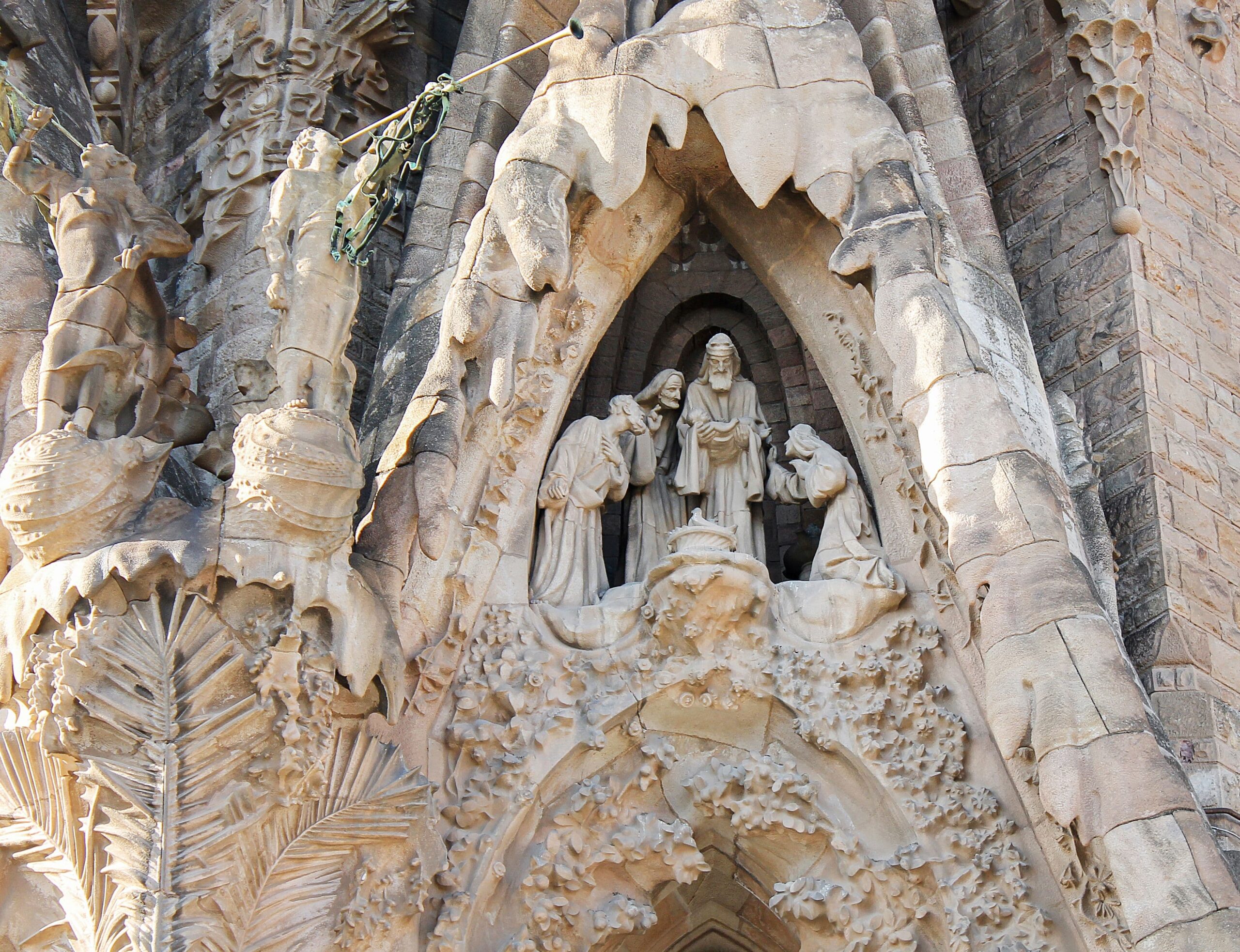
The Sagrada Familia is saturated with religious symbolism, beginning with its towers and facades.
The three facades represent the most significant moments in the life of Jesus. Two of them — the Nativity Facade and the Passion Facade — are complete. The Glory Facade, the grandest of the three, is expected to reach its full form around 2034. The Sagrada Familia, it bears repeating, is still unfinished.
The towers number 18 in total: 12 dedicated to the apostles, four to the evangelists, one to the Virgin Mary, and the central tower — rising 566 feet — to Jesus Christ. That central tower was recently inaugurated, marking an architectural milestone that makes the Sagrada Familia the tallest Catholic church in the world.
Crowned by a four-armed cross standing nearly 56 feet tall, the Tower of Jesus Christ is aligned with the cardinal points. Its final height is no accident either.
Gaudi set a deliberate limit: the tower would not exceed the height of Montjuic, the hill that rises over Barcelona. In doing so, he chose to honor the work of the Creator over the ambitions of man.
Architecture as Nature
The Sagrada Familia bears almost no resemblance to a conventional Catholic church.
Gaudi conceived the interior as a forest, where the columns are not mere structural supports but tree trunks that branch upward into knots and capitals, spreading into vaults that mimic a canopy of leaves.
The result is a monumental space defined by verticality, one that compels the eye — and the spirit — upward. Beneath it all, in the crypt, rest the remains of the architect himself.
Just as the columns draw the gaze toward the sky, the play of light through the stained glass carries its own deep symbolism. The cool blues and greens on the eastern side greet the dawn — the Nativity, birth, beginnings. The deep reds and oranges on the western Passion Facade evoke dusk, death, and the final hours.
The Hidden Details and Secrets of the Sagrada Familia
Beyond its overwhelming scale, the Sagrada Familia is a microcosm of obsessively planned detail.
Gaudi was a tireless observer of the natural world, and he carried it into the temple in surprising forms, leaving traces of his genius in every corner.
On the Nativity Facade, one tower bears the letter B. It marks the tower dedicated to Saint Barnabas — the only tower Gaudi lived to see completed. Knowing he would not finish the rest, he built it as a full-scale model for the architects who would follow him.
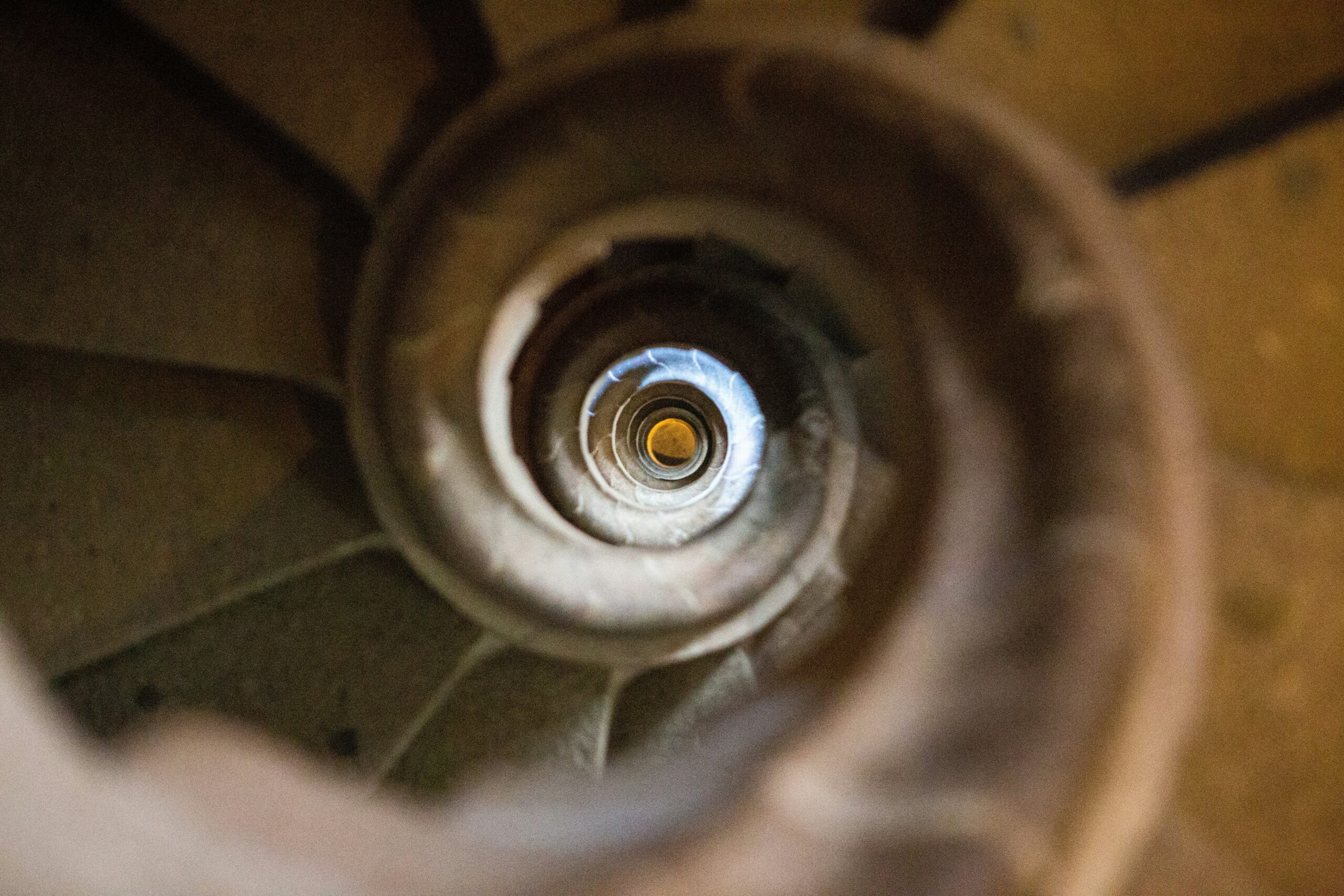
Gaudi’s ingenuity also winds through the more than 300 spiral staircases that climb through the towers. These, too, were placed with intention.
The staircases on the eastern side, facing the sea, are marked with a carved sea snail. Those on the western side, facing the mountain, display a land snail. The helical form is not merely aesthetic — it creates a shifting interplay of light and shadow that draws visitors upward toward the summit.
The same naturalist eye shaped the apse, where Gaudi replaced the traditional medieval gargoyles with realistic depictions of local fauna. Reptiles and amphibians hang upside down along the walls.
The design serves a dual purpose: functionally, they channel rainwater away from the structure; symbolically, they represent creatures that appear to flee from the divine light emanating from within the temple.
One final detail deserves attention before you leave: the enigma embedded in the Passion Facade. Alongside the angular sculptures of Josep Maria Subirachs, a magic square of 16 numbers poses a quiet challenge to every visitor.
It is a mathematical grid in which every row, column, and diagonal adds up to the same number: 33 — the age, according to tradition, at which Christ died. The square was not created from scratch. Its designer drew on the famous magic square by Dürer, then altered two of the numbers so that the constant would align precisely with the Christian symbolism woven through every stone of the temple.
Through its history and its symbolism, the Sagrada Familia has gone from near-utopian dream to UNESCO World Heritage Site.
It is, by almost any measure, one of the most beloved churches on earth — a living work of art that stands as a testament to what becomes possible when a singular mind refuses to think small.