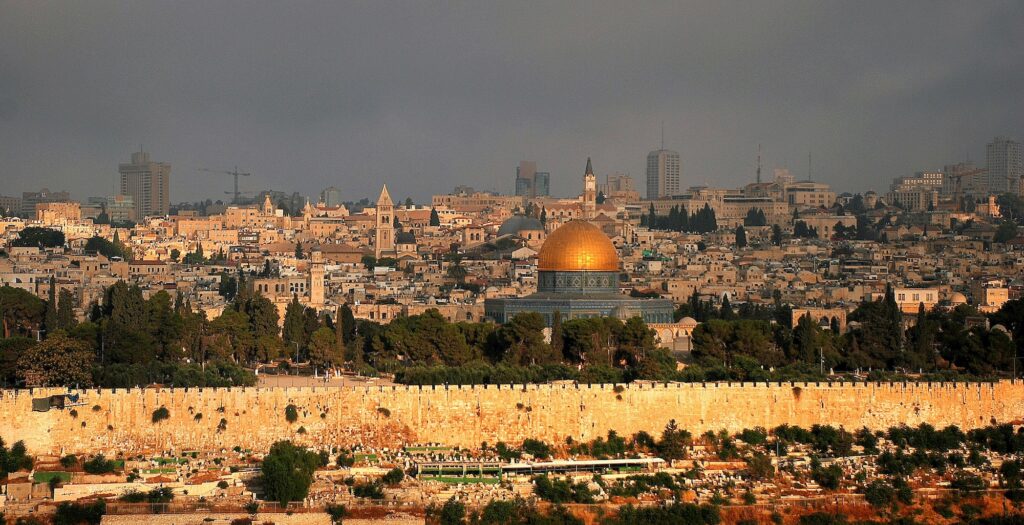
From the top of the Mount of Olives, Jerusalem appears as a city with a living history beneath every stone.
A Glimpse Into Eternity
In the Kidron Valley, east of the Old City, the Mount of Olives is one of the best places to view Jerusalem. It is stunning all day long and offers remarkable sunsets.
As a living witness to the city’s history and also its backdrop, the Mount of Olives figures prominently in several biblical passages, witnessed wars and their consequences, and has been the chosen resting place for tens of thousands of Jews.
From its peak, you can see the Temple Mount, the Western Wall, the Dome of the Rock, and the Church of the Holy Sepulchre.
The view seems frozen in time.
This hill is also one of the most sacred places in the world. In Jewish tradition, it is believed that from here God will begin to redeem the dead at the end of time.
That is why thousands of tombs cover its slopes, forming a white shroud of stone and silence in a cemetery that holds the remains of numerous historical figures. Visiting it is an unmissable experience.
The mount is located across from the Golden Gate: the only one of the eight gates of the Old City that is sealed. It is said that the Messiah will enter through this gate upon his arrival.
A Crossroads of Spiritual Paths
The Mount of Olives is important for Jews, Christians, and Muslims. In this part of the city, according to the New Testament, stands the Church of All Nations, where it is said that Jesus used to pray, and where he prayed on the night of his arrest.
Higher up, the Chapel of the Ascension marks the place from which Jesus ascended to heaven.
For Islam, the mount is part of the sacred landscape surrounding Al-Quds (the Arabic name for Jerusalem), and some legends associate it with the Day of Judgment.
In the Bible, the olive tree symbolizes peace, spirituality, and the divine covenant. The mount embodies those symbols, emerging as a place where the world’s great faiths converge.
Thus, on a single hill, times, languages, scriptures, and beliefs intersect. A cultural and religious crossroads, all distilled into a breathtaking landscape of stone and golden rooftops.
The silence of the mount is, in truth, a vast unspoken conversation. But if you pay attention, you can sense a little of it.
Intense Jerusalem
Beyond the Mount, Jerusalem hums with an intensity that is hard to put into words. In its streets, religions and eras intermingle with daily life.
Pilgrims, merchants, tourists, soldiers, students: everyone walks among walls that have seen empires and prophecies come and go.
In the song Jerusalem of Gold, by Naomi Shemer, Jerusalem is rightly described as a city of gold, bronze, and light. Listening to it before traveling, and again once you’re there, adds a romantic depth to the experience that is hard to forget: “your name burns my lips / like an angelic kiss, / if I forget you, / Jerusalem, golden city”.
The Old City, divided into four quarters (Jewish, Christian, Muslim, and Armenian), contains some of the most iconic sites in the world’s religious history, but also markets, scents, debates, prayers, and contradictions.
Viewed from above, Jerusalem looks like an eternal postcard. Walking through its streets, you feel something profoundly alive.
It is not only the people walking, talking, and shopping: it is also the scent of old stones, living traditions, and the feeling of stepping on historic ground that continues to gather the footprints of the present.
An Experience That Leaves Its Mark
From the top of the Mount of Olives, you take in an awe-inspiring landscape.
It does not matter if you come for religious, historical, or emotional reasons — something happens. You feel it like vertigo — the same sensation as standing before a towering mountain or watching a waterfall crash endlessly into the river below.
Perhaps it is seeing the city to scale, or the weight of history layered into its stones and sacred buildings. The faint scent of olive trees when the wind passes through. Perhaps it is the closeness between beauty and the conflict that beats, between the human and the transcendent.
But the truth is that from there, Jerusalem etches itself into your memory with a force that doesn’t fade.
Like an unforgettable photograph.