

Off the southeastern coast of Pohnpei, in Micronesia, lies one of the most important archaeological sites in the Pacific — and one of its most enigmatic: Nan Madol.
Built from basalt columns and coral rock, the ancient city spreads across a labyrinth of 94 artificial islets, each rising from the sea.
It is the only ancient city ever built on a reef. It is also a place steeped in legend and mystery that remains unexplained to this day.
How were enormous basalt stones transported from the far side of the island without pulleys, wheels, or draft animals?
That question has no satisfying answer. Nan Madol is a place that seems to defy ordinary logic.
The Origin of Nan Madol, Told Through Legend and Myth
Often called the “Venice of Micronesia,” this archaeological site — today a UNESCO World Heritage Site in Danger — was not carved from the earth. It was summoned from the ocean itself.
Nan Madol was built directly over the sea, through an intricate system of artificial islets and an ancient engineering tradition that continues to baffle researchers.
The city’s imposing ruins were constructed using more than 750,000 tons of prismatic basalt columns — formations that appear hand-cut but are in fact volcanic in origin — transported from the opposite coast of Pohnpei. That in itself is only the first mystery.
There is no record of pulleys, wheels, or oxen ever being used. The sheer density of the stonework rivals that of the pyramids at Giza — except here, the foundation was not desert bedrock. It was a living coral reef, expected to bear hundreds of thousands of tons without sinking.
Both science and local folklore have attempted to explain the mysterious transport of the stones from distant quarries.
Researchers suggest that palm-log rafts, combined with the force of tidal currents, may have allowed the heavy basalt columns to be floated around the coast of the island. A system of levers, they theorize, was then used to stack the stones in alternating layers, like the timbers of a log cabin.
Through this method, elevated platforms, ceremonial sites, tombs, crypts, and dwellings were raised to house the now-vanished inhabitants of Nan Madol. The logic relied on the weight and position of each column, with coral fill used to stabilize the structure.
But sometimes engineering logic can’t account for what seems impossible. In those gaps, it is the oral histories that take over — and Nan Madol has plenty of its own.
For the people of Pohnpei, the city’s twin founders, Olisihpa and Olosohpa, used magic to make the stones fly through the air and settle into place.
Oral tradition also speaks of a series of channels through which eels — animals considered sacred to this day — entered the city from the sea. On the small island of Idehd, a well was said to be inhabited by an eel that embodied a marine deity, fed by priests with the entrails of sea turtles.
Curiously, traces of these canal systems have been found. A large mound containing turtle remains was also discovered on Idehd. So where does myth end and history begin at Nan Madol?
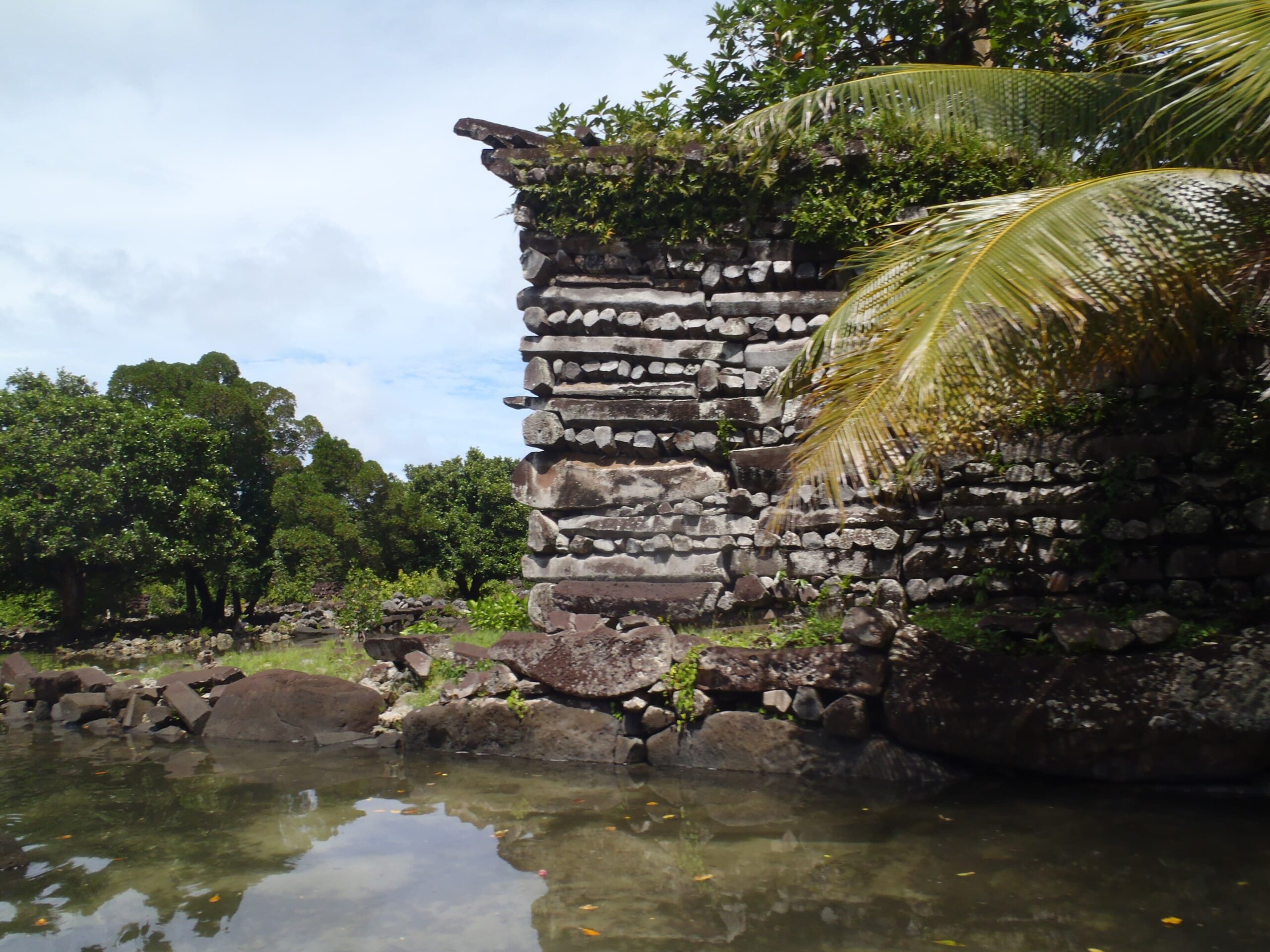
The Sanctuary of Giants: Nandauwas
If the history of Nan Madol is an enigma, the islet of Nandauwas is its boldest statement.
The most elaborate structure in the entire city, it served as the principal ceremonial center and stands as the most compelling evidence of an architectural ambition that defies easy explanation.
Its enclosure was protected by walls rising nearly 26 feet high. Within them, surrounded by sepulchral silence, lay the remains of the first Saudeleur king — founder of the dynasty that ruled Nan Madol for more than a millennium.
What makes Nandauwas remarkable is its use of the cobwork technique. Basalt columns were stacked in alternating layers and held in place by their own weight and the precision with which they were fitted together — a method that has withstood centuries of typhoons and the relentless battering of the Pacific.
But its labyrinthine design served a purpose beyond physical defense. The inner passages of Nandauwas are said to have channeled the voices of ancestors, and ancient kings reportedly used the acoustics of the stone walls to communicate with the deities of the reef.
Imagine a cathedral of volcanic rock floating above a coral garden — a monument built by a dynasty determined to leave a mark that not even the ocean could erase.
The Rise and Fall of a Dynasty That Collapsed Under Its Own Weight
For anyone trying to place Nan Madol on a historical timeline, the story begins somewhere between 900 and 1200 A.D. The precise date of construction remains uncertain, but it is within that window that the elevated islets are believed to have been raised.
The first monumental burial is thought to have taken place around 1200 A.D., when the Saudeleur chief was interred in the coral and basalt tomb described above.
What followed was a period of megalithic construction on a massive scale, extending through 1600 A.D.
The Saudeleur gave Nan Madol its grandeur, but that grandeur had a darker side. The dynasty ruled not only the territory but also the will of its people.
What began as a system of centralized governance gradually hardened into a suffocating tyranny, in which tribute — paid in food, labor, and sacrifice — became unbearable.
According to legend, the last kings of Nan Madol demanded control over the dreams and thoughts of their subjects. That overreach sowed the resentment that would eventually undermine the city’s basalt foundations.
The city’s survival also depended entirely on the mainland, since there were no freshwater sources on the islets.
This required a daily procession of canoes carrying supplies from the interior of Pohnpei to the priestly and warrior elite who lived on the water.
In oral tradition, the end of the Saudeleur came in the form of Isokelekel, a semi-divine warrior who led a fleet of canoes from the island of Kosrae, arriving with a promise of liberation for a subjugated people.
After a series of battles that stained the coral channels red, the last Saudeleur was defeated. According to legend, he escaped his fate by transforming into a fish and fleeing downstream.
A new chapter in the history of Nan Madol began: the establishment of the Nahnmwarki chieftainship system, which persists to this day.
But the new rulers, fearful of the spirits of the ancient kings, chose to move their residence to dry land. Without the constant labor of enslaved workers to maintain it, the canals of Nan Madol were surrendered to time — and to a nature that quickly forced its way through the cracks in the basalt.
Today the city, ruined by abandonment, stands as a sacred relic — a place the islanders prefer to keep at a distance. For the people of Pohnpei, spirits inhabit the ruins after dark — and it is better, they say, to keep away.