The world offers no shortage of monuments to human ingenuity, but few places challenge the laws of physics and time quite like the Kailasa Temple.
This colossal structure wasn’t built from brick or mortar. It was carved out of a mountain, from the top down, with the precision of a master jeweler working a single mass of basaltic rock.
To witness this wonder, you must travel to the heart of India and into the extraordinary complex of the Ellora Caves in Maharashtra.
There, the landscape opens onto a sweeping ensemble of temples and monasteries cut directly into the cliff face — a place that is not only a UNESCO World Heritage Site but a living testament to India’s religious pluralism, where Buddhist, Jain, and Hindu traditions coexist in remarkable harmony.
The jewel of the complex, the Kailasa Temple, continues to guard secrets that modern archaeology has barely begun to uncover.
How did its builders achieve such geometric precision in the 8th century, without digital mapping or heavy machinery? Where did the more than 200,000 tons of debris go — the rock that, by any estimate, had to be removed from the hillside?
What remains is a wonder of India that inspires awe at the minds that conceived it and the hands that brought it into being. With patience, time, and an unwavering faith, the Kailasa Temple took shape — and has survived the centuries intact.
The Extraordinary Construction of the Kailasa Temple
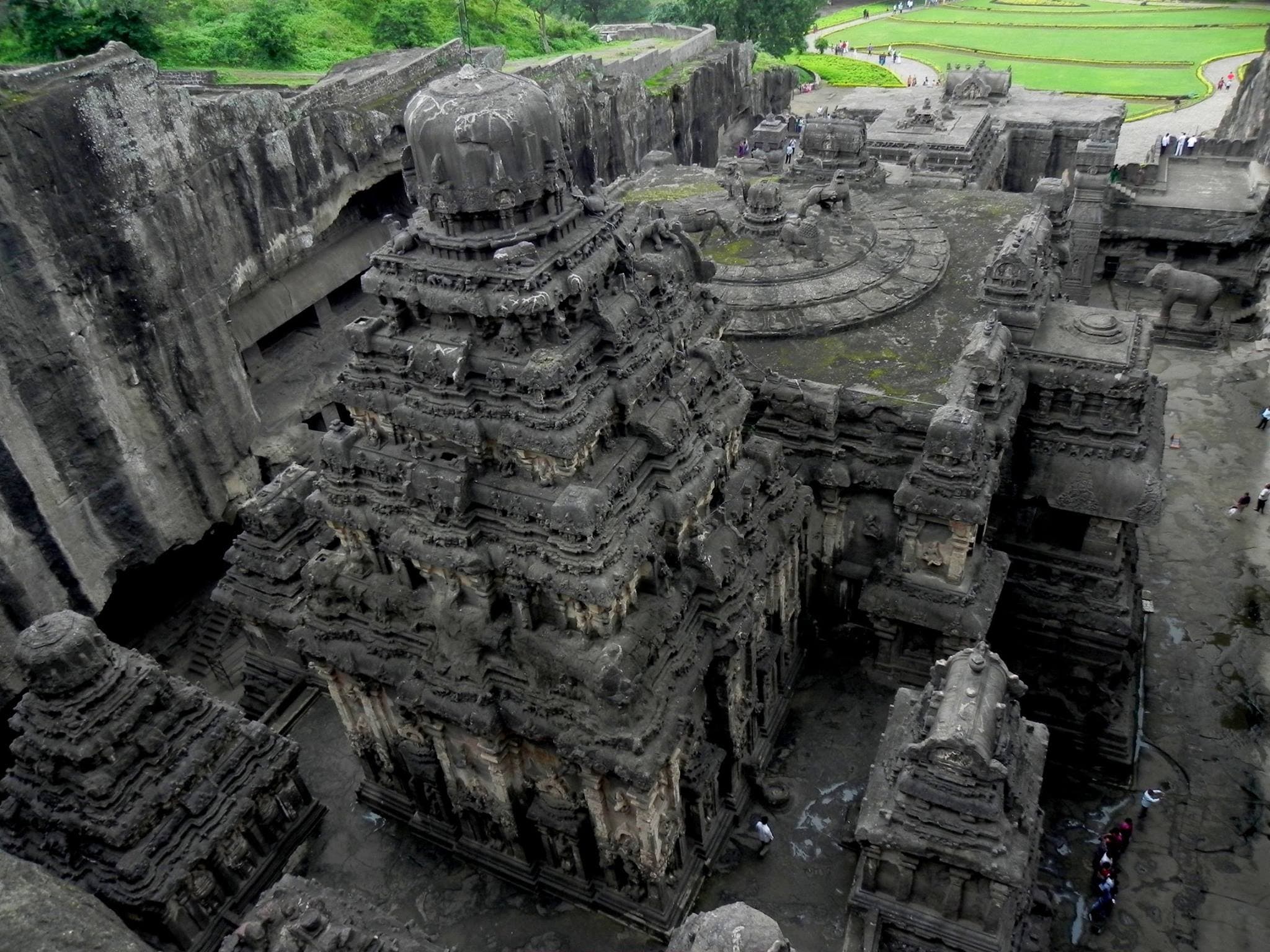
The Kailasa Temple is the largest monolithic structure in the world. But what truly sets it apart goes well beyond its size. Equally astonishing is the intricacy of its carved detail, the labyrinthine system of interior chambers, and an ingeniously designed drainage network.
Scholars date the start of construction to the 6th century, with completion around the 10th century A.D. Local tradition, however, attributes the Kailasa Temple to the reign of Krishna I (756-773 A.D.) of the Rashtrakuta dynasty.
Architects, supervisors, and master carvers worked together to achieve a level of precision that is difficult to comprehend even today.
The process began by marking the outline of the temple at the top of the basaltic rock face. Deep trenches were then cut around that outline, isolating an enormous rectangular block from the surrounding stone.
Unlike a conventional building project, Ellora required no external scaffolding at all. Instead, builders employed a vertical carving system that turned gravity into an ally. Debris fell naturally to lower levels, clearing the workspace with no extra effort.
This top-down method preserved the structural integrity of the upper sections throughout the entire process. Beginning with the roof also meant that the interior chambers and the most delicate reliefs were sheltered from the elements from the very first day of work.
Another detail that sets the Kailasa Temple apart is its integrated drainage system, engineered before the carving even began. Rainwater was redirected away from the carved foundations, preventing the kind of destructive seepage that might otherwise have compromised the structure over centuries.
All of this was accomplished with tools as simple as iron wedges, levers, picks, hammers, and hardened chisels.
The 3D modeling software architects rely on today was not merely unavailable — it was unimaginable. And yet it was not needed, which may be the best evidence of what human ingenuity and sheer determination can achieve. The Kailasa Temple stands as proof.
As for the more than 200,000 tons of extracted basaltic rock — no one knows where it went.
This is, in fact, one of the great mysteries of the Kailasa Temple. That much material would have left an unmistakable mark on the surrounding landscape. Yet there is no trace of that debris anywhere near the Ellora Caves. It vanished from history as completely as if it had never existed.
Then there is the matter of what the temple survived. Soldiers of the Mughal emperor Aurangzeb worked relentlessly for three years to demolish the structure. They managed to disfigure a handful of statues. The temple itself emerged essentially untouched. Nor did natural disasters succeed where the soldiers had failed.
Through the advanced engineering of its time — and perhaps, as the faithful would have it, through divine protection — the Kailasa Temple endures today as something you can touch, stand before, and struggle to comprehend.
The Sacred Mountain: Where Heaven Meets Stone
The name of this monument is no accident. In Hindu mythology, Mount Kailash — located in the remote reaches of Tibet — is the axis of the world, the eternal dwelling place of the god Shiva.
The architects of Ellora were not building a simple temple or place of worship. Their ultimate ambition was to recreate the Himalayan mountain range in the heart of the sun-scorched plains of Maharashtra.
In its original form, the temple was coated in a thick layer of white plaster. That finish has long since worn away, but its symbolism was deliberate. Under moonlight, the structure would have gleamed as if blanketed in eternal snow, mirroring the frozen peaks where the deity was believed to reside.
At the base, life-size elephants, carved in relief, appear to carry the full weight of the mountain on their backs — representing how the universe rests on the strength and steadiness of the natural world.
The interior carries its own symbolic weight. Moving through its chambers is meant to enact the soul’s journey toward enlightenment. Step by step, the pilgrim arrives at the heart of the temple, where the Shiva Lingam resides — the symbol of creative energy and the origin of all that exists.
The walls tell stories. Among them, the most arresting is the scene of the demon Ravana trying to uproot the mountain to prove his power. The sculpture captures the full drama of the moment: gods tremble, animals flee in terror, and Shiva remains utterly unmoved.
The god’s response, rendered in stone, is almost casual in its confidence. He simply presses one toe into the ground, pinning the demon beneath the mountain’s weight. It is a demonstration of absolute divine power rendered in the most physical terms imaginable.
The Kailasa Temple is a testament to what human potential can achieve when technical mastery and spiritual devotion converge around a single purpose.
Walking its corridors, beneath the gaze of ancient gods and stone elephants, it is difficult not to feel diminished before a work that was born from absence — from rock removed rather than stone laid.
The questions that remain unanswered about its construction are, perhaps, its greatest achievement. In a world that insists on explaining everything, Kailasa endures as a genuine enigma carved in stone.