

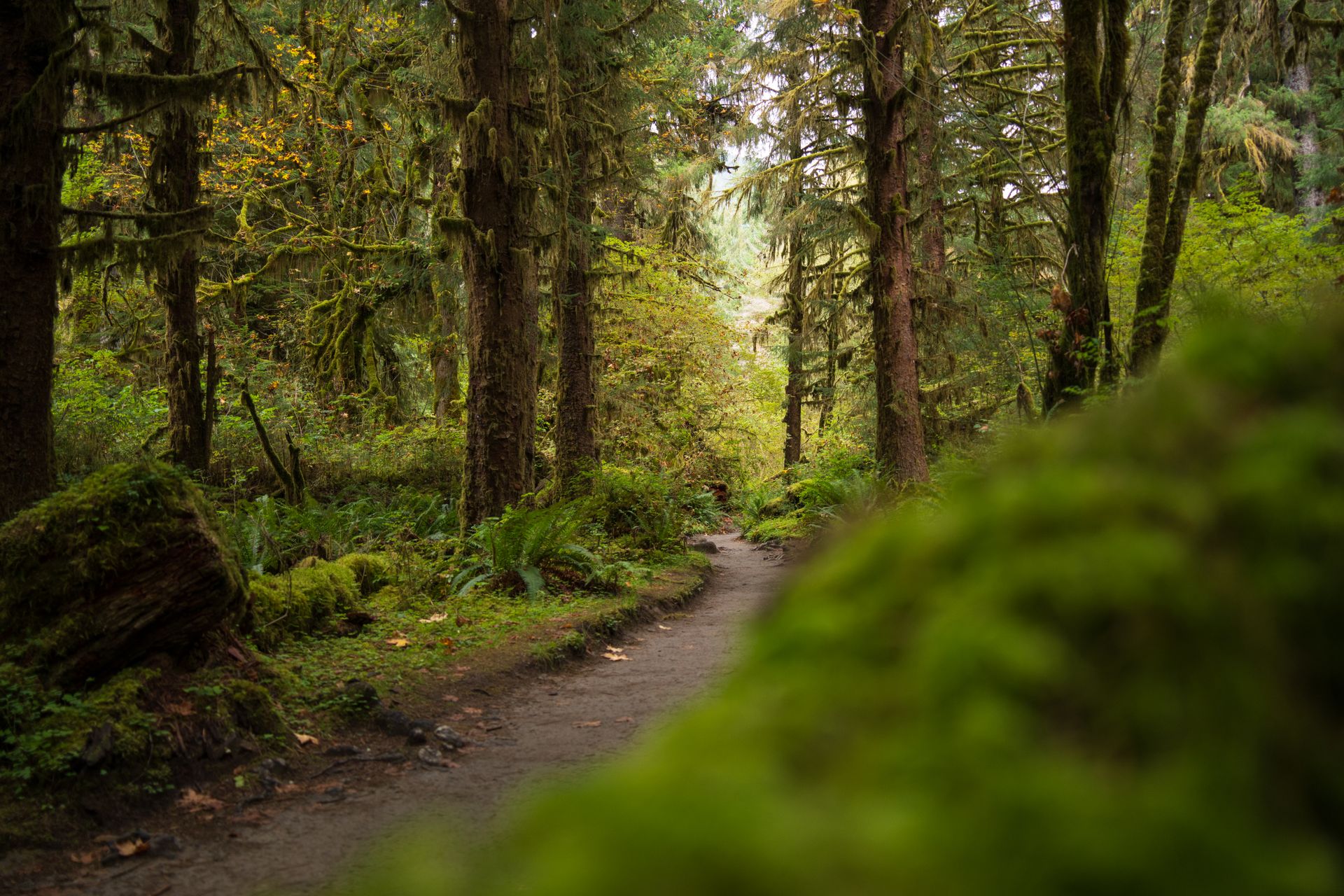
In the far northwestern corner of the United States, on Washington’s Olympic Peninsula, there is a place that feels borrowed from another world. Trees rising more than 295 feet are draped from crown to root in moss. Ferns grow chest-high. The humidity is so constant and so dense that the air itself seems to have weight.
This is Hoh Rainforest, one of the last intact temperate rainforests on Earth, protected within Olympic National Park.
An Ecosystem That Is Not Tropical — Though It Looks the Part
For all its lushness, the Hoh is not a tropical rainforest. It is a temperate rainforest, a far rarer type of ecosystem worldwide, and one that depends on a very specific combination of factors: proximity to the ocean, mountain ranges that trap moisture-laden clouds, and mild temperatures year-round.
At Hoh, the formula works because the valley sits roughly 25 miles inland from the Pacific, on the western slope of the Olympic Mountains, where humid winds rolling off the ocean collide with the range and wring out rain in an almost unbroken cycle.
The result is a forest that receives between 11 and 14 feet of precipitation each year, making it one of the wettest places in the contiguous United States.
That relentless moisture is what lets thick layers of moss hang from every branch, transforms fallen logs — known as nurse logs — into cradles for new trees, and supports a level of per-acre biodiversity that multiple studies rank among the highest on the planet.
Flora and Fauna: Who Lives Beneath All That Moss
The undisputed star of the Hoh is the Roosevelt elk, the largest subspecies of North American elk, which has found close to an ideal habitat in this valley: abundant vegetation and no hunting pressure within the park’s boundaries.
You’ll often come across a herd grazing near the river, especially at dawn or dusk. The park recommends keeping at least 150 feet of distance for the safety of both visitors and wildlife.
The rest of the ecosystem is equally remarkable: black-tailed deer, mountain lions that move far more elusively, a wide variety of temperate forest birds, and the famous banana slug — a reliable favorite with younger visitors.
In autumn, the Hoh River comes alive with the salmon migration, as fish push upstream to spawn and draw other forest predators along with them.
The dominant trees are Sitka spruce and Douglas fir, some more than 500 years old, alongside big-leaf maples so thickly covered in club moss they look padded. Beneath them, sword ferns carpet the forest floor in an almost unbroken green.
The Most Popular Trails
Most visitors stick to two short trails that begin near the Visitor Center.
The Hall of Mosses, at just under a mile, is the most iconic trail in the forest — and the most visited. It loops through a cathedral of moss-draped trees and passes through the Maple Grove, a stand of big-leaf maples that is, by any measure, extraordinarily photogenic. Because it’s both famous and short, arriving early in the morning is the best way to experience it without the crowds of peak season.
The Spruce Nature Trail, at roughly 1.4 miles, offers a similar experience with considerably fewer people. It has the added advantage of tracing the Hoh River for several stretches, opening up views of the snow-capped mountains in the distance.
For those looking for something more demanding, the Hoh River Trail is the serious option.
It runs up to 18.5 miles one way, following the river upstream until it reaches Blue Glacier on the flanks of Mount Olympus. Day hikers can turn around at intermediate points like Five Mile Island or Mineral Creek Falls, while those with more time can treat it as a multi-day trek, camping at designated sites along the route.
Getting There and What to Know Before You Go
The Hoh is reached via Upper Hoh Road, an approximately 19-mile road that branches off Highway 101 and ends at the Visitor Center.
The center sits roughly two hours from Port Angeles and less than an hour from the town of Forks, the two most common bases for exploring the park. Because Highway 101 runs around much of the peninsula, it is easy to combine a visit to the Hoh with other sections of the park on the same trip.
One important note before setting out: Upper Hoh Road is vulnerable to severe weather, and it has been closed for months at a time due to landslides or river flooding — and it’s the only road in. Check current conditions on the official Olympic National Park website before planning your visit.
Entry requires the standard park entrance fee — $5 per person or $15 per vehicle — valid for seven days.
Unlike some other American national parks, there is currently no timed-entry reservation system, though the Visitor Center parking lot fills quickly on busy days.
When to Go
Every season offers a different version of the forest.
Summer, from June through September, brings the most stable weather and the least rain — but also the largest crowds, with trails and parking lots filling fast on weekends.
Spring arrives with vivid green foliage, fuller waterfalls, and noticeably fewer visitors, though rain is more likely.
Autumn offers pleasant temperatures, the added draw of the salmon migration, and a significant drop in foot traffic.
Winter is the quietest and wettest season of all. The Visitor Center keeps reduced hours, and the trails can feel genuinely remote. But winter is also when the forest is most fully itself — atmospheric, ancient, and almost otherworldly. For those who prefer solitude over comfort, there is no better time to come.
Regardless of when you visit, the Hoh Rain Forest is not the kind of destination you check off your bucket list and forget.
With moss dampening every step and an almost total absence of noise, this is one of those rare places where the landscape effortlessly forces you to slow down.
Whether on a short one-hour hike or a multi-day trek following the river up to the glacier, what you take away from here is not so much the photos as the feeling of having been, for a little while, in a corner of the world that has not yet finished changing.


