
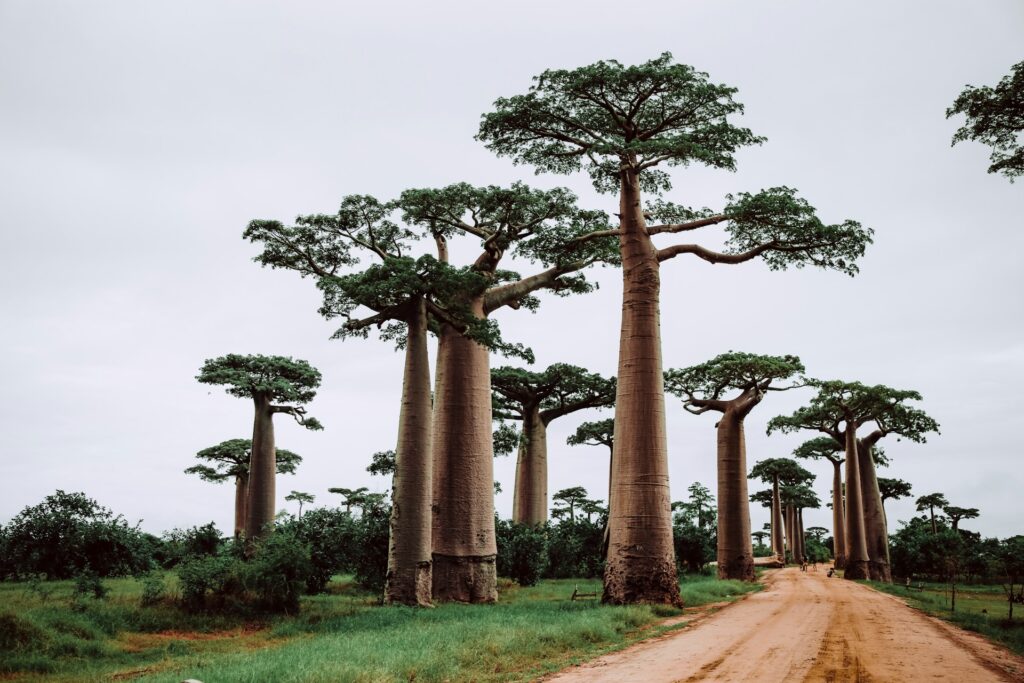
In Madagascar, a dusty trail flanked by millennia-old giants invites travelers to lose themselves in its quiet magic. Welcome to the Avenue of the Baobabs.
Its beauty peaks at twilight, but these towering, life-filled colossi grace the landscape of an island as rich in gifts as it is scarred by hardship. Madagascar—the largest island in Africa—has a surface area roughly the size of Spain, and its natural wealth dazzles the few tourists who make the journey.
Of all its treasures, the Avenue of the Baobabs may be the most photographed—and the reason is clear. But the beauty of this island nation goes far beyond it: lush vegetation, rice paddies, secluded beaches, curious lemurs, and a cultural crossroads make Madagascar a one-of-a-kind destination.
Madagascar: Endemism, Stone Forests, and Ancient Baobabs
Madagascar is often called the “mother island of baobabs.” These trees, whose root-like branches look as though they were planted upside-down, grow only in Africa and western Australia—but here, you’ll find seven distinct species. The ones lining the Avenue are just a small portion of the many scattered across the island.
Madagascar is also home to an incredible variety of endemic species. In fact, nearly 90% of its flora and fauna exist nowhere else on Earth. The lemurs are its most iconic inhabitants.
In 2007, the Ministry of Environment, Water, and Forests added the Avenue of the Baobabs to the list of protected natural sites and later declared it Madagascar’s first Natural Monument.
What does this mean? That the site has been officially recognized for its ecological, scenic, and cultural value and is part of the island’s natural heritage. While it doesn’t have the full protections of a national park, harmful activities like illegal logging, invasive agriculture, or uncontrolled urban development are restricted.
Beyond the Avenue, Madagascar continues to fight to preserve its natural legacy—and it’s not alone. Across its 587,000 km², you’ll find numerous national parks working toward the same goal.
One of the most famous is the Tsingy de Bemaraha National Park, a UNESCO World Heritage Site. This labyrinth of needle-shaped limestone formations, sculpted by over 200 million years of erosion, features trails and suspension bridges that astonish anyone brave enough to explore it.
The Avenue of the Baobabs and a Cinematic Sunset
The Avenue of the Baobabs (or Allée des Baobabs, as named by the French) is a 250-meter stretch of dirt road connecting the town of Morondava with Belon’i Tsiribihina.
Though Madagascar does not receive mass tourism, many who travel thousands of kilometers to reach the island do so with one goal in mind: to walk along this tree-lined road, where dozens of Grandidier’s baobabs (Adansonia grandidieri), one of the island’s many endemic species, stand like silent sentinels.
These particular baobabs can live over 800 years, with many reaching heights of 30 meters or more. Altogether, around 300 specimens are concentrated in just over 1 km², with some lined up—almost magically—along the dirt road, offering a perfect panoramic view.
For the Malagasy people—and in much of Africa—baobabs are sacred. They are deeply linked to spirituality, ancestry, and life itself. It’s believed that spirits inhabit them. Their fruits nourish, their bark heals, their leaves are used as medicine. They are not just trees, but living symbols of wisdom and divine connection.
Walking the Avenue of the Baobabs means stepping into tradition and myth, into another way of understanding the world. It’s a slow journey, letting the sun tint their canopies gold and feeling the privilege of having made it there.
Twilight offers the most magical moments. At sunrise and sunset, the tourists arrive. The light softens, the colors intensify, and the elongated shadows of the baobabs transform the road into a scene straight out of a postcard. At midday, few dare approach—the heat is punishing, and only the canopy offers shade.
The king of the Avenue stands at the northern end: a baobab over a thousand years old, protected by a natural hedge. To enter, one must remove their shoes—a gesture of respect—and leave an offering.
Some trees have grown intertwined, like the famous “Lovers’ Tree,” their trunks twisted together, while others stand tall and straight, crowned with small canopies that remain leafless for much of the year.
This is the Avenue of the Baobabs. In their presence, everything becomes relative: time, noise, worries. Only the moment remains—the shadow, the silence, and the awareness that you are standing on sacred ground.
Because in Madagascar, walking among baobabs is an act of contemplation and reverence. And perhaps that is the greatest gift this corner of the world has to offer.