
Back in the 1970s, archaeologists already suspected that the dense jungle of northern Guatemala still concealed major discoveries waiting to be unearthed.
While traditional archaeology had uncovered monumental Maya centers such as Tikal and El Mirador, the true scale of this ancient civilization remained hidden.
That changed in 2015 with the arrival of LiDAR, a groundbreaking technology that has forever transformed our understanding of the Maya world.
LiDAR — short for Light Detection and Ranging — works by emitting millions of laser pulses from the air to the ground.
Each pulse measures the time it takes to bounce back, enabling researchers to reconstruct distances, volumes, and terrain shapes with extraordinary precision—even through the densest jungle.
Its effect, as archaeologists describe it, is like “turning off the jungle” to reveal an ancient world beneath, almost like X-rays of the landscape.
What Have We Discovered With LiDAR in Northern Guatemala?
The Pacunam LiDAR Initiative (PLI) led the scanning of this Guatemalan region, covering more than 2,100 km² of jungle.
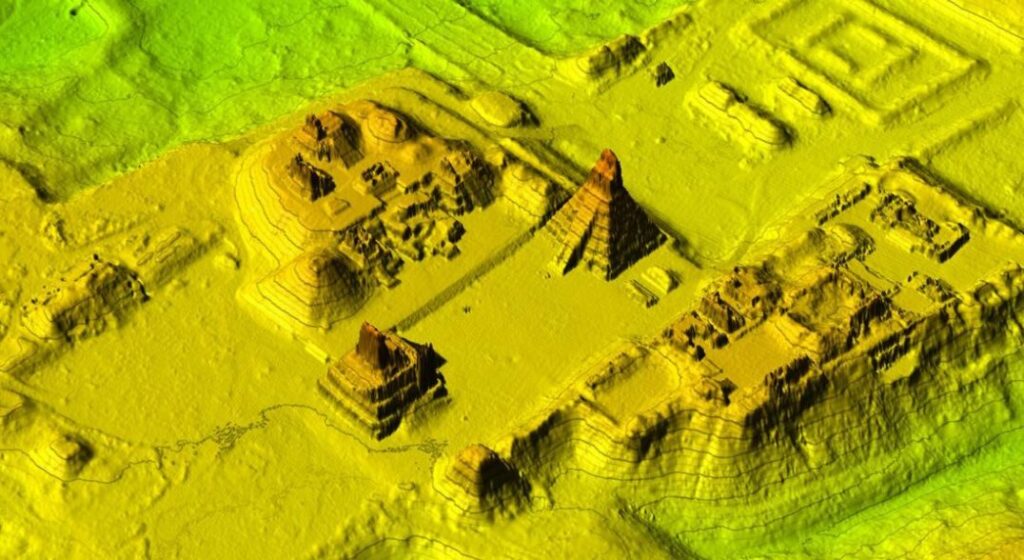
The analysis revealed 964 settlements and more than 60,000 structures, many of which had been previously unknown.
Among the findings were platforms, palaces, fortresses, ceremonial centers, and an extensive infrastructure network that overturned previous ideas of isolated Maya cities.
One of the most astonishing discoveries was the identification of 177 kilometers of elevated highways, some over 20 meters wide. Archaeologists such as Richard Hansen and Alan Chase — two of the most renowned in the field — have described these as the world’s first superhighways.
Cities were connected by this network of roads, enabling the movement of rulers and the exchange of goods. Many of the causeways are adorned with mythological carvings representing the underworld, making them even more remarkable.
One of the most important is the Tintal – El Mirador causeway, which stretches over 25 kilometers and was built over a thousand years before the Common Era.
El Mirador is one of the most significant settlements in the region and served as the heart of the Kaan kingdom, an early civilization that dominated much of northern Guatemala.
Thanks to this new technology, we now know that El Mirador wasn’t isolated — it was a megacity interconnected with other sites like Nakbé, Tintal, and Tinfal.
El Mirador is home to the largest pyramid by volume in the world: La Danta. Standing over 72 meters tall, 300 meters wide, and 600 meters long, LiDAR has revealed the true grandeur of this monumental structure.
The Mayas Engineered Sophisticated Water Systems
Another fascinating discovery is the existence of artificial water systems — including reservoirs, canals, and aguadas. The Maya were already reshaping the landscape through sophisticated, planned engineering to channel water to their cities, with causeways serving as water-management infrastructure.
No discussion of this region would be complete without Tikal and Holmul.
Tikal is one of the most thoroughly studied capitals of the Maya world. For over a century, researchers have known of its ceremonial center and reconstructed its pyramids.
But the new LiDAR mapping showed that the city was far larger and more densely populated than previously believed.
This new mapping data finally confirmed the scale that scholars had long suspected. Not only were thousands of new structures identified, but a defensive wall stretching over 25 kilometers came into view, following the contours of the hills and reaching heights of over 9 meters.
As for Holmul, it was once a nearly unknown city. Today, we can see its true magnificence and how it, too, was interconnected with other major sites.
One of the most remarkable findings has been the discovery of royal tombs, with wall carvings depicting dynastic rulers as sun kings in the afterlife.
Thanks to LiDAR technology, we’ve uncovered treasures of the past that lay hidden beneath the jungle for centuries — undetectable and indecipherable until now.
These new discoveries bring us closer than ever to one of humanity’s great ancient civilizations.