

Every year, a tiny, remote island in the Indian Ocean becomes the stage for one of the most astonishing wildlife spectacles on Earth.
On Christmas Island, an Australian external territory lying about 930 miles northwest of mainland Australia, millions of red crabs (Gecarcoidea natalis) rise from the rainforest floor at once and set off on a grueling march to the sea.
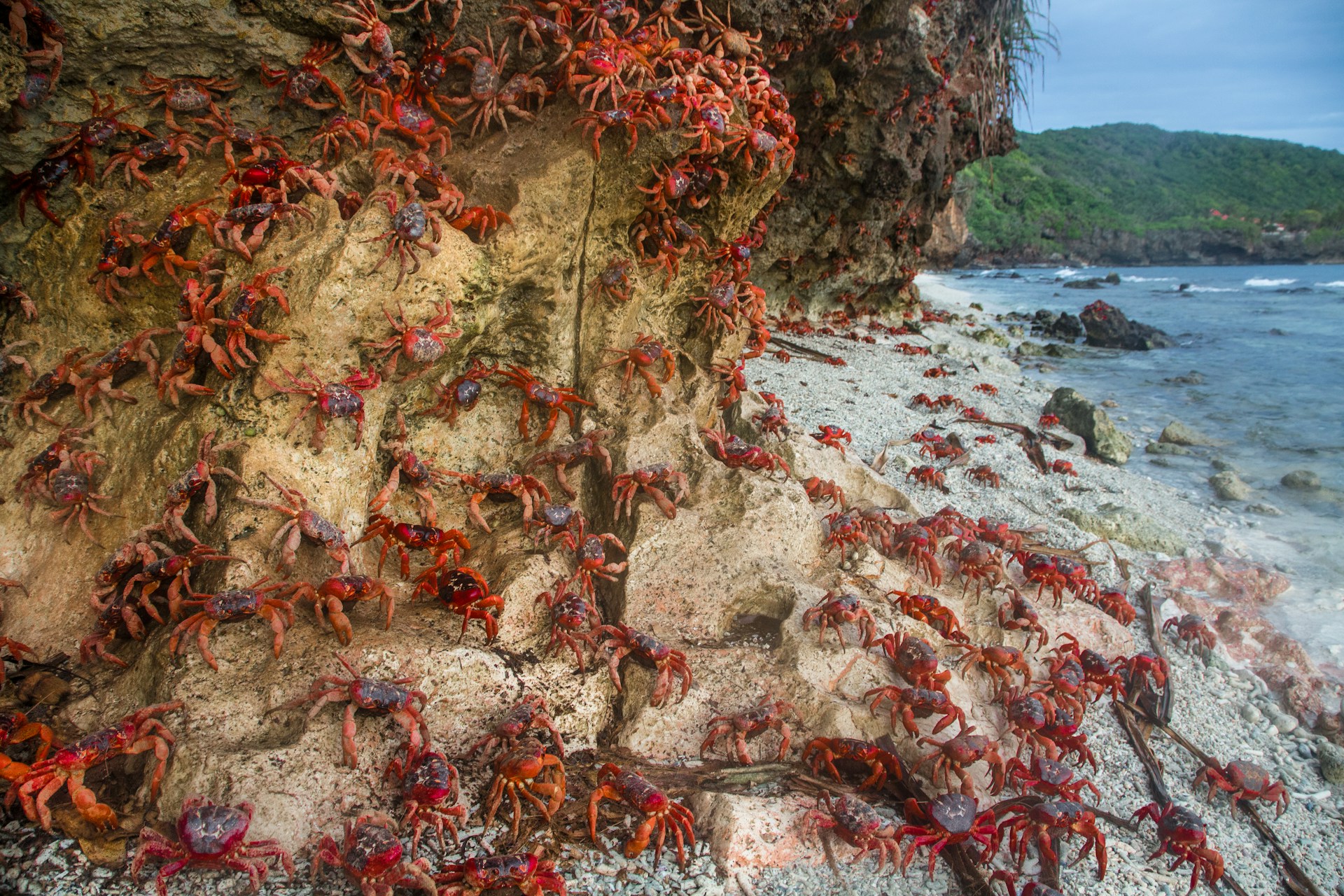
For days, columns of crimson bodies spill across paved roads, forest trails, backyard gardens and rocky cliffs.
The timing of this migration is neither random nor a simple response to the weather. It follows a finely tuned biological clock.
Timed by Rain, Tides and the Moon: Why Christmas Island Red Crabs Migrate
For most of the year, these land crabs live solitary lives, tucked into damp burrows beneath the island’s dense tropical canopy.
Everything changes with the season’s first heavy rains, usually in October or November. The moisture softens the forest floor and gives the crabs the conditions they need to survive outside their shelters without drying out.
Once underway, the red crab migration keeps to a remarkably precise schedule set by the lunar cycle and the ocean tides.
The largest males lead the way, descending from the inland plateaus to the lower coastal terraces. After a brief dip in the sea to replace the moisture lost on the journey, they dig burrows in the sand and compete with one another for space. The females arrive soon after to mate inside or near these shelters.
With mating done, the males take a second plunge in the ocean and begin the long walk back into the forest. The females stay hidden in the moist hollows for two weeks, each one brooding as many as 100,000 eggs in an abdominal brood pouch.
When the moon reaches its last quarter, the females emerge and crowd the tide line, packing up to nine crabs into a single square foot of rock or sand. As the tide turns before first light, they step into the surf and shake their bodies to release their eggs into the water. The eggs hatch the instant they touch salt water.
Engineering Safe Passage for Millions
With a population estimated at up to 100 million red crabs sharing an island of 52 square miles with fewer than 2,000 residents, coexistence takes careful planning. National park rangers and locals spend weeks preparing the infrastructure ahead of the peak migration.
The sheer scale of the movement forces islanders to completely overhaul their daily routines during the busiest weeks. Parks Australia and the island’s local council close main roads such as Murray Road and Northwest Point Road, either fully or intermittently, and install low plastic barriers along the routes to funnel the crabs and keep them from being crushed by traffic.
The island is also famous for its striking crab bridges: elevated walkways of steel and plastic built over the main roads, allowing entire columns of crabs to pass safely above the cars below.
Guardians of the Rainforest Floor
Beyond the sheer spectacle, the Christmas Island red crab plays an essential ecological role.
As the island’s dominant land species, these crustaceans are tireless forest gardeners. By feeding on fallen leaves, fruit, flowers and seedlings, they speed the recycling of nutrients, enrich the soil and keep the undergrowth in check throughout Christmas Island National Park.
The British naturalist Sir David Attenborough, who filmed the event, famously counted the migration among the greatest natural wonders he had ever witnessed, likening the scene to a scarlet curtain sweeping across the land.
The Return of the Young and the Threats They Face
Once at sea, the larvae drift in open water for three to four weeks, passing through several stages of development while serving as prey for the fish, manta rays and whale sharks that gather near the island, drawn by the abundance of food.
Those that survive wash back ashore as tiny crabs barely a fifth of an inch across. They then begin a nine-day trek inland, where they shelter beneath the leaf litter for the first three years of their lives.
Today the population faces a threat from the yellow crazy ant (Anoplolepis gracilipes), an invasive species introduced by accident. The ants form vast supercolonies and attack the crabs as they make their way across the island.
Biological control programs in the national park aim to hold the invasion back, so that each year, when the rains return, the scarlet tide that defines the natural identity of this corner of the Indian Ocean will awaken once more.