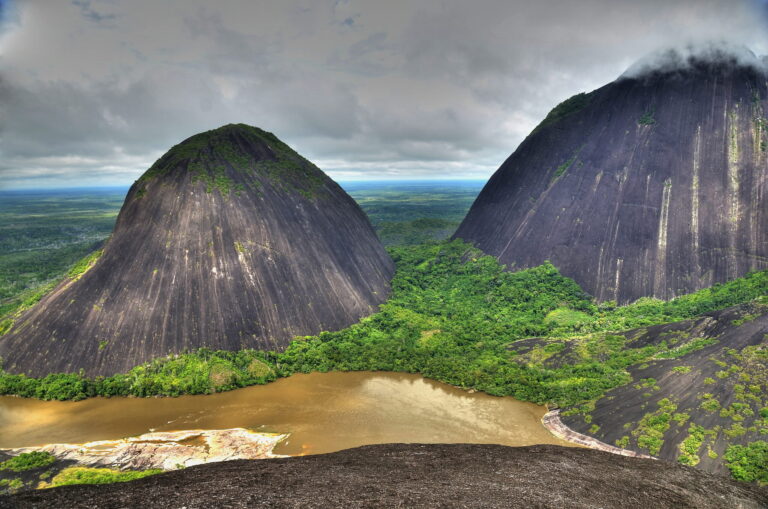




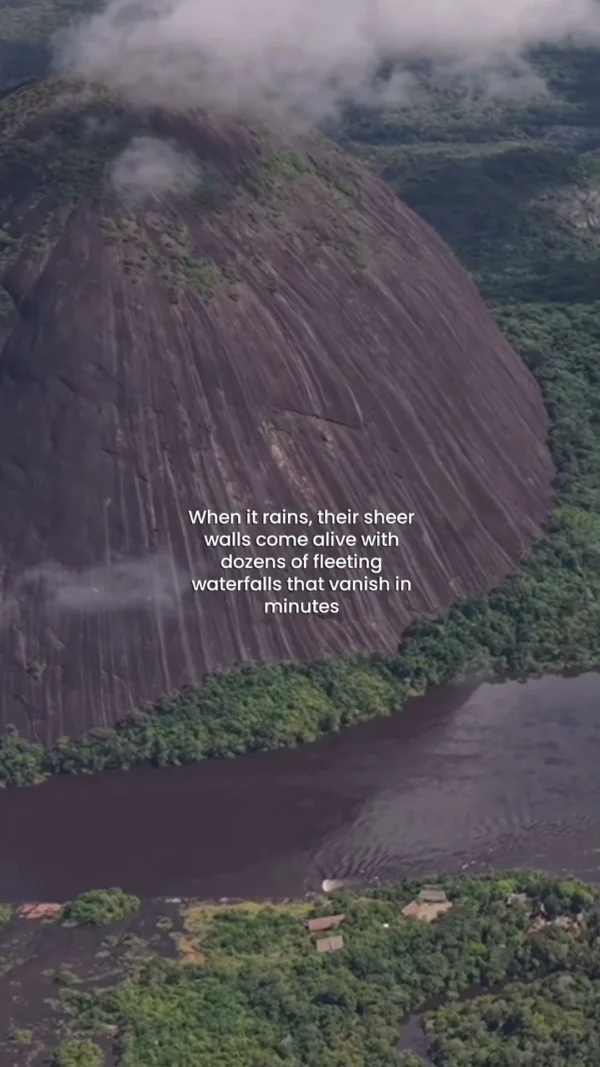
On the banks of the Inírida River, in Colombia’s Guainía department, three dark stone giants rise from the otherwise unbroken green of the rainforest.
They are called Mavicure, Mono and Pajarito. These granite masses tower as high as 560 feet and are part of the Guiana Shield, one of the oldest geological regions on Earth, formed about 1.5 billion years ago.
When storms sweep across this corner of the Amazon, the sheer walls of bare rock are transformed within minutes.
Rainwater races toward the river, breaking into dozens of short-lived waterfalls that trace white ribbons down the stone.
To scientists, it’s simply rapid runoff. To the Puinave people, the explanation is far older, and far more human.
The Legend of Cerro Mavicure: The Tears of Princess Inírida
In the oral tradition of the region’s Indigenous communities, the streams of water that pour down the mountain are the tears of Princess Inírida.
As the story goes, the young woman took refuge on the summit of Cerro Mavicure to escape an unwanted love spell and keep her freedom.
She has lived inside the rock ever since. Whenever thunder rolls over the savanna, locals see the torrents running down the slopes as a living expression of her grief: the memory of a woman who chose a life in stone over surrendering her independence.
As the downpour fades, the threads of water grow thinner until they disappear altogether. The mountain’s face turns dark and dry again, its empty channels waiting for the next storm.
The Science Behind the Waterfalls: Impermeable Granite
Geologically, the explanation lies in the monoliths themselves. Made of solid granite, with no vegetation or soil on their upper slopes, they absorb almost none of the rain that falls on them.
The water immediately collects in the rock’s natural grooves and fissures. As it gains speed on the way down, the current mixes with air and churns into white foam visible from far away. It is an instant drainage system, one that lasts only as long as it takes the storm to pass.
Getting to these ancient formations takes a two-hour motorboat ride from the city of Inírida. The area lies within Puinave and Curripaco Indigenous reserves, whose communities manage access and guide visitors along Cerro Mavicure’s authorized trails.
Balancing Myth and Conservation in the Guainía Rainforest
The Mavicure hills rise from a landscape protected by its remoteness and by the care of the peoples who have lived here for centuries. Well off the mass-tourism trail, the Guainía ecosystem weaves together savannas spread over bare rock, flooded forests and blackwater rivers stained dark by tannins.
Local guides lead the climb up wooden steps anchored into the rock, sharing the stories of their people as they go. For the families living along the Inírida, geology and myth do not contradict each other. They complement each other.
As long as the rains keep coming to this remote corner of Colombia, water will flow again through the fissures of the Guiana Shield. And with every storm, the stones of Mavicure will go on telling the story of the princess who chose to remain forever in the heart of the mountain.