
Bogota sits at more than 8,500 feet above sea level — and it pulses with energy. Colombia’s capital and largest city is not a place to pass through. It is a place to walk, to savor — and simply to let the city carry you.
Do you only have a weekend in Bogota? This guide will help you make the most of every hour.
What follows is a guide to experiencing the city’s rhythm before altitude sickness has a chance to slow you down. That said, if you’ve just landed from somewhere near sea level, take it easy — walk slowly and enjoy the pace.
The Colombian capital awaits — a perfectly calibrated blend of tradition, chaos, and modernity.
Saturday: From the Mystical Summit of Monserrate to the Colonial Heart of La Candelaria
Saturday begins with a climb up Bogota’s most iconic mountain. Don’t worry — you won’t be doing it on foot. No need to tempt fate — or altitude sickness — on your first day.
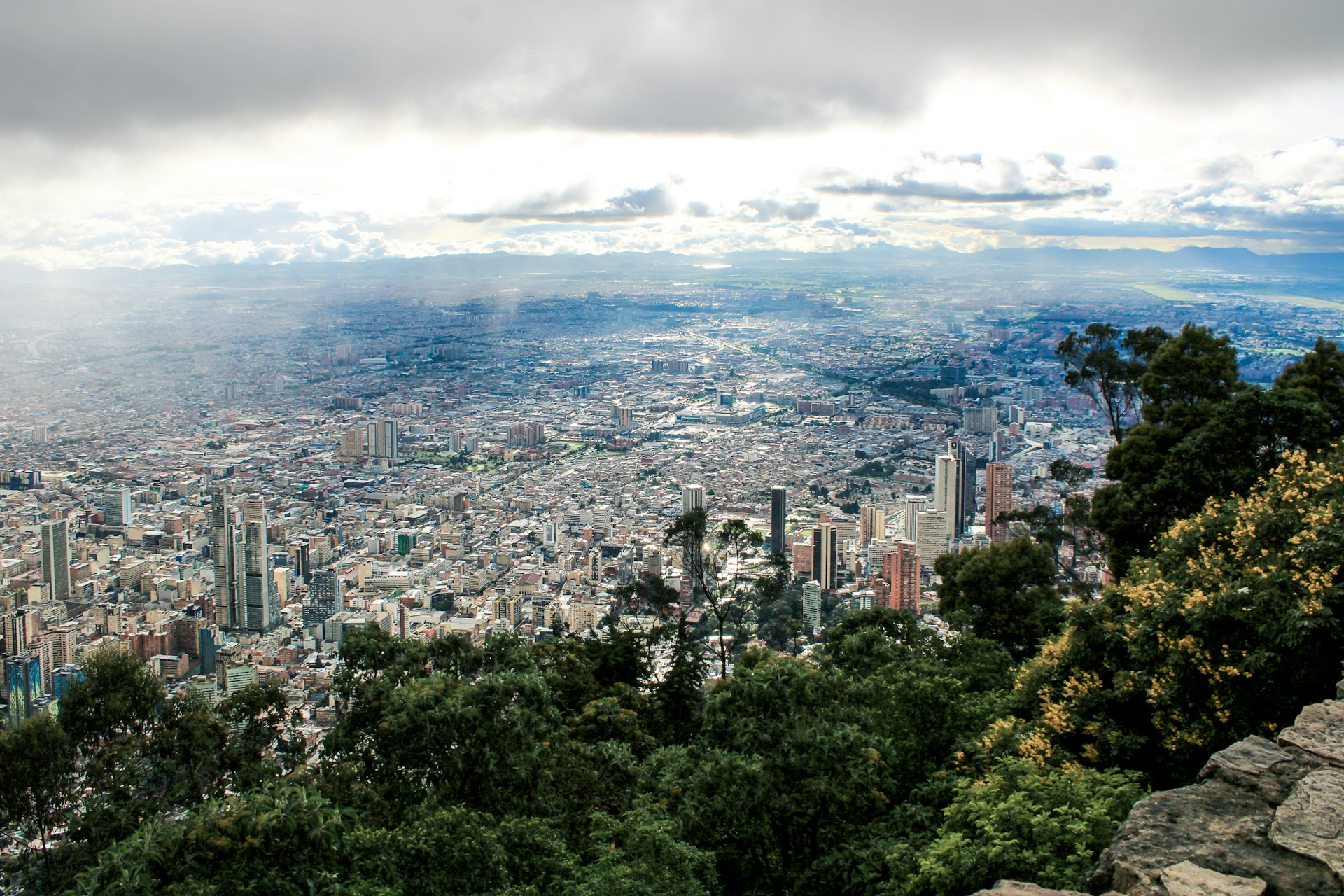
Rising to 10,341 feet, the hill of Monserrate is Bogota’s premier viewpoint and its spiritual guardian. This peak of the Cordillera Oriental marks the boundary between the city and the Andean cloud forest. Its white silhouette — the Santuario del Señor Caído — is the landmark every Bogotano instinctively looks for when they glance up.
The best way to reach the summit is by funicular, which departs from the base of the hill, just behind the Universidad de los Andes and about a 15-minute walk (or five minutes by taxi) from the center of La Candelaria.
During the ascent, you’ll glide up a near-vertical slope, passing through a stone tunnel before emerging onto the first sweeping panorama of the city.
At the top, you can take photographs, walk the Via Crucis trail through gardens where hummingbirds dart among the flowers, and visit the Santuario. If you take your time, the whole visit runs two to three hours — though the ascent and descent themselves are only five minutes each.
On the way down, take the cable car for a different — and equally dramatic — view of the city.
A tip for making the most of your time: Monserrate is Bogota’s most visited site, and lines can be unpredictable. Arriving by 8 a.m. is your best bet to beat the crowds — both pilgrims and tourists alike.
Your next stop should be the Museo del Oro, home to the world’s largest collection of pre-Hispanic goldwork.
From the funicular station, the journey is short. A taxi or rideshare will drop you at the entrance in under 10 minutes. If you prefer to walk, it’s about a 15-minute downhill walk along Avenida Jimenez.
Once inside, rent an audio guide. It’s the best way to fully appreciate the scale of the collection and the stories behind the pieces. Set aside at least two hours — the minimum this place deserves.
Leaving the museum, you find yourself at the doorstep of La Candelaria. Before diving into the neighborhood, stop for lunch at La Puerta Falsa and try the traditional Ajiaco Santafereno. If you’re in the mood for something more contemporary, Prudencia — a restaurant set inside a restored colonial mansion in La Candelaria — is your best option.
With lunch behind you, it’s time to step fully into historic Bogota.
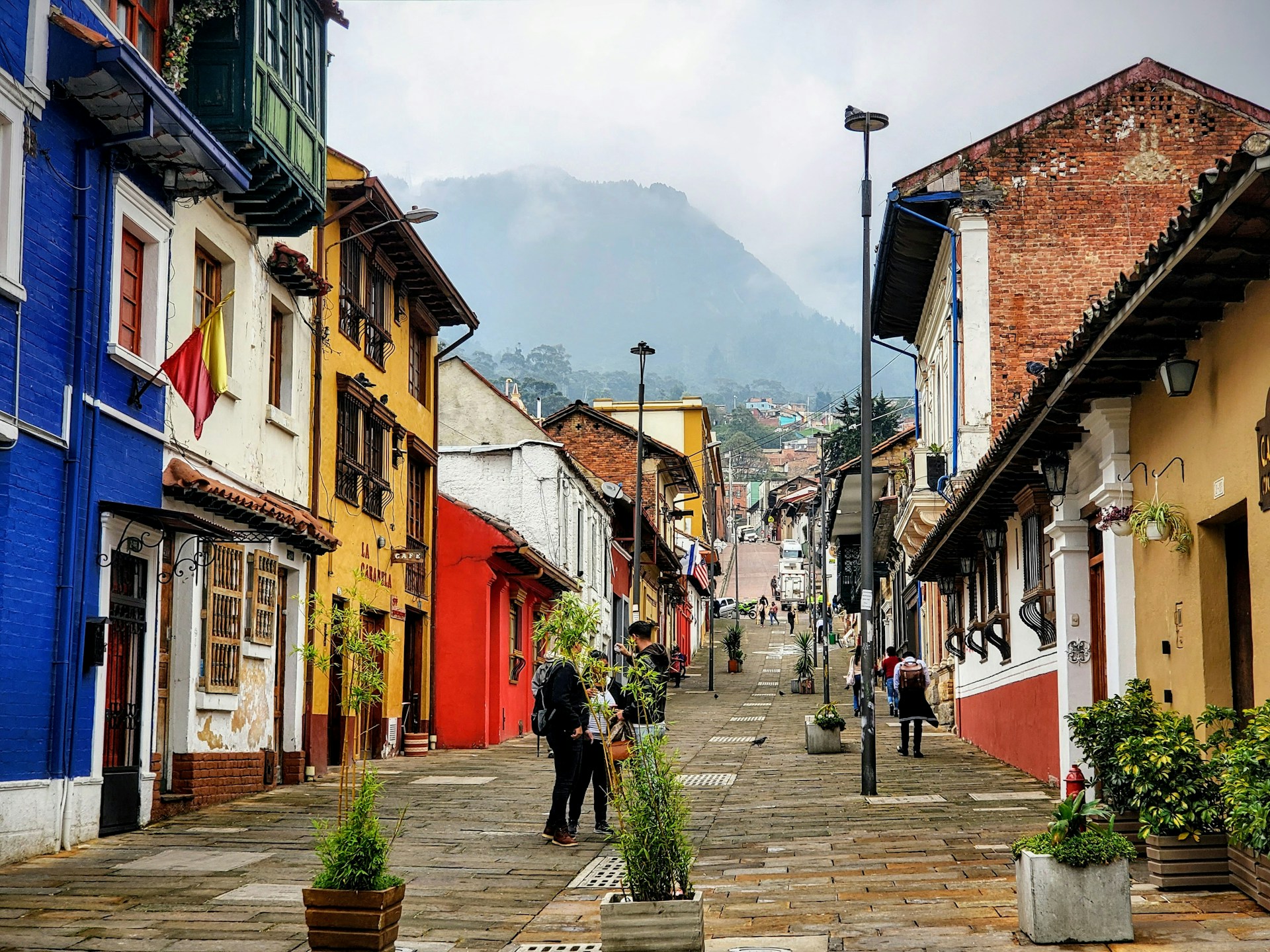
La Candelaria is the most celebrated neighborhood in the Colombian capital. Its narrow, steep streets lined with vividly painted colonial facades make for a scene unlike anything else in the city.
The neighborhood stretches roughly between Calles 7 and 13, and from Carrera 1 to Carrera 10. It is a district made strictly for walking — and one where the altitude will have you stopping to catch your breath more than once.
Don’t miss Plaza de Bolivar, the heart of the historic center. Around this broad gray-stone square stand the Catedral Primada, the Capitolio Nacional, the Palacio de Justicia, and the Palacio Lievano.
Plan on spending a full afternoon here — not because of the distance, but because of how much there is to take in. The wooden eaves, the balconies with their Mudéjar heritage, the interior courtyards, and the craft shops will give you plenty of reasons to pause.
Before the sun disappears behind the mountains, duck into one of the neighborhood’s cafés for a Colombian coffee — the perfect way to end the day. Order a “perico” at Cafe Pasaje, or try an internationally awarded cup at San Alberto.
Sunday: From the Bustle of Paloquemao to the Calm of Usaquén
The second day of your weekend in Bogotá is best devoted to experiencing the city at its own pace.
Start the day early (around 8 a.m.) at Paloquemao Market — an immense marketplace where the goal isn’t to stock up on groceries, but to experience the ritual itself. Watching the fresh flowers arrive, sampling exotic fruits, and sipping coffee as the market hums around you — that’s the whole point.
Next, you’ll make your way toward the northern end of Bogotá — and here’s a tip worth following. Take a taxi or rideshare and ask the driver to go along Carrera Séptima. It is the city’s most iconic avenue, running past the Centro Internacional, the Chapinero neighborhood, and the residential districts in the northern part of the city.
By the end of the journey, you will arrive in Usaquén — once an independent town absorbed by the capital, yet still preserving its colonial character — just as its artisan market is in full swing.
Here, time seems to slow down. It’s a place to wander without any particular destination, drifting among antique shops and local design stalls. The low-rise architecture and cobblestone streets make it easy to forget that you are in a metropolis of millions.
To close your Sunday, consider heading to either Parque de la 93 or Zona G, two northern districts of Bogotá connected by Carrera Séptima. Choose based on your mood at that point.
The first is a leafy park ringed by a lively, ever-buzzing cluster of cafés, bars, and restaurants. It also regularly hosts book fairs, outdoor art exhibitions, and cultural events.
Zona G, meanwhile, is a residential pocket of Chapinero Alto that has evolved into the city’s most refined dining destination. If you are looking for a quieter, more elevated dining experience, this is the place.
And so your weekend in Bogotá comes to a close, the city’s brick facades dissolving softly into the mountain mist.
Where to stay in Bogotá
Bogotá’s steep streets and elevation — more than 8,500 feet above sea level — demand proper rest. Here are three excellent options:
- Casa Legado (Quinta Camacho): a mid-century design oasis set in a neighborhood known for its Tudor-style architecture. It is the most intimate option, and ideally positioned for exploring the residential elegance of Bogotá’s northern districts.
- Four Seasons Casa Medina (Zona G): housed in a building declared a national monument, it features carved-beam ceilings and stone fireplaces that transport guests to an earlier, more storied era of Bogotá.
- The B.O.G. Hotel (near Parque de la 93): a striking work of contemporary architecture inspired by gold and emerald. Its rooftop terrace offers one of the finest views of northern Bogotá’s skyline and modern energy.