











Table of Contents
ToggleDublin is, for many, one of Europe’s most underrated capitals. This warm, layered city offers more than most visitors expect — from the live music and late nights of the legendary Temple Bar district to the weathered stones and quiet secrets of a past the Irish have long and proudly guarded.
Trinity College is a must for anyone passing through, and St. Patrick’s Cathedral will inevitably earn its place on every itinerary. But just steps from that cathedral lies one of the city’s best-kept secrets: Ireland’s oldest public library, founded in 1703 and steeped in mystery.
This is Marsh’s Library — a place that rarely appears in mainstream guidebooks, but one that rewards the curious traveler, if only to test its reputation as a haunted place.
It was also here, far from Transylvania, that Bram Stoker began researching the vampire novel that would make him immortal.
Marsh’s Library: A Haunted Place in an Idyllic Setting
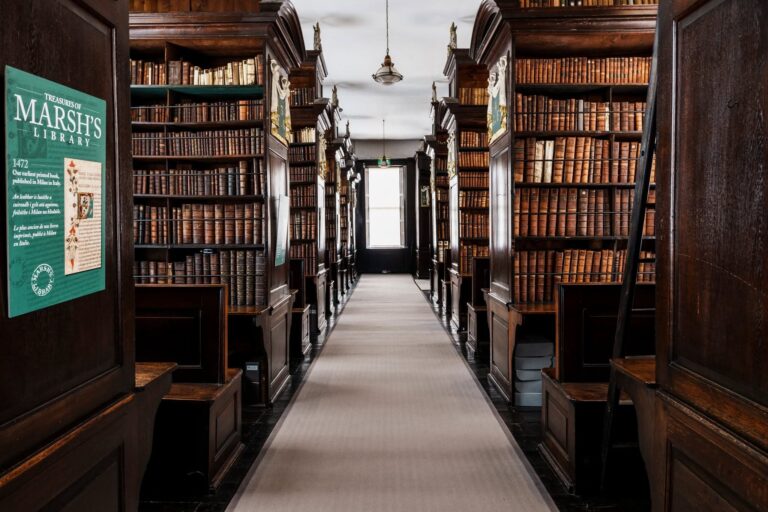
The entrance is easy to miss. On St. Patrick’s Close, just beside St. Patrick’s Cathedral, a modest gate opens onto a tidy garden. Beyond it stands a building that has served the same purpose for more than 300 years — a library, built to be a library, and still functioning as one.
Its fame has long been overshadowed by Trinity College’s celebrated Long Room, but Marsh’s Library has its own distinguished roster of literary visitors — and its own atmosphere, which no amount of tourist traffic has managed to dilute.
In a city as old and story-soaked as Dublin, it would be strange if a building like this had no ghost. And indeed, it does.
The legend holds that the wandering spirit of the library’s founder, Narcissus Marsh, still moves through the shelves — not only at night, but at any hour. The story goes that Marsh died heartbroken after his niece Grace, whom he had raised as a daughter, slipped away to marry a vicar without his blessing. She left him a letter explaining herself, tucking it between the pages of one of the library’s books. And so the spirit of Narcissus Marsh has spent more than three centuries searching every shelf, looking for a note he has never found.
The atmosphere inside does nothing to discourage such stories. The readers’ cages — small enclosed alcoves installed in the 19th century to prevent visitors from walking off with rare and valuable volumes — give the library a particularly gothic quality. Readers could lock themselves inside with their books; the books could not so easily disappear.
Those cages can still be used today, with permission from the librarians. Or visitors can simply sit in the reading room, on the same benches once occupied by Jonathan Swift, James Joyce, and Bram Stoker.
From the Birth of Dracula to the Odyssey of Ulysses
Marsh’s Library has been a quiet but essential fixture of literary Dublin, a city that has produced some of the most significant works of the past two centuries.
Library records show that Bram Stoker himself spent time browsing travel books and maps of Transylvania within these walls, some 30 years before he published “Dracula.” His obsession with vampire lore ran deep, and though he never traveled to Romania or set eyes on the Carpathian Mountains, the books at Marsh’s Library fed his imagination and gave his novel a geographic precision that still astonishes readers.
Other legendary Dublin writers have passed through as well. Jonathan Swift, author of “Gulliver’s Travels,” was a regular. So was James Joyce, whose masterwork “Ulysses” remains one of the most celebrated and demanding novels in the English language — a book that maps the streets and souls of Dublin with obsessive, exhilarating detail. Joyce counted the library among his favorite retreats, a place to read, to think, and to let the city’s stories take shape.
To step inside Marsh’s Library is to step into that literary history of Dublin — not as a museum exhibit, but as a living room where the past has simply never been cleared away.
The library is open to the public for an admission fee of $19. A combined ticket with St. Patrick’s Cathedral offers a more economical way to visit both, and entry is free for visitors under 18.
For those who love literature and want to understand something essential about the history of Ireland, this is not a stop to skip.
Frequently Asked Questions
Is Marsh’s Library free?
No. Admission is $19, though entry is free for visitors under 18, and a combined ticket with St. Patrick’s Cathedral offers a more economical way to visit both.
Is Marsh’s Library worth seeing?
For those who love literature and want to understand something essential about the history of Ireland, it is not a stop to skip. Its readers’ cages and its reading room, once used by Swift, Joyce, and Stoker, still welcome visitors.