

Argentines — and the people of La Plata in particular — just added another point of pride to their country’s long list of wonders: the Catedral de La Plata took the title in the “Mundial de Catedrales” — the Cathedral World Cup.
The single-elimination tournament, organized on Instagram, sent sixteen houses of worship from around the world up against each other in a public vote.
In the final, La Plata’s cathedral defeated Santa Maria del Fiore in Florence, taking 93% of more than 54,000 votes cast — after knocking out Notre Dame de Paris, Milan’s Duomo, and Cologne Cathedral in earlier rounds.
How the Tournament Unfolded
The competition began on the Instagram account @documentales_de_bolsillo, created by Chilean filmmaker Daniel Katanella — an account with more than 400,000 followers that posts short documentaries about places around the world.
The format was a straightforward bracket. Sixteen cathedrals faced off in pairs across successive posts, with each matchup decided by the number of votes users left in the comments or the poll on each post.
The Catedral de La Plata’s run gained momentum with every round.
In the round of sixteen, it eliminated the iconic Notre Dame de Paris with 63% of the vote — a result that turned heads given how famous the Paris landmark is.
In the quarterfinals, it beat Milan’s Duomo with 82%. In the semifinals, facing Cologne Cathedral in Germany, the result was just as lopsided: 93% in a round that drew more than 20,000 votes.
According to the organizers, the tournament pulled in more than 200,000 votes in all, plus millions of views and thousands of comments.
One of the top comments during the final, with more than 2,300 likes, called for a citywide party if La Plata’s cathedral won.
A City Built From Scratch — and a Cathedral to Match
The building’s history is inseparable from the founding of La Plata itself.
Dardo Rocha, the city’s founder, launched an international competition in 1881 to choose a design and set a budget for the future cathedral — but none of the entries measured up.
The job ultimately went to the Department of Engineers at the Buenos Aires provincial Ministry of Public Works, led by the engineer Pedro Benoit. The final drawings came from the German architect Ernesto Meyer, with contributions from Emilio Coutaret.
The cornerstone was laid in 1884, two years after the city’s founding. The design drew directly from two icons of European Gothic architecture: Amiens Cathedral in France and Cologne Cathedral in Germany — the very cathedral that would one day lose, in an Instagram tournament, to the building it helped inspire.
The Detail That Sets It Apart From Its European Rivals
One thing separates it from every cathedral it knocked out.
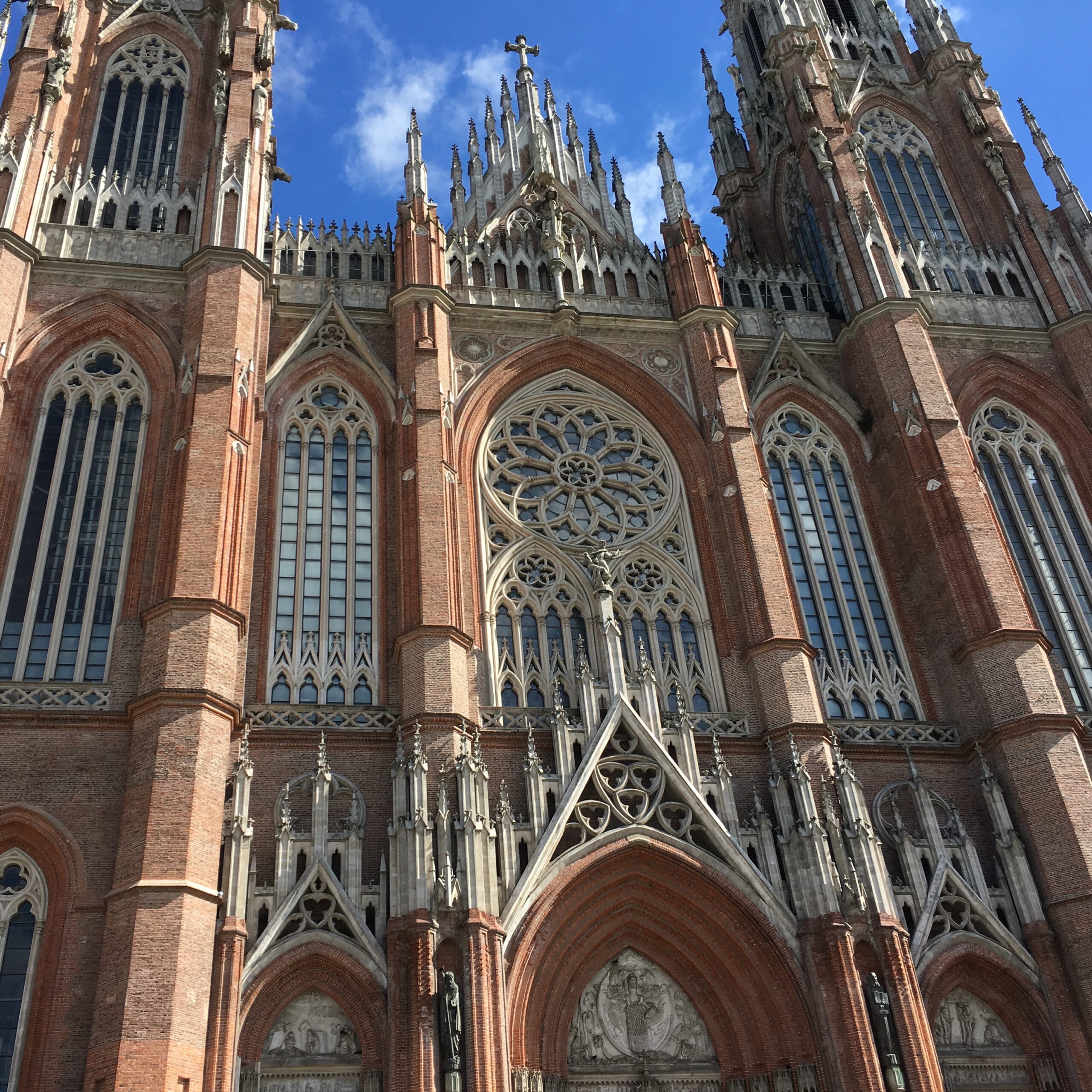
While Notre Dame, Milan’s Duomo, and Cologne Cathedral were built of stone, La Plata’s was built entirely of brick — fired from clay dug out of the surrounding countryside.
This was not an aesthetic choice. In a city still rising out of the open pampas, importing carved stone from Europe would have been prohibitively expensive. Brick solved two problems at once: cost and availability. It also accounts for the cathedral’s distinctive reddish facade.
Construction, however, was anything but straightforward. Pedro Benoit died in 1905 without ever seeing the cathedral finished; the architect César Gutiérrez took over the work.
It was not until Nov. 19, 1932 — coinciding with the city’s 50th anniversary — that the cathedral opened its doors for the first time, though calling it finished would be generous.
The two front towers were missing, as were the stained-glass windows, the floors, the sculptures, and much of the interior detailing. In every meaningful sense, it was a half-built cathedral.
It would take nearly seventy more years to finish — a story with turns worthy of a novel.
The first stained-glass windows arrived in 1937 from Munich, commissioned from the German firm Franz Xaver Zettler. World War II severed that supply line, and in 1940 a new source had to be found: the Paris firm Maumejean Frères.
A year later, in 1941, the floors were installed: pink granite from Olavarría combined with black stone from Calamuchita and gray from San Luis. The columns were clad in Mar del Plata stone.
The final twenty-seven stained-glass windows — also French, depicting scenes from the New Testament — were added in 1958.
The project then stalled for decades until 1997, when the Fundación Catedral and the Buenos Aires provincial government committed to finishing it once and for all.
And they finally did, on Nov. 19, 1999 — exactly sixty-seven years after that unfinished 1932 opening.
Quirks and Masonic Legends
With towers rising 367 feet — the first 207 in brick, the next 66 in imitation white stone, and the final 98 clad in copper — the Catedral de La Plata is the largest neo-Gothic structure in South America.
It also ranks among the biggest neo-Gothic churches anywhere in the world, a distinction made official in 1996, when its name was inscribed on the marble plaques set into the floor of St. Peter’s Basilica in Rome.
The cathedral holds roughly 7,000 people. Together with the Municipal Palace — which faces it across Plaza Moreno — it anchors the geometric axis Dardo Rocha laid out when he founded the city. The layout is often read as a symbolic balance between spiritual and civic power.
The striking geometry of La Plata’s street plan has long fueled a persistent legend that the cathedral has Masonic origins.
There is no conclusive evidence that the cathedral was designed as a Masonic building, though it is well documented that several of the key figures behind the city’s founding were lodge members.
Beneath the cathedral, a crypt holds the remains of Dardo Rocha and his wife, Paula Arana, transferred there in 1940. Next to the crypt, a small museum documents how it was built and pays tribute to the workers who spent more than a century on it.
What Comes Next: A Papal Blessing
The result carries no official weight. No architectural body recognizes it, and no serious critic is likely to cite it when ranking the world’s great cathedrals.
But that 93% did prove something else: that tens of thousands of people — many of whom have never been to Europe — spent weeks mobilizing to defend a brick cathedral in La Plata.
In November 2026, when Pope Leo XIV sets foot on Argentine soil for the first time and blesses the Catedral de La Plata, the same community that flooded every round of the tournament with votes will likely gather beneath its towers — not to compete with anyone, but simply to be there.



