
Easter Island is home to a writing system that no one has been able to read since the 19th century. It is called rongorongo, and its very existence raises a question linguists have yet to resolve: did the Rapanui invent it independently, in the most isolated corner of the Pacific, or did it emerge as a response to contact with Europeans?
Rapa Nui, known to the world as Easter Island, lies in the remote southeastern Pacific Ocean, roughly 2,360 miles off the coast of Chile.
It was among the last habitable territories colonized by human beings, and that extreme isolation shaped everything that followed: the island’s colossal architecture, its distinctive culture, and above all, its language.
The Polynesians who arrived between A.D. 1150 and 1280 brought with them a language from the Austronesian family, related to Tahitian and Māori. Cut off from every other human community by thousands of miles of open water, the language evolved entirely on its own.
Very little is known about Rapa Nui before European contact. Most of its vocabulary derives directly from Proto-Eastern Polynesian, though later contact with Tahiti introduced alternative forms for words that already existed.
What has survived from that civilization — carved into wood — stands as one of the most enduring enigmas in the history of writing.
The 15,000 Signs No One Can Read and the Tablet That Changed Everything
Rongorongo was first documented in the 19th century and has never been deciphered. With only 26 known artifacts bearing these inscriptions — and none of them deciphered — scholars continue to debate whether rongorongo constitutes a true writing system or a form of proto-writing.
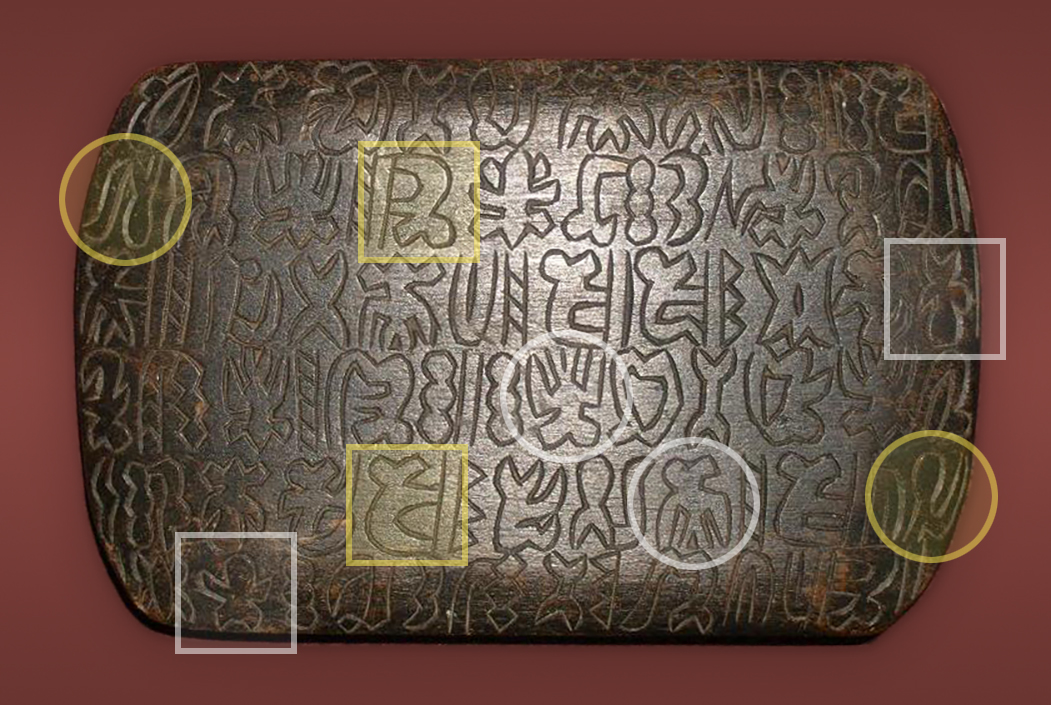
The corpus includes more than 15,000 pictographic characters representing animals, plants, geometric shapes, and human-like figures. The text runs in horizontal lines written in a style known as reverse boustrophedon, in which every other line is rotated 180 degrees and read in the opposite direction.
Three factors make rongorongo particularly difficult to decipher: the small number of surviving texts; the absence of illustrations or contextual clues that might aid decipherment; and the fact that ancient Rapanui — the language the inscriptions most likely encode — is itself poorly understood.
For decades, the question that divided specialists was more fundamental: did the Rapanui develop this system independently, or did it emerge in response to contact with Europeans?
Part of the answer came from four tablets that Catholic missionaries sent to Rome in 1869, where they had been held in a convent for more than 150 years.
Researchers conducted radiocarbon testing on all four pieces. Three dated to the 18th and 19th centuries, but the fourth dated to between 1493 and 1509 — more than 200 years before Europeans ever arrived on Rapa Nui.
Silvia Ferrara, a philologist at the University of Bologna and the study’s lead author, noted that the rongorongo glyphs bear no resemblance to European letters — a finding that points to an entirely indigenous origin.
If the system developed independently, it could represent one of the very few times in human history that writing was invented from scratch.
The use of rongorongo was restricted to a priestly elite who transmitted that knowledge orally. When that chain was broken in the 19th century — after epidemics and Peruvian slave raids decimated the population — the ability to read the tablets was lost forever.
Today, only 27 wooden objects inscribed with rongorongo are known to exist in the world, and not one of them remains on Rapa Nui itself.
The Decipherment That Never Came
The scientific community received Ferrara’s findings with interest but also with caution. The debate over whether rongorongo constitutes true writing or proto-writing remains unresolved.
In 2025, researcher Erik Kiley claimed to have fully deciphered all 26 known inscriptions, arguing that the system is syllabic and encodes Polynesian mythology, navigational data, and ritual knowledge.
His work has yet to undergo peer review and has not been accepted by the academic community. The history of rongorongo is full of such claims: at least 20 proposed decipherments have failed to gain scholarly acceptance.
For now, the tablets scattered across museums in Europe, the United States, and Japan hold their secrets — ones that even modern algorithms have been unable to unlock. Within them may lie the grammar of a language no one will ever speak again — or simply marks whose meaning a Rapanui priest once knew by heart.
That distinction, in itself, is the whole problem.