Rapa Nui is in Chile, in South America, but it is in Polynesia, in Oceania. It is separated from the mainland by 3,700 kilometers of the open Pacific Ocean. The nearest inhabited region is more than 2,000 kilometers away, and its people speak another language.
It belongs to the Valparaíso region, which is on another continent.
They speak Spanish — unlike most islands of its kind.
Its inhabitants are concentrated in the capital, Hanga Roa, which is also the island’s only town.
But are they really that isolated? That remote?
Surrounded by stone giants reminiscent of the giant statue’s foot seen on the shores of Lost.
Giants Looking Inward
The first thing that surprises those arriving on Easter Island is that the moai, or stone giants, do not look at the sea.
It was also the first thing seen by the earliest Europeans who dared to sail there.
The moai: those monolithic giants, with humanoid shapes, carved from the rock of a quarry formed by a volcanic eruption, composed of ash and other compressed sediments. Some are complete, others half-carved, toppled, or restored, representing the legacy of the island’s native inhabitants, who gave the statues their name: Rapanui.
There are more than nine hundred scattered everywhere. They once had ceremonial topknots carved from red stone. They also once had eyes made of coral.
Their meaning is not exactly known; it is said that the ancient inhabitants may have carved them to represent their dead, so that their mana, or power, would extend over the living. Other studies suggest they could have been indicators: fresh water can be found here.
Their gazes turn toward the land, to the ancient villages that once flourished there. Some exceed ten meters in height and weigh dozens of tons.
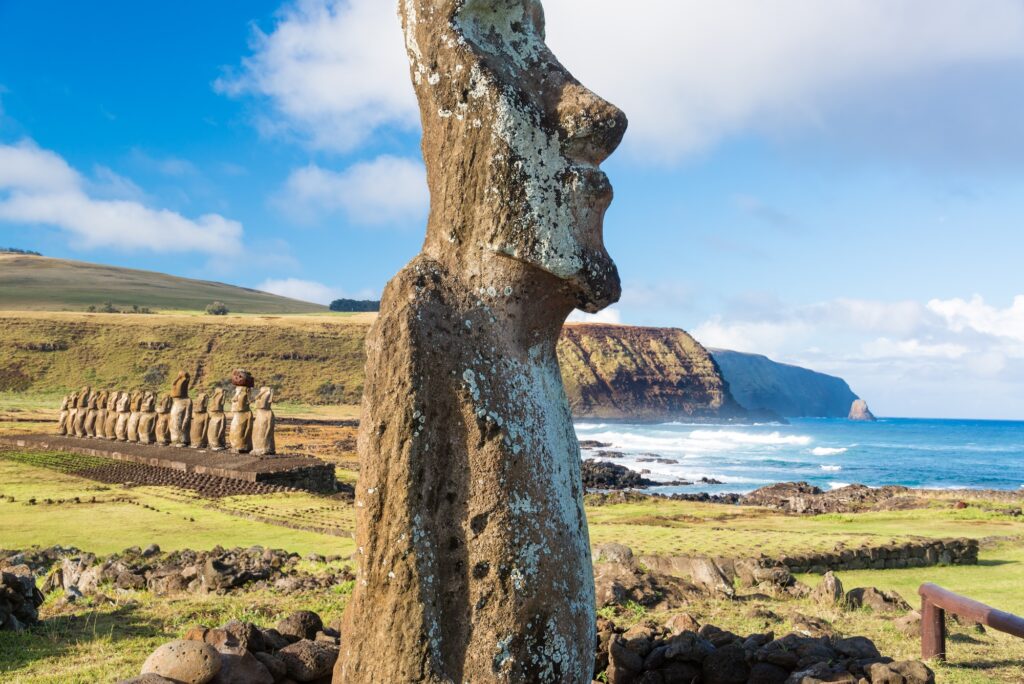
An imposing moai stands in the foreground, with fifteen more behind, at Ahu Tongariki, Easter Island.
The Walking of the Moai
Some things are not so hard to understand: the material used to carve the giants could have been worked with the right tools, even centuries ago.
Transporting the moai from the Rano Raraku quarry to their final location without modern tools is another matter: a feat that still fascinates archaeologists and engineers alike.
They might have used wooden vehicles. There is evidence on the island of sophisticated ancient engineering techniques—or perhaps the statues were simply rolled onto their sides.
Oral tradition says the statues walked on their own, guided by their mana. Science suggests pulleys, sledges, or balancing systems.
No explanation erases the wonder of confronting them.
An Island With Memory
Although the island’s name may have been introduced by foreigners, the Rapa Nui were a self-sufficient people with their own language, gods, and rituals. The natives called Easter Island the navel of the Earth.
Their legends speak of kings who came from the sea, sacred birds that chose the leader in the Birdman ceremony, and clans competing to build ever-larger moai.
But it is also the story of a collapse: overexploitation of resources, internal conflicts, and diseases brought by foreign sailors led to a dramatic decline.
Today, Rapanui culture endures. To preserve the moai, people have devoted significant effort in recent years to managing Rapa Nui National Park, which was declared a World Heritage Site.
On the island, their language is still spoken, new statues are carved, traditional festivals like Tapati are celebrated, and the spiritual bond with their ancestors endures.
To protect its ecosystem, the island’s inhabitants have developed initiatives, such as a circular-economy model for recycling and reusing discarded clothing, preventing it from ending up in polluting landfills.
Very recently, a prolonged drought exposed the bottom of a volcanic crater, where a small one-and-a-half-meter moai was found. It is now said there could be more.
Also today, a mystery hovers over the vast landscape: fierce seasonal waves could reach the highest points of the standing giants and sweep them away before this century ends.
A Landscape Out of Time
Dormant volcanoes, green meadows, cliffs falling steeply into the sea.
Volcanic craters and incomplete stone gods. A four-armed moai, sanctuaries, beaches, archaeological sites, gardens that look like they belong to the Moon, and cave paintings.
The wind here is not just an element; it carries echoes of the past and the scent of volcanic stones that once sheltered their ancestors’ souls.
Walking across the island means moving from one ceremonial site to another, tracing the invisible line that links the ahu (altars) and feeling that everything is arranged like a sacred map.
A fertile territory for surprise, Easter Island reveals itself to whoever is lucky enough to visit, revealing itself as a mystery that seems to belong to another world.
At sunset, the moai stand silhouetted against the sky like giants who have chosen to remain in their land to preserve memories, destinies, and bloodlines.
A Message in the Stone
Rapa Nui is not only an open-air museum; it is a living island, weaving together past and present in a landscape striking not only for its views but also for what human hands have made of it.
The question left by the moai goes beyond the obvious: how did they get here? The other is just as important: what do they want to tell us?
Perhaps, like all great mysteries, the answer lies not in discovering everything, but in learning to look as they do: inward, seeking within ourselves what connects us to humanity’s shared history.