Mount Athos is an autonomous monastic republic within Greece that lives in a different time: the liturgical time.
For over a thousand years, Athos has upheld a strict rule: the avaton, the prohibition of women entering the territory. Children may not enter either, and there are no cars or conventional tourism.
Only hens, monks, and men with special permission are found here, visiting the monasteries as guests in a world ruled by the logic of prayer.
The isolation is not entirely a whim, though, depending on who you ask, it may seem so. But it is the way this autonomous territory under Greek sovereignty has preserved a way of life that has survived empires, invasions, and wars.
It is a kind of purity they chose to preserve: a mountain kept sacred by belonging only to men.
Time of Prayer
Orthodox Christians have free access. Men looking to enter the monasteries must be at least 21 years old and must clearly state their intention as pilgrims.
Once there, pilgrims request asylum at one of the monasteries; depending on which monastery accepts them, accommodations may range from relatively comfortable to austere, or the monastery may simply turn them away. And the walk may take hours.
As women, we have no place here. Barred from entry, we can only imagine a calendar untethered from the Western pace. Time follows the Julian rhythm, 13 days behind the Gregorian, a quiet rebellion against the modern age.
So, women of the world, let us picture our own Mount Athos: time moving in circles rather than lines, a cycle that repeats and returns, seeking eternity—like a child instinctively finding the shelter of a mother’s womb.
The deep tolling of the belfry bells marking each hour of prayer, and the silence that stretches between them, become part of the liturgy itself—a dialogue of sound and stillness.
A Republic of Monasteries
Mount Athos is not a single monastery but a constellation of 20 monasteries, encircled by hermitages, cells, and sketes, where some two thousand monks from around the world live in varying degrees of seclusion.
Its capital, Karyes, handles the peninsula’s few administrative matters without disturbing the monastic silence.
Silence reigns. Imagine streets where no woman has ever walked — where no child has ever chased a ball or pedaled a bicycle.
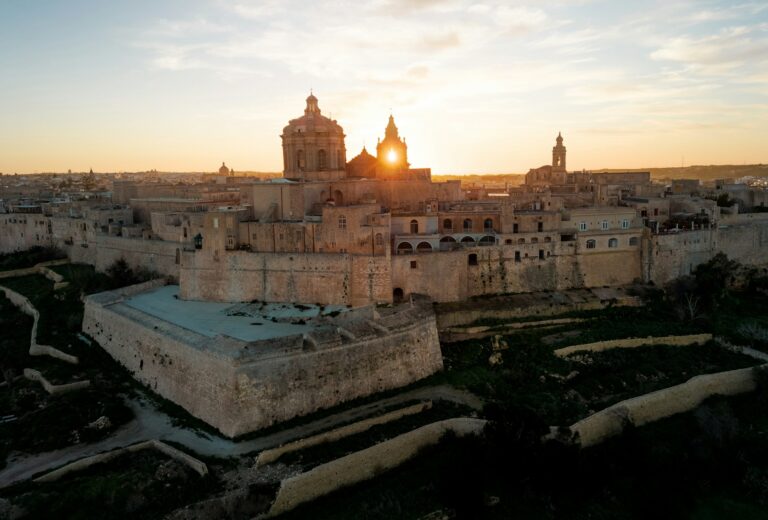
The monasteries, with their whitewashed walls, Byzantine frescoes, and libraries of centuries-old manuscripts, icons, and chalices, seem to hover outside of time.
Picture the solitary cells.
The rising domes.
The mountain itself, sacred and dedicated to the Virgin Mary, the only feminine presence, admitted here in spirit.
Mount Athos From the Outside
Travelers who circle the peninsula by boat glimpse only the silhouettes of monasteries perched like stone fortresses above the sea.
From that distance, legend surfaces: the giant Athos hurling a massive rock at Poseidon, a rock that fell into the Aegean and became this mountain.
From afar, the monasteries resemble medieval castles fused with the cliffs.
Draw closer and you hear Byzantine chants riding the wind, a low murmur above the soft sound of the waves.
What else lives in that silence?
The water brushes rock, steady as a lullaby.
The bells, the echo of prayers.
Mount Athos is both frontier and refuge—a frontier between the secular and the sacred, between earthly time and the eternal; a refuge where only man — and here, truly only man — seeks the divine.
It does not welcome visitors, yet its mere existence resonates with all who watch from beyond.
Picture the vegetarian meals, the occasional fish, the grapes, and the wine.
A simplicity drawn from the surrounding land.
Mount Athos keeps its autonomy not by selling its mystery as a spectacle, but by remaining apart, resisting the glossy lure of tourism.
Mount Athos: Echoes of Another Time
Mount Athos neither seeks modernity nor rejects it—it simply ignores it.
Its monasteries stand as guardians of another rhythm, another world — a world without women.
The traveler who circles the peninsula by boat never sets foot on its soil, yet carries away a whisper: that there are still places choosing silence, bearing the weight of their own decisions as if knowing that only in such silence can the sacred endure.
As a woman barred from entry, I find it hard to be offended. What strikes me most, when I try to imagine the mountain’s quiet, is that I cannot—because such silence exists nowhere else. And in that impossibility, I find admiration: for the resolve to preserve pauses and stillness, those fertile spaces where one might encounter God, if one believes, or perhaps simply oneself, one’s imagination, and the quiet richness of simply being alive.