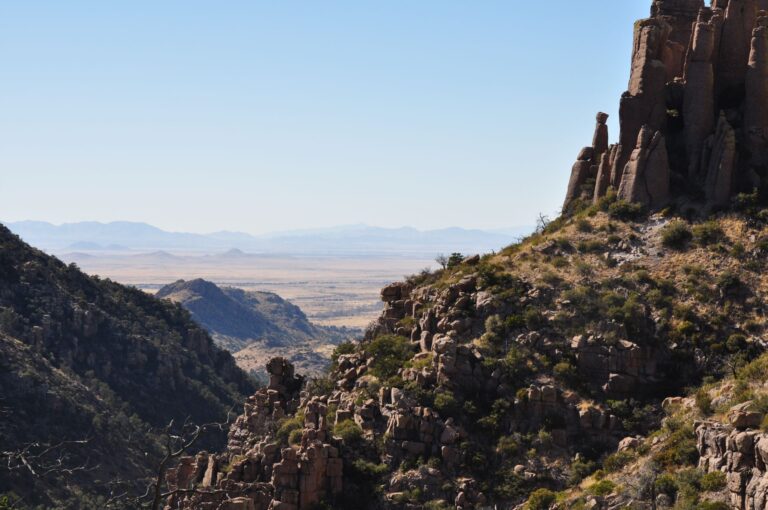





Deep in the Bolsón de Mapimí, where the borders of Durango, Chihuahua and Coahuila meet, lies a stretch of parched tableland known as the Zone of Silence, or Zona del Silencio.
According to popular lore, radio signals vanish here without a trace, compass needles spin aimlessly and the land acts as a kind of vortex, drawing electromagnetic anomalies to a single spot.
Geology tells a different story. The strange behavior of instruments can be traced to the minerals in the soil, and the region’s fame was born not of mystery but of a military mishap in July 1970.
The area lies within the Mapimí Biosphere Reserve, a protected ecosystem covering more than 840,000 acres that shelters endemic species such as the Bolson tortoise (Gopherus flavomarginatus) and violet-tinged prickly pear.
The aura of mystery still draws explorers and researchers of the unexplained. Yet scientific measurements have clearly separated what the terrain actually does from the legends that have circulated for the past half century.
The Athena Rocket Failure and the Birth of an International Myth
Global media attention first turned to the Durango desert on July 11, 1970, when the U.S. Air Force launched an Athena test rocket from its launch complex at Green River, Utah.
The rocket was meant to arc toward the White Sands Missile Range in New Mexico. Instead, a guidance failure sent it more than 430 miles off course to the south, and the Athena came down on the dry lakebed of the Bolsón de Mapimí.
On board were two small capsules containing cobalt-57, a radioactive isotope used to simulate how payloads behave under extreme conditions.
To recover the wreckage, the U.S. government mounted an elaborate operation. Crews laid temporary railroad track across the dunes, built an emergency airstrip and hauled tons of contaminated soil in shielded containers to military facilities in the United States.
The secrecy surrounding the recovery, along with the arrival of foreign technicians, set rumors swirling among locals.
Newspapers of the day began reporting alleged radio blackouts and electromagnetic disturbances, and the name Zone of Silence caught on.
Hematite, Magnetite and the Real Physics of Compasses
The erratic behavior of compass needles at certain spots in the region owes nothing to extraterrestrial forces or energy vortices. The explanation lies underground, in the mineral makeup of the Bolsón de Mapimí.
The basin holds high concentrations of magnetite and hematite, iron-rich minerals that can throw off a compass held close to exposed rock.
As for radio and cellphone signals, field measurements show that interference is neither constant nor widespread.
The terrain, a landscape of low ranges and volcanic mesas, blocks the line of sight those signals depend on. The result is the kind of dead zone common in remote desert valleys far from any city.
Some stories also blame the Allende meteorite, which fell in northern Mexico in February 1969. Laboratory analysis of its fragments found them rich in iron and nickel.
Despite what tourist accounts claimed for decades, the meteorite did not alter the magnetic properties of the reserve.
The Life That Thrives in the Silence
Set the debate over physical anomalies aside, and what stands out about the Zone of Silence is its ecological value: the resilience of the plants and animals that survive here.
In 1978, Mexico’s Institute of Ecology, known as INECOL, established a permanent research station in the area to study Chihuahuan Desert biodiversity. Its work has dispelled the notion that this is a lifeless or radioactive wasteland.
The desert is home to the Bolson tortoise, the largest land reptile in North America, as well as mule deer, mountain lions and plant communities that can endure years of drought.
Local guides and residents have turned curiosity about the legends into a small nature-tourism trade, steering visitors toward stargazing and the region’s geology.
A Geological Landmark Where Science Replaced Legend
Today, the remnants of the structures built during the Athena recovery serve as reminders of the accident that changed how the world saw this corner of the Mexican desert.
GPS receivers, which do not rely on magnetism, work normally throughout the area, and compass deviations are confined to the iron-rich outcrops.
The Zone of Silence still captivates not because of last century’s conspiracy theories but because of the sheer scale of a landscape where ancient geology and deep isolation shape life in the desert.