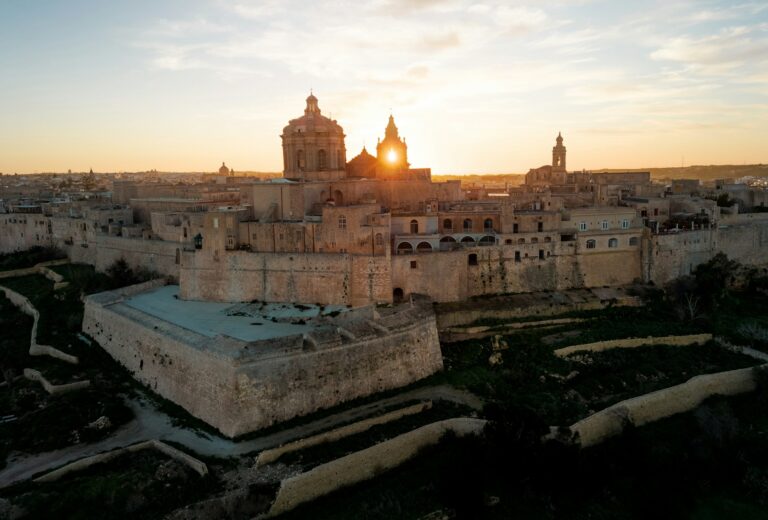
The capital of Malta, Valletta, was founded in the 16th century by the Order of the Knights of St. John, following their legendary stand against the Great Ottoman Siege of 1565.
Built beside the sea purely for defense, the city was designed as a flawless grid of walls, bastions, and secret underground tunnels.
And it worked. For centuries, Valletta remained untouched—until the 20th century brought enemy air raids that finally broke through what cannonballs had never managed to.
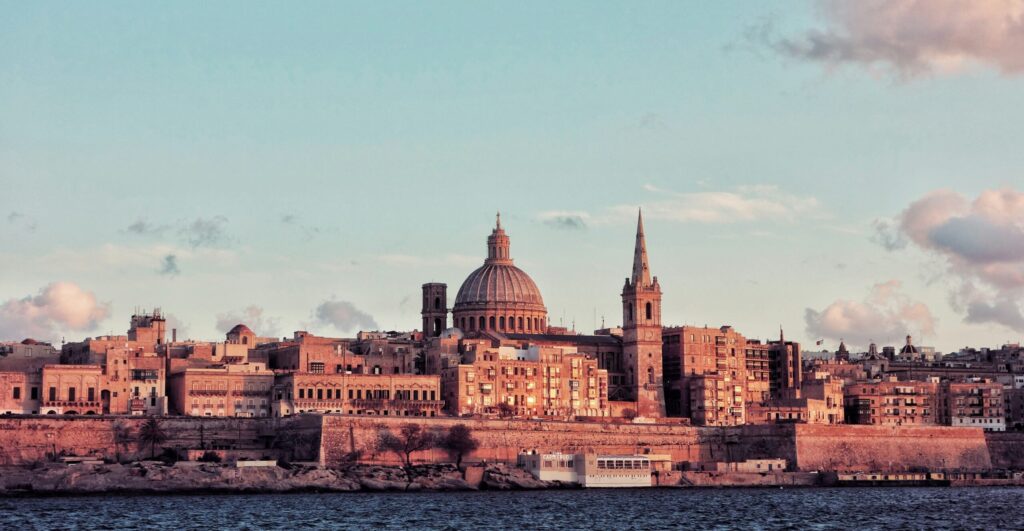
From afar, the city appears as something mythical: a stone ship moored in the blue expanse of the Mediterranean, defiant and immovable.
After its triumph over the Ottoman Empire, the city was honored with the title of “Most Humble City”, in recognition of its strength and perseverance.
Yet over time, as its baroque architecture flourished and new fortifications were raised, Valletta embraced another title: Superbissima — “the proudest.”
Both humble and proud, Valletta began as a fortress but endured as a city marked by the violence of conquest—and by the resilience of those who call it home.
The Baroque Soul of Valletta
Within these defensive walls, military precision gives way to baroque splendor. At St. John’s Co-Cathedral, marble tombs pave the floors, while gilded interiors glow with a mix of devotion and power.
Steep, narrow streets are lined with wooden balconies painted in pastel colors. Quiet squares host shaded cafés where time seems to stand still.
Valletta’s architectural tapestry weaves together Renaissance, neoclassical, and even modern elements, all coexisting in harmony.
But the scars of World War II are also visible—reminders that beauty and destruction have long been intertwined here.
Though it is the smallest capital in the European Union, Valletta boasts more monuments per square meter than any other European city.
Resist and Rebuild
During World War II, the city once again became a battleground. German and Italian bombers did what ground armies never could: they breached Valletta’s defenses from the air.
Its entire air defense? Just three fighter planes. Yet Malta’s unyielding spirit earned it the George Cross, one of the United Kingdom’s highest civilian honors.
Today, every restored stone tells a story of endurance. Valletta has always stood at the crossroads of empires, choosing survival over surrender.
Among its losses: the majestic Royal Opera House, destroyed by bombs. But what remains speaks volumes — 25 churches, grand theaters, the Upper and Lower Gardens, and museums of archaeology, war, and fine arts.
Beneath the city, its underground tunnels — once used as bomb shelters — remain as echoes of both vulnerability and resilience.
A Balcony Over the Mediterranean
From the Upper Barrakka Gardens, the Grand Harbour unfurls like a vast amphitheater: ships, sea walls, and deep waters once sailed by Phoenicians, the Normans, the Arabs, the French, and the British.
Below, the St. Peter and St. Paul Bastion still fires its cannons daily—now a salute to locals and travelers rather than a call to arms.
Nearby, Fort St. Elmo offers some of the island’s most sweeping views. Inside lies a war museum, and outside, the massive fortifications that once protected Valletta during the Ottoman siege.
That shimmering Mediterranean horizon, luminous and fleeting, reminds us that this island has always been a prize in the shifting tides of power.
In 1980, Valletta was designated a UNESCO World Heritage Site, recognized for its resilience and astonishing density of historical landmarks.
And in 2018, it was celebrated as a European Capital of Culture, a city where stone and story are inseparable.
Here, heritage and culture intersect: one anchored in permanence, the other alive in constant movement.
That movement comes alive on Strait Street, once a sailor’s haunt, now a hub for clubs, jazz festivals, and nightlife.
It pulses through carnivals, processions, and feast days—rituals that echo the city’s rhythm and resilience.
Valletta is a city suspended between eras, where the past and present weave together in every footstep on its limestone streets.
To walk here is to sense the weight of time: the echoes of knights, the bustle of modern life, and a future determined to preserve the past.
Its walls don’t just protect: they invite you to look outward, across the open sea, toward everything this city has withstood and everything it still offers.
Valletta, city of thresholds, seems to whisper to every traveler: here, we resist. Here, we remember. And here, history is still being written.