
After years of anticipation and a grand opening worthy of its legacy, the Grand Egyptian Museum finally opened its doors on November 1, 2025. It is now the world’s largest museum dedicated to a single civilization.
Its collection is priceless, but what’s most astonishing is the display of more than 5,500 objects from Tutankhamun’s treasure, all together for the first time in history.
When Howard Carter, the British archaeologist who discovered King Tutankhamun’s tomb in 1922, was asked what he saw inside, he famously replied: “Wonderful things.”
For centuries, Ancient Egypt has fascinated archaeologists, historians, curators, and enthusiasts. Among its long list of pharaohs, the so-called “Boy King,” Tutankhamun, remains perhaps the most captivating, and much of that allure lies in his treasure.
Who was Tutankhamun? What wonders were found in his tomb? Why is his legacy one of the most enduring in history?
Let’s journey back in time to uncover the answers.
A Brief Life: The Reign of the Boy King
Tutankhamun ascended the throne at just 9 years old. His reign was brief, lasting barely a decade, and he was laid to rest in a modest tomb in the Valley of the Kings.
It wasn’t until 1922, when Carter discovered the tomb virtually intact, that his magnificent treasure was revealed to the world. Today, Tutankhamun is arguably the most famous pharaoh in modern history.
Born around 1345 BCE, Tutankhamun was the son of Pharaoh Amenhotep IV, better known as Akhenaten. He died in mysterious circumstances around 1327 BCE, at the age of 18.
Little is known about his biological mother, though historians believe she was not Queen Nefertiti, Akhenaten’s chief wife.
Tutankhamun ruled during the 18th Dynasty, around 1336–1327 BCE. His original name was Tutankhaten, a reference to the sun god Aten, whom his father worshipped in an attempt to shift Egypt from polytheism to monotheism.
This religious revolution fractured Egyptian society, undermining the priesthood and destabilizing the economy. When Tutankhamun took the throne, he changed his name to honor Amun, restoring Egypt’s traditional gods and reestablishing religious order, all before he was even a teenager.
He married his half-sister, Queen Ankhesenamun, daughter of Akhenaten and Nefertiti. The couple had no surviving children, though two stillborn daughters were buried in his tomb. The queen’s own burial site remains undiscovered.
Some of the most intimate glimpses into their marriage come from artifacts in the tomb. One shows the queen applying ointment to the king’s shoulders, a rare portrayal of affection and tenderness.
The Mystery of Tutankhamun’s Death
Tutankhamun’s death remains one of Ancient Egypt’s greatest enigmas, giving rise to countless theories.
A 2010 study of his remains revealed that he suffered from several health conditions, including malaria and Köhler disease, a rare bone disorder of the foot. This is supported by the 130 walking canes found in his tomb, suggesting he may have had difficulty walking.
One theory suggests he died from a combination of malaria, a leg fracture, and chronic illness.
Another study proposed he may have suffered fatal injuries in a chariot accident or endured a traumatic wound.
Despite his fragile health, Tutankhamun appeared to enjoy hunting and other dangerous activities. His tomb contained 46 bows, 400 arrows, knives, and six chariots, suggesting he led a physically active life.
Another hypothesis links his poor health to hereditary diseases, possibly caused by inbreeding, a common practice among Egyptian royalty.
There is no consensus. What is clear is that his death was sudden and likely unexpected, as evidenced by the modest size and rushed construction of his tomb.
Tutankhamun’s Treasure
On November 4, 1922, Carter’s team discovered the entrance to Tutankhamun’s tomb in the Valley of the Kings, near modern-day Luxor.
His wasn’t the only tomb in the area. From 1550 to 1070 BCE, Egyptian royalty abandoned pyramids in favor of rock-cut tombs. The Valley is also home to the burials of Ramses II, Seti I, Thutmose III, Amenhotep II, and Horemheb, among others.
A few days later, Carter entered the tomb and spent the next decade excavating, photographing, and cataloging thousands of items from its four chambers.
Tutankhamun’s sarcophagus was protected by four golden shrines and three nested coffins, like a sacred set of nesting dolls.
But the entire collection includes over 5,000 artifacts, intended to accompany the pharaoh into the afterlife: furniture, jewelry, weapons, chariots, garments, statues, food, and sacred amulets—all remarkably preserved for over 3,000 years.
No other royal tomb from ancient Egypt has been discovered in such pristine condition. The treasure’s state of preservation allowed researchers to reconstruct the lifestyle, rituals, and power of the pharaonic elite and of King Tut himself.
Carter’s discovery wasn’t mere luck; it was an unmatched archaeological triumph. The greatest treasure of Ancient Egypt, and perhaps in all of human history.
The Treasure on Display: The Grand Egyptian Museum
After decades of meticulous restoration, Tutankhamun’s entire treasure is now displayed to the world for the first time.
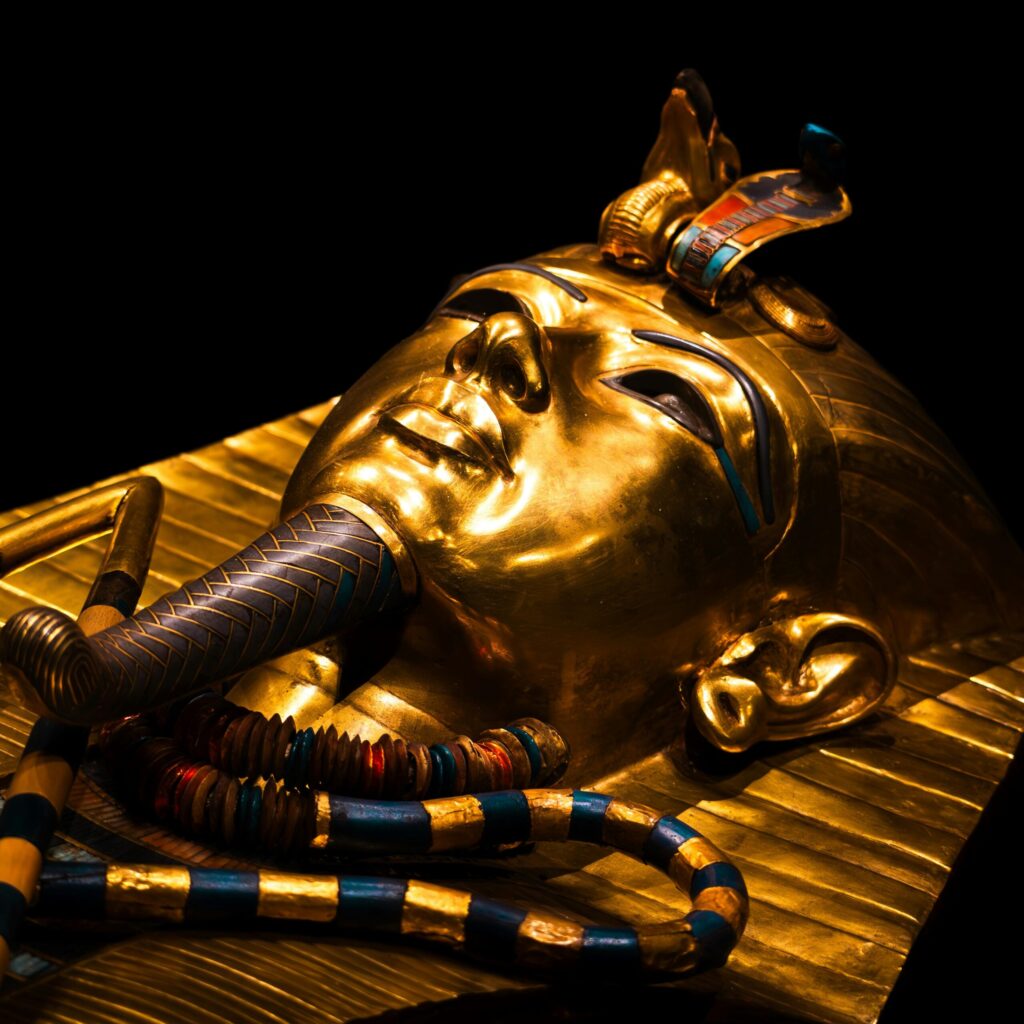
From his dazzling gold funerary mask to his armor and hundreds of delicate artifacts, the exhibition is — according to Egyptian President Abdel Fattah el-Sisi — “a gift from Egypt to the world.”
The most iconic objects are showcased in a monumental hall with special lighting that highlights every intricate detail.
As expected, the solid gold mask, inlaid with blue glass, glazed ceramic, and semi-precious stones, steals the show.
Tutankhamun: The Eternal Pharaoh’s Treasure
Tutankhamun’s treasure is a living record of ancient Egypt’s soul.
It tells not just his story, but the story of an entire civilization.
Its true value is immeasurable; not in gold, but in what it reveals about royalty, funerary customs, craftsmanship, faith, and daily life in 1300 BCE.
As these artifacts dazzle the world, Tutankhamun (the forgotten boy king) continues to reign for all eternity.