
Getting to know India can be as transformative as it is overwhelming. This immense country — the most populous on Earth — holds treasures far beyond the bustle of Delhi, the ghats of Varanasi, or the timeless allure of the Taj Mahal.
But if what you’re seeking is an intimate experience, one of introspection and quiet beauty (think Julia Roberts in Eat, Pray, Love), then the monasteries of Ladakh should be on your radar.
Tucked between the jagged peaks of the Himalayas and the towering Karakoram range, these ancient spiritual centers — known as gompas — offer a deep immersion into Tibetan Buddhism. In their prayer halls, where incense mingles with the murmur of mantras, monks keep centuries-old traditions alive with serene devotion.
Ladakh invites not just travel, but stillness. Its untouched landscapes, the absence of mass tourism, and the spirituality that fills the air turn every step into a form of meditation. Encounters with Ladakhi hospitality — simple, warm, and genuine—only amplify the sense of this journey into the spiritual heart of India.
What Is Ladakh and Where Does It Fit Within India?
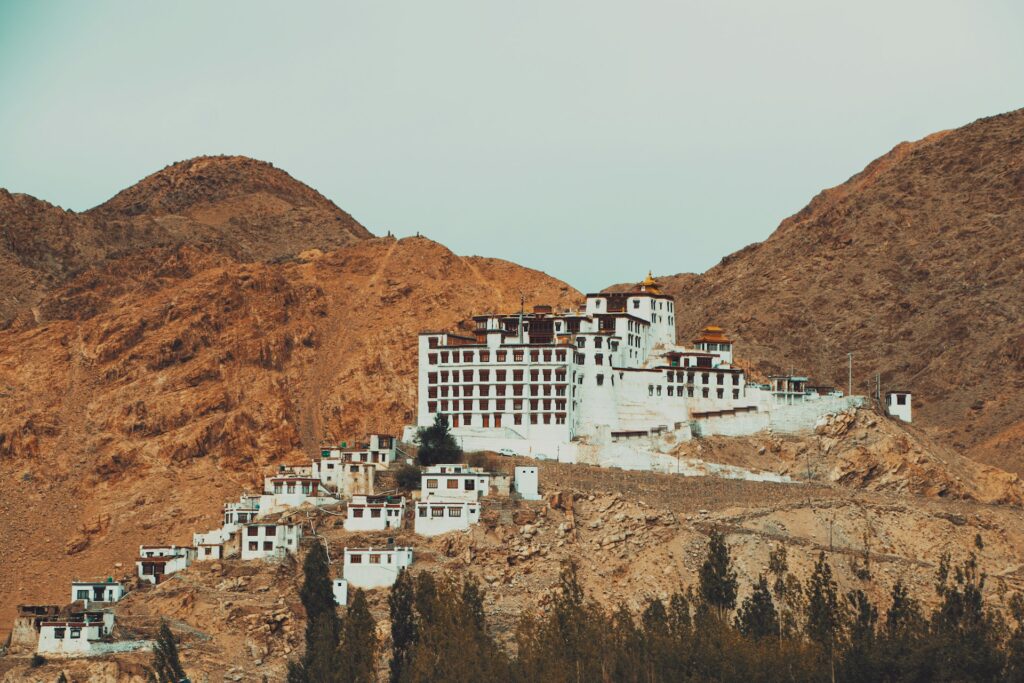
Ladakh unfolds like a Tibetan jewel on the map of India. This remote region, now classified as a union territory, borders Pakistan, China, and the Indian state of Himachal Pradesh. Far from New Delhi’s chaos or the lush landscapes of the south, Ladakh sits at over 3,000 meters above sea level—a world caught between sky and earth.
Leh, its capital, sits at 3,500 meters and will likely be your starting point for exploring the monasteries.
From there, the landscape reveals itself in all its grandeur: snow-capped peaks, crystal-clear lakes, mountain passes where the only sound is the wind, and vast desert plains. The Indus River flows through the heart of the region, nurturing the valley and sustaining small farming villages and ancient sanctuaries.
Known as “Little Tibet,” Ladakh has preserved the essence of Tibetan Buddhism in a way few places have. While much of the tradition was suppressed in historic Tibet, here monks chant mantras aloud, prayer flags flutter tirelessly, and monasteries remain living centers of study, meditation, and spiritual practice.
Ladakh is home to more than 80 Buddhist monasteries, some over a thousand years old, scattered among remote valleys, dusty hillsides, and lonely peaks. Visiting them all is challenging unless you plan to stay for a while, but if you only have a few days, don’t miss Hemis, Thiksey, Diskit, and Alchi.
These architectural jewels each house sacred relics, frescoes, and other treasures you’ll discover as your journey unfolds.
Thiksey Monastery
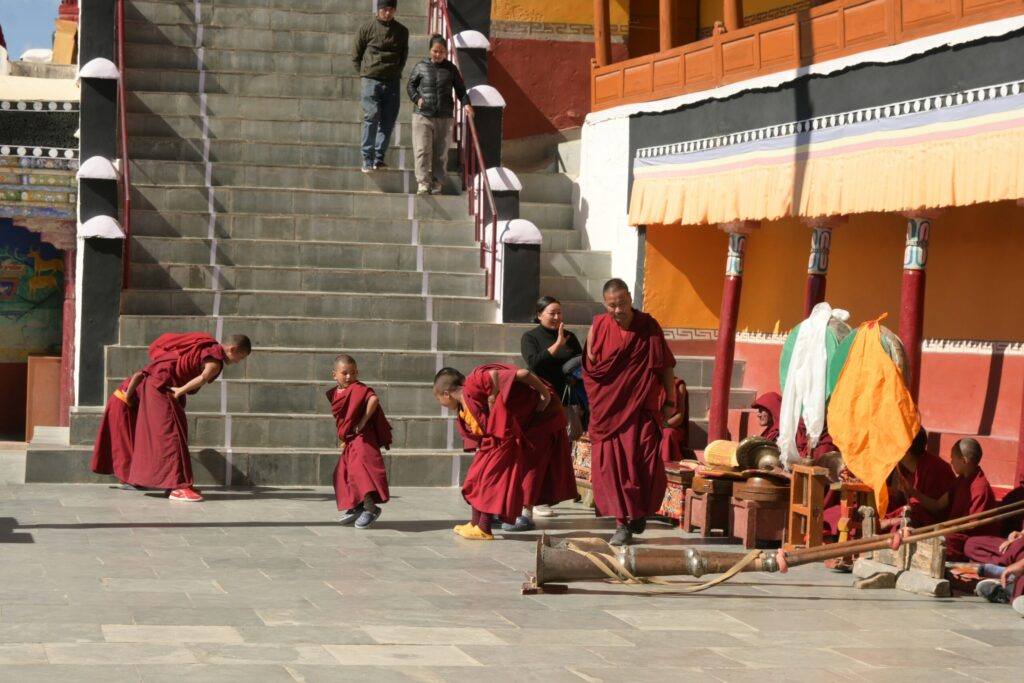
Thiksey is one of the finest monastic complexes in all of Ladakh. Perched atop a hill in the Indus Valley just 19 km from Leh, it can be visited on an organized tour or independently. With a history dating back to the 15th century, it’s among the most visited and photographed sites in Ladakh—and an essential stop on your route.
From a distance, its tiered structure may evoke the iconic Potala Palace in Lhasa, earning it the nickname “Little Potala of India.”
But if the exterior impresses you, wait until you step inside: the prayer halls are thick with incense, the walls adorned with colorful thangkas, and statues gaze silently at each visitor.
The true jewel of Thiksey is the Maitreya statue, the great Buddha of the future. Standing 15 meters tall and spanning two levels of the monastery, it was erected in 1970 to honor the 14th Dalai Lama’s visit. With its serene expression, it seems to greet everyone who enters with reverence.
At the top of the complex, you’ll find the temples, prayer rooms, the library, the monks’ residences, and buildings related to their daily routines. For the best view, climb to the rooftop, where the Indus Valley and surrounding mountains stretch out before you in breathtaking scale.
Another tip: visit at sunrise, when the sound of Tibetan horns signals morning prayers and the golden light bathes the monastery’s whitewashed walls in a warm glow. In that moment, Thiksey sheds its role as a tourist attraction and reveals its true spirit.
Bonus for your itinerary: the visit can be completed in half a day, and most travelers pair it with a visit to Hemis, Shey Palace, and Stakna Monastery. Though Stakna’s interior is more modest, its position atop a hill overlooking the Indus River makes it worth a stop.
Hemis, the most famous monastery in Ladakh
Hemis is the largest and most revered monastery in Ladakh. Located about 45 km from Leh, it’s nestled among red-hued mountains and quiet valleys, as if nature itself had conspired to protect it.
Founded in the 17th century, Hemis became the spiritual heart of Tibetan Buddhism in the region and continues to oversee more than 200 affiliated monasteries across the Himalayas.
At first glance, its sturdy architecture and modest façade might seem less imposing than those of Thiksey or Alchi, but its interior holds true spiritual treasures: ancient manuscripts, ceremonial masks, gilded statues, and centuries-old tangkas that tell the legends of kings and bodhisattvas.
Hemis’s hallmark, however, is its annual festival, which draws tourists and pilgrims from around the world. Held each summer, it honors Padmasambhava, the guru who introduced tantric Buddhism to Tibet.
For the occasion, the monastery’s large courtyard becomes a sacred stage where monks perform masked dances in multicolored robes, moving to the sound of horns and drums to symbolize the eternal struggle between good and evil.
But if your trip doesn’t coincide with the festival, don’t worry. The monastery has a quieter charm during the rest of the year. The stillness makes it easier to share a cup of yak butter tea with a monk or to sit in a corner, soaking in the atmosphere. Here, spirituality isn’t on display — it’s lived.
Alchi Monastery
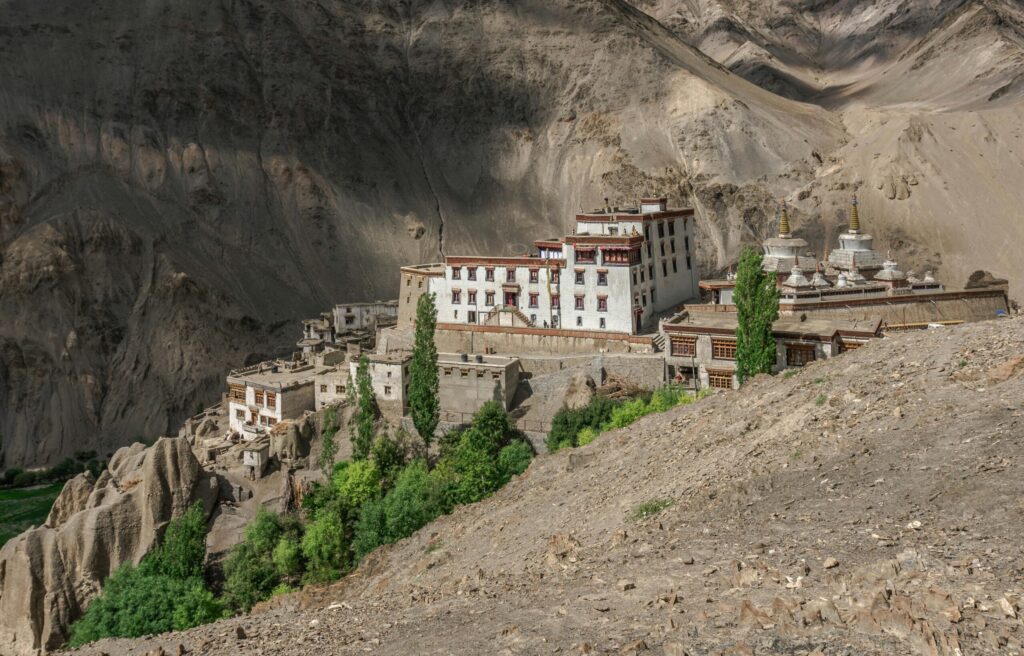
This sanctuary of art and spirituality is one of Ladakh’s hidden gems, located on the banks of the Indus River, far from the towering peaks that dominate most of the region’s monasteries. It blends harmoniously with the village around it, as though it were trying to remain hidden.
But don’t be fooled. Inside, Alchi guards one of the Himalayas’ most valuable legacies: a collection of murals and sculptures that fuse Kashmiri, Indian, and Tibetan Buddhist art with extraordinary refinement.
The frescoes at Alchi are over 900 years old and depict bodhisattvas, cosmic guardians, mandalas, and scenes from the Buddha’s life with rich detail, vivid color, and expressive nuance that’s hard to find elsewhere in Ladakh. Photography is not allowed inside, so take your time to absorb every detail—and etch it into your memory.
Unlike most other monasteries in Ladakh, Alchi is uninhabited, as the monks were relocated to nearby Likir Monastery. Yet it still radiates spirituality: its adobe corridors, shadowed chapels, and the silence within its walls invite deep reflection.
Alchi lies 70 km west of Leh, and the drive takes around two hours along the Leh–Srinagar Highway (NH1), followed by a short turn-off.
Many travelers go on their own, though booking an excursion is ideal for combining the visit with other nearby sites, such as the confluence of the Indus and Zanskar Rivers or the Likir Monastery.
Diskit Monastery
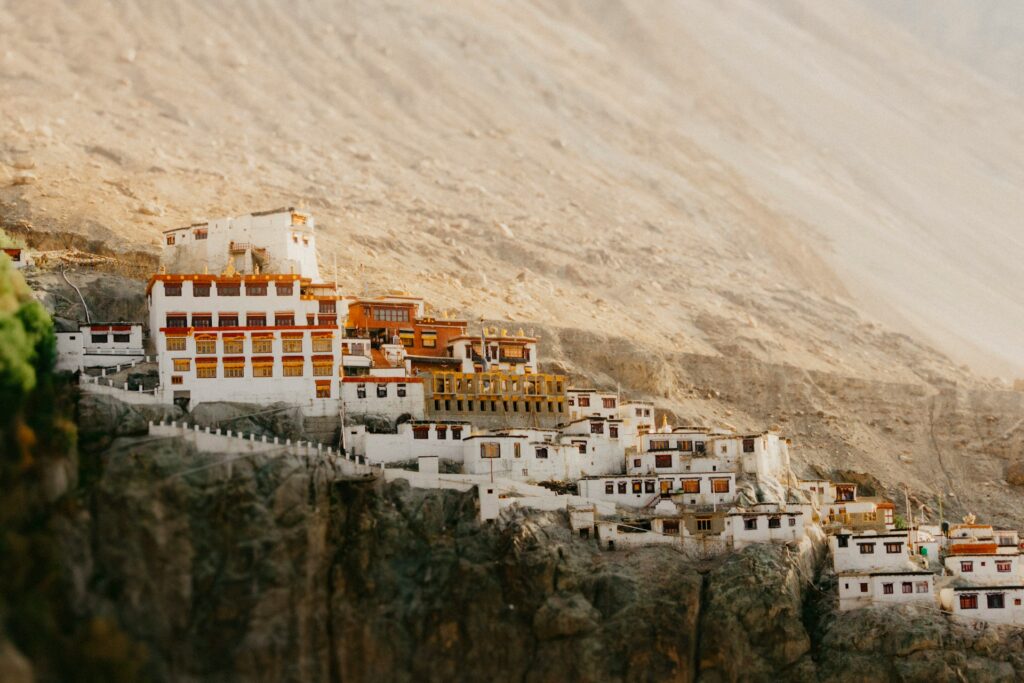
Diskit Monastery is home to hundreds of monks who greet each day to the resonant sound of shankhas—large conch shells used as trumpets—inviting visitors to participate in morning ceremonies.
This architectural gem sits high on a barren hill, overlooking the vast Nubra Valley. It is the oldest and most iconic monastery in northern Ladakh, founded in the 14th century by the Gelugpa order. The complex includes several chapels, ancient frescoes, and a prayer hall filled with protective deities and prayer wheels still spinning to the monks’ chants.
Another highlight is the colossal statue of Maitreya, standing 32 meters tall atop a platform that commands sweeping views of the valley. From here, the sight of the Shyok River winding through snowy peaks and remote villages is simply unforgettable. A similar panorama unfolds from the monastery’s terraces, offering a breathtaking mix of desert and mountain.
Diskit is still an active monastery, with a monastic school dedicated to preserving Buddhist teachings among younger generations. If your visit coincides with a religious ceremony, you’ll hear chants accompanied by Tibetan horns and drums.
Getting there involves crossing Khardung La, one of the world’s highest motorable passes. It’s not recommended to travel this route alone — the terrain is demanding and best navigated with a private vehicle so you can focus on the extraordinary scenery.
This journey through Ladakh’s monasteries may end here, but these are just four of the many gompas that dot the region. Each one has its character, and the more time you spend exploring, the deeper your experience will be.
You’ll return from Ladakh with photos, of course, but also with a quiet sense of inner peace, a reminder that the sacred is not always found in temples, but in the way we breathe in the world.